
A camera that simply records everything that happens is no longer enough for many modern security environments.
Security teams increasingly need systems that can recognize unusual activity, identify events as they happen, connect video with access-control and alarm systems, and help operators focus on incidents rather than hours of routine footage. That shift has turned video surveillance from a passive recording tool into an active component of smart security architecture.
Modern systems combine network cameras, video management software, analytics, sensors, access control, cloud infrastructure, and increasingly AI-driven event detection. The result is a security environment that can detect, interpret, and respond to events instead of simply documenting them afterward.
That transformation also introduces new challenges. More connected cameras mean more infrastructure to secure. More analytics mean more decisions to validate. More stored footage means greater privacy and data-management responsibilities.
The role of video surveillance in smart security systems is therefore not just about adding better cameras. It is about creating a coordinated layer of physical security intelligence.
From Camera Recording to Intelligent Detection
Traditional CCTV systems were largely designed around recording and later investigation. An operator might watch several monitors, while recorded footage became useful after an incident had already occurred.
Smart surveillance changes the workflow.
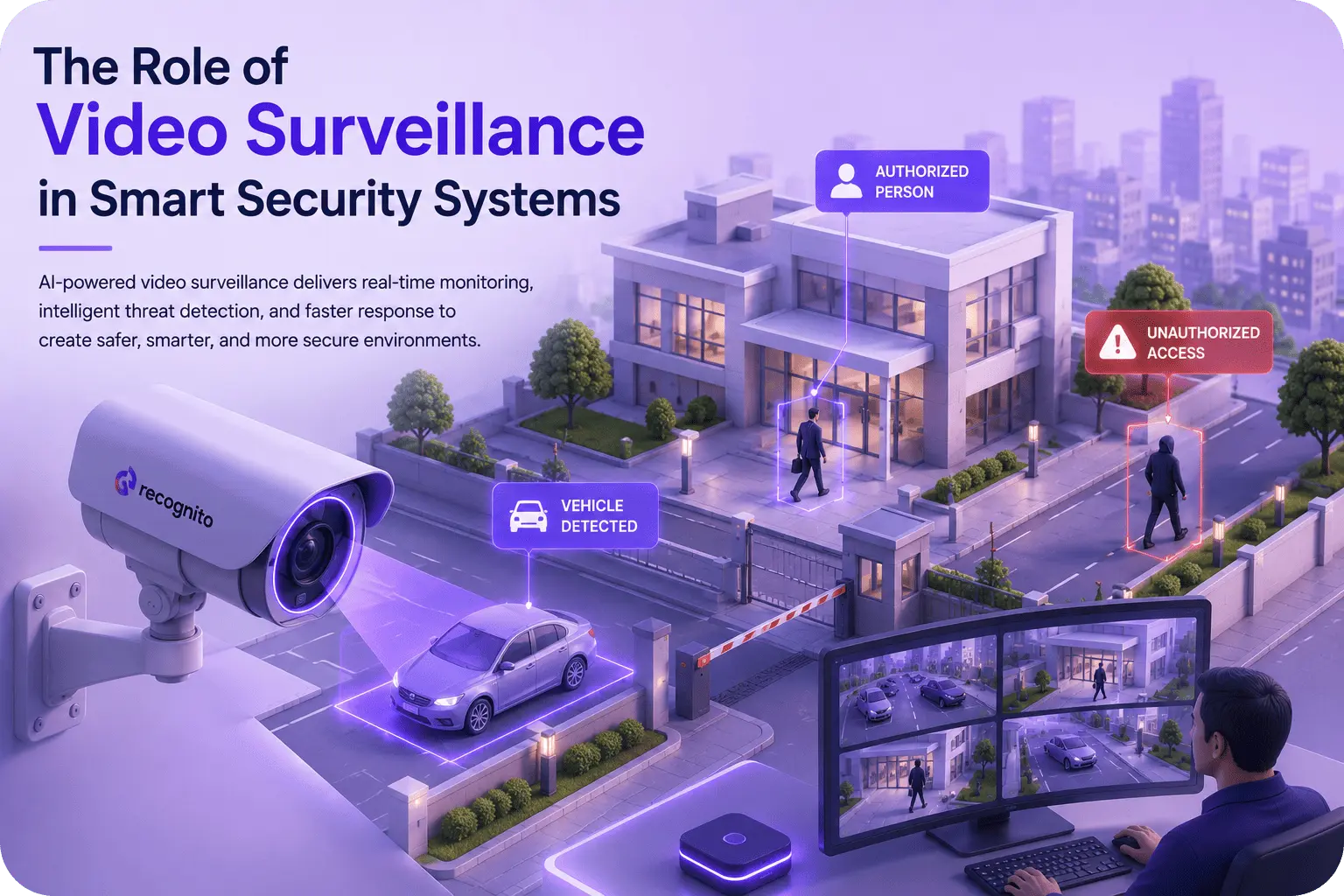
Video analytics can examine live streams for events such as movement into restricted areas, perimeter crossings, loitering, unusual object behavior, or other predefined conditions. Instead of requiring an operator to notice every event manually, software can generate alerts when a rule or analytical model is triggered.
ONVIF’s video analytics specifications describe an architecture in which analytics engines generate scene information and rule engines evaluate that information against conditions such as restricted lines, protected zones, and object behavior.
That creates a fundamental change in the value of surveillance footage: the system can turn raw video into structured security events.
For businesses exploring this evolution, the history and evolution of video surveillance provides useful background on how surveillance has moved from conventional recording toward connected and intelligent systems.
What Makes a Surveillance System “Smart”?
A smart security system usually combines several layers rather than relying on cameras alone.
The camera captures the physical environment. The video management system organizes streams and recordings. Analytics evaluate visual information. Sensors provide additional context. Access-control systems establish whether a person or vehicle should be allowed into an area. Central security software can correlate these signals and determine what should happen next.
Consider an employee-only entrance. A camera might detect a person approaching the doorway. An access-control system knows whether the door was legitimately opened. Video analytics can identify unusual crowding or tailgating behavior. An alarm system can trigger when these signals conflict with expected activity.
Each individual component has limited context. Together, they can provide a much more useful security picture.
ONVIF continues to emphasize interoperability between IP-based physical-security products and services, allowing systems from different manufacturers to exchange information instead of creating isolated technology islands.
AI Video Analytics Is Changing Operator Workloads
The biggest operational advantage of intelligent video surveillance is not that security teams can watch more cameras. It is that they can spend less time watching footage that contains nothing unusual.
AI analytics can help prioritize events for human review. Instead of continuously observing dozens or hundreds of feeds, an operator may receive an alert when activity matches a defined rule.
Useful applications include:
- perimeter intrusion detection
- restricted-area monitoring
- object detection and classification
- abandoned-object alerts
- unusual movement patterns
- occupancy monitoring
- queue and crowd analysis
- vehicle detection
- safety-policy monitoring
The right application depends on the environment. A warehouse may prioritize perimeter intrusion and vehicle monitoring. A corporate office may care more about unauthorized access, after-hours movement, or occupancy. A transportation facility may need a broader combination of vehicle, pedestrian, and perimeter analytics.
The important distinction is that analytics should solve a specific operational problem rather than simply being added because a camera supports AI.
Edge AI vs. Cloud-Based Video Processing
Where video analytics run has important security, cost, and performance implications.
Edge processing
With edge analytics, processing occurs close to the camera or on local infrastructure.
This can reduce the amount of raw video that needs to travel across the network. It can also reduce latency for applications where immediate detection matters.
For example, an analytics-capable camera could identify activity at a restricted doorway and send an event to the security platform without continuously transmitting every frame to a remote processing environment.
Cloud processing
Cloud-based architectures can simplify centralized management, support distributed sites, and provide scalable storage and processing capacity.
ONVIF’s current Profile V initiative is specifically focused on cloud-based video surveillance and Video Surveillance as a Service. Its release-candidate architecture supports secure live streaming, cloud recording, event notifications, and interoperability between conformant devices and cloud platforms.
The trade-off is that organizations must carefully manage connectivity, access controls, bandwidth, storage, and cloud security.
Hybrid architecture
Many deployments benefit from combining both approaches. Time-sensitive detection can happen at the edge while selected video, metadata, or events are transferred to centralized systems for investigation and long-term management.
The best architecture depends on latency requirements, connectivity, infrastructure, data sensitivity, and the scale of the deployment.
Video Surveillance Works Best as Part of Layered Security
A camera should rarely be considered the complete security control.
Physical security works best when multiple measures support one another. CISA guidance on security systems emphasizes the value of integrating surveillance with other controls and considering the physical location and exposure of surveillance equipment itself.
A layered smart-security environment may include:
Video surveillance: observes activity and provides visual evidence.
Video analytics: identifies events that warrant attention.
Access control: determines whether entry is authorized.
Intrusion detection: identifies unauthorized physical access.
Environmental sensors: provide information such as smoke, temperature, or equipment conditions.
Alarm management: escalates confirmed or high-risk events.
Security operations software: correlates events and gives operators a unified view.
The value comes from correlation. A camera detecting movement is one signal. A camera detecting movement at the same time as an unauthorized door opening is a much stronger security event.
Real-Time Response Is Where Smart Surveillance Creates Value
The difference between recording an incident and helping stop one can be measured in seconds.
Suppose someone enters a restricted zone outside normal operating hours. A conventional system records the event. A smart system can detect movement, check the time and zone, generate an alert, and present the relevant camera view to an operator.
Additional controls could then determine whether the event should trigger lighting, an alarm, an access restriction, or another response.
This turns surveillance into part of the response chain.
However, automation should be proportional to confidence. A system that automatically triggers major security actions from every low-confidence visual alert can create unnecessary disruptions and alarm fatigue.
Good design separates detection from response and establishes appropriate escalation thresholds.
Interoperability Matters More Than Ever
Smart surveillance systems frequently combine devices from multiple vendors.
A business may have cameras from one manufacturer, access-control equipment from another, a video management system from a third party, and cloud storage elsewhere. Without interoperability, integrating these components can become expensive and difficult to maintain.
Standards can reduce some of that complexity.
ONVIF’s Profile M was designed to standardize metadata and event communication between analytics-capable devices or applications and systems such as video management software, cloud services, and IoT platforms.
That matters because analytics become more valuable when their results can trigger actions outside the camera itself.
For example, an analytics event should ideally be able to interact with an access-control system, alerting platform, or broader security-management environment rather than remaining trapped inside one manufacturer’s software.
Cybersecurity Is Now Part of Physical Surveillance
Network-connected cameras are computers with sensors, software, credentials, storage, and network interfaces. They therefore introduce cybersecurity considerations into physical-security architecture.
Poorly secured cameras may expose video feeds, provide an entry point into networks, or become vulnerable infrastructure within a larger attack.
CISA has repeatedly advised organizations to reduce unnecessary network exposure and place vulnerable control-system and remote devices behind appropriate protections.
Security teams should therefore consider:
- strong device authentication
- secure configuration
- network segmentation
- firmware and software updates
- restricted remote access
- encrypted communications
- credential management
- logging and monitoring
- controlled administrative privileges
Camera placement matters too. A device mounted in an easily accessible location may be physically tampered with even when its network security is strong.
Video Authenticity Is Becoming a New Security Concern
As AI-generated and manipulated media becomes more convincing, organizations increasingly need confidence that recorded surveillance footage has not been altered.
ONVIF introduced a Media Signing Add-on Release Candidate in August 2026 that provides a standardized method for cryptographically signing surveillance video at the point of creation and later verifying whether the media has remained unaltered. ONVIF says the specification is intended to help establish video origin and integrity across uses such as investigations, insurance, legal proceedings, and security operations.
This is an important development because surveillance footage may become evidence after an incident. If organizations cannot establish where footage came from or whether it was modified, its evidentiary value can be weakened.
Video integrity therefore belongs alongside recording, storage, and analytics in the broader architecture.
Privacy Cannot Be an Afterthought
Smart surveillance systems can observe large numbers of people and may process more information than traditional CCTV.
The privacy implications become greater when systems incorporate sophisticated analytics, biometric identification, or behavior analysis.
The UK’s Information Commissioner’s Office notes that modern surveillance systems can be particularly intrusive, especially when they monitor individuals beyond what people would reasonably expect. Its current guidance emphasizes lawfulness, transparency, purpose limitation, data minimization, retention, and secure storage and viewing.
That means organizations should define the purpose of surveillance before deciding what technology to deploy.
Not every security problem requires identifying people. In many environments, detecting movement, unauthorized entry, or occupancy may achieve the security objective without introducing additional biometric processing.
The principle should be simple: collect and analyze what is needed for the defined security purpose, and no more.
Smart Surveillance in Different Business Environments
| Environment | High-value surveillance capabilities | Primary security objective |
| Corporate offices | Access monitoring, occupancy analytics, restricted-zone alerts | Protect people, facilities, and sensitive areas |
| Retail | People counting, incident detection, loss-prevention analytics | Reduce theft and improve situational awareness |
| Warehouses | Perimeter monitoring, vehicle analytics, restricted-area detection | Protect inventory and infrastructure |
| Transportation | Crowd, vehicle, perimeter, and incident analytics | Detect threats across complex environments |
| Smart buildings | Occupancy, access, safety, and IoT integration | Coordinate physical and building security |
| Residential or smart-home environments | Person, vehicle, and perimeter detection | Improve property awareness and response |
The technology should follow the environment. A surveillance design built around retail loss prevention will not necessarily be appropriate for a high-security industrial site.
How Video Analytics Improves Incident Investigation
Smart surveillance is not only about real-time alerts.
When an incident occurs, analytics and searchable metadata can reduce the time investigators spend manually scanning footage.
Instead of reviewing hours of video chronologically, investigators may be able to search for events based on time, camera, object, location, or analytical classification.
This makes the surveillance system an operational intelligence platform rather than simply a recording archive.
The quality of that investigation still depends on camera positioning, recording quality, retention policies, synchronization, metadata integrity, and the ability to export evidence reliably.
The technology should therefore be evaluated for both detection before an incident and investigation after an incident.
A Practical Smart Surveillance Architecture
A resilient deployment usually starts with the security objective rather than the camera model.
First, identify what the organization needs to detect. Then determine which combination of cameras, analytics, sensors, and access controls can produce sufficient evidence.
From there, define where processing should happen, how events should be transported, where recordings will be stored, and who is authorized to access them.
For connected environments, interoperability should be evaluated early rather than after hardware and software have already been purchased.
Organizations building broader smart environments can also examine advanced biometric IoT applications for smart-home security to understand how connected sensing and intelligent security technologies can interact.
What Businesses Should Evaluate Before Deployment
A successful surveillance project should be evaluated on more than camera resolution.
Consider:
Detection performance: Can the system reliably identify the events that actually matter?
False-alert rate: Will operators receive too many irrelevant notifications?
Coverage: Are critical areas visible under realistic lighting and environmental conditions?
Latency: How quickly can an event move from detection to operator action?
Integration: Can surveillance events interact with access control, alarms, and other systems?
Cybersecurity: Are cameras, servers, cloud systems, and remote interfaces adequately protected?
Privacy: Is the monitoring proportionate to the purpose, with appropriate transparency and data controls?
Evidence integrity: Can recordings be trusted, exported, and verified when needed?
Scalability: Can the architecture support additional cameras, locations, analytics, and storage without becoming unmanageable?
These questions usually reveal weaknesses that a camera specification sheet will not.
Smart Security Requires Human Oversight
The objective of AI-powered surveillance should not be to remove people from security operations.
Security teams still need to interpret ambiguous situations, investigate incidents, adjust rules, and decide how automated responses should work.
AI is best used to reduce repetitive monitoring and prioritize events that deserve human attention.
That also requires ongoing monitoring of the analytics themselves. A model that works well in one lighting condition may generate different results in another. Camera repositioning, environmental changes, software updates, or altered activity patterns can affect performance.
NIST’s guidance on operational technology security emphasizes addressing the unique performance, reliability, and safety requirements of systems that interact with the physical environment.
In smart surveillance, that means performance monitoring is not optional. The system should be treated as operational infrastructure.
The Future of Smart Video Surveillance
The long-term direction is toward deeper integration.
Cameras will increasingly function as intelligent sensing devices rather than passive recording endpoints. Analytics will generate structured events. Cloud and edge platforms will distribute processing according to operational requirements. Access control, IoT devices, and security operations platforms will increasingly exchange event information.
At the same time, video integrity and cybersecurity will become more important as organizations depend on surveillance footage for real-time decisions and post-incident evidence.
The most effective systems will not necessarily be the ones with the largest number of AI features. They will be the ones that produce reliable security intelligence, integrate cleanly with existing controls, preserve appropriate privacy, and give human operators better information when decisions matter.
For workplaces with shared environments and multiple security zones, video analytics for enhancing security in co-working spaces illustrates how intelligent monitoring can be applied to practical facility-security challenges.
For developers and technical teams evaluating connected security technologies, the Recognito GitHub repository can provide additional technical resources alongside system and vendor evaluation.
Conclusion
Video surveillance has evolved from a passive record of what happened into an increasingly intelligent layer within broader security architecture.
The strongest smart-security deployments combine cameras with analytics, access control, sensors, alarms, secure networking, interoperable platforms, and appropriate human oversight. Edge and cloud processing provide different architectural options, while emerging technologies such as cryptographic media signing address the growing need to establish video authenticity.
But more intelligence also means more responsibility. Cybersecurity, privacy, system reliability, and operational monitoring need to be designed into the surveillance environment from the start.
For organizations incorporating intelligent visual technologies into broader security architectures, Recognito provides biometric and vision capabilities that can complement modern smart-security workflows.
Frequently Asked Questions
What makes a video surveillance system smart?
A smart surveillance system combines cameras with analytics, event detection, automation, and integration with other security technologies. Instead of only recording video, it can identify defined events and help trigger appropriate responses.
Is AI necessary for modern video surveillance?
Not every surveillance deployment requires AI. Basic recording remains appropriate for some environments. AI becomes valuable when the organization needs automated detection, event prioritization, searchable video, or analysis at a scale that manual monitoring cannot support efficiently.
Should video analytics run on the camera or in the cloud?
It depends on the application. Edge processing can reduce latency and network traffic, while cloud processing can support centralized management and scalable infrastructure. Hybrid architectures can combine both.
How can businesses protect surveillance systems from cyberattacks?
Use strong authentication, network segmentation, secure remote access, timely updates, encryption, restricted privileges, monitoring, and careful device placement. Cameras should be treated as connected computing infrastructure rather than ordinary peripherals.
Does smart surveillance create privacy risks?
Yes. Advanced surveillance can process large amounts of personal information and may be highly intrusive. Organizations should define a specific purpose, minimize unnecessary collection, establish appropriate retention and access controls, and provide transparency about surveillance practices.