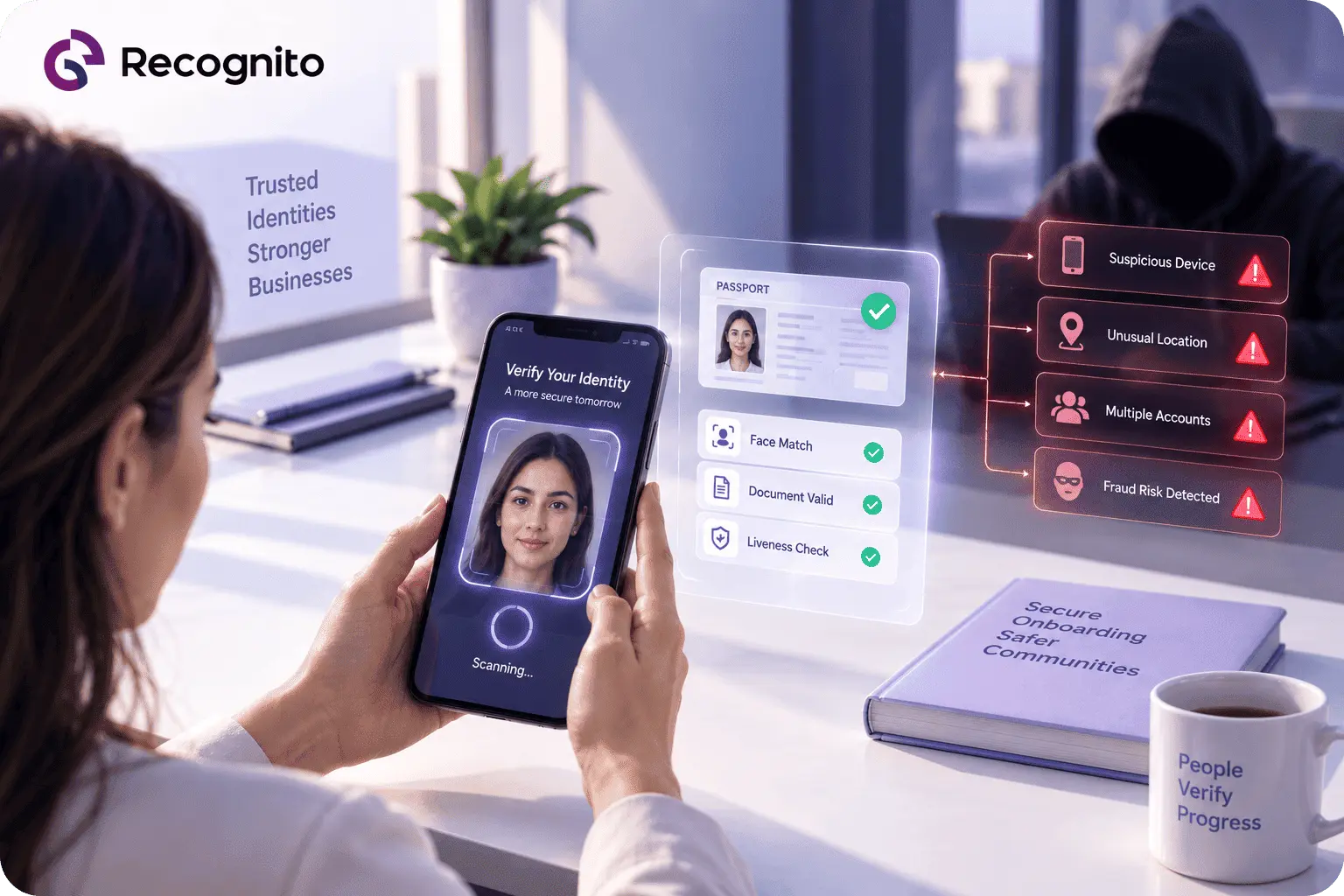

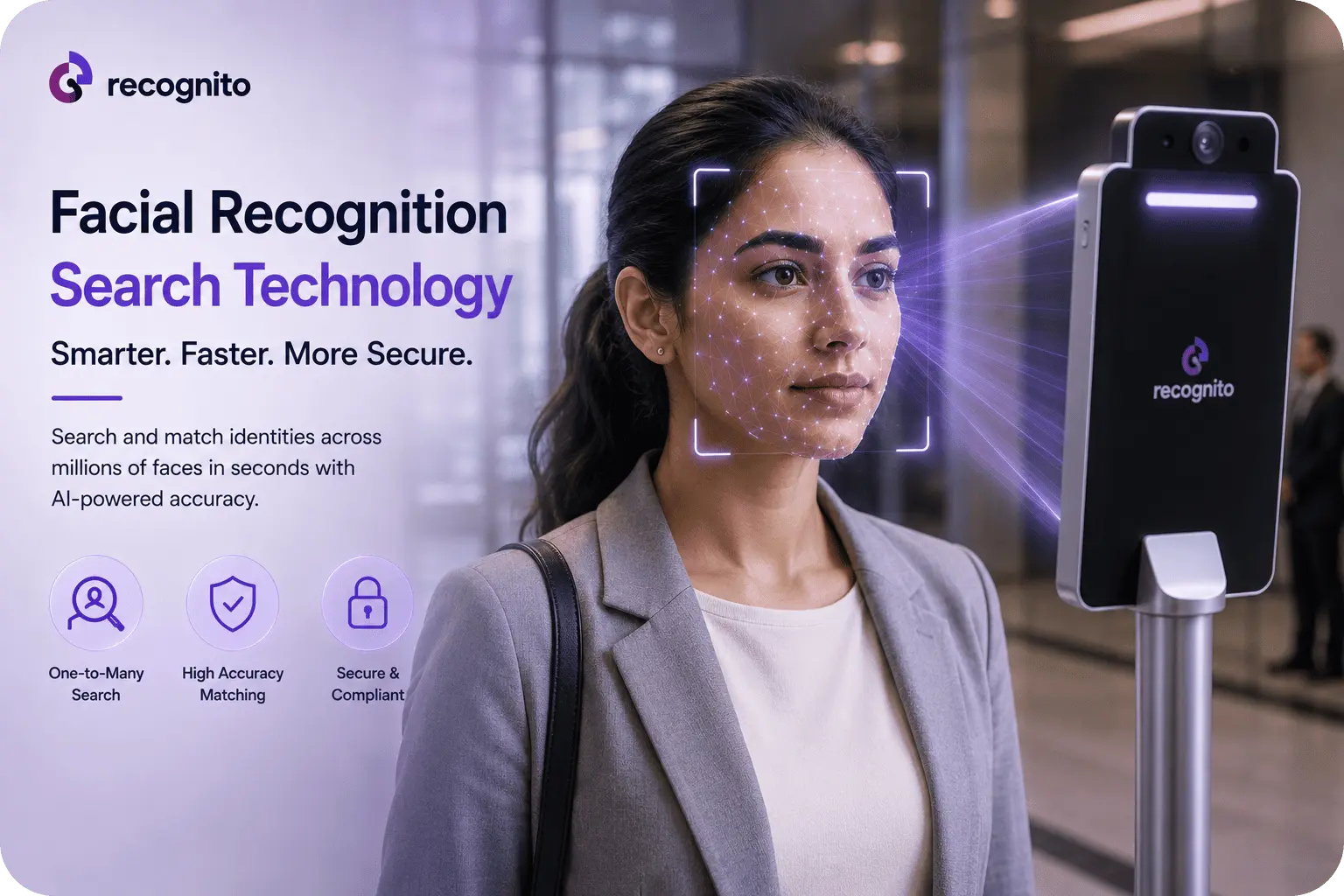
Facial recognition search is moving beyond simple face unlocking. Organizations can now search a facial image against a database to identify a possible match, locate a known person, detect duplicate identities, or connect an individual with an existing record.
That capability is fundamentally different from one-to-one facial verification. Verification asks whether a person is who they claim to be. Search asks whether a person can be found within a larger collection of enrolled identities.
For businesses, that difference creates opportunities in fraud prevention, access control, identity management, investigations, customer operations, and other workflows. It also introduces important questions around false matches, demographic performance, privacy, database quality, and responsible use.
Why Facial Recognition Search Matters
In a traditional identity workflow, a company already needs some kind of identifier before it can retrieve a customer’s record. A name, account number, card, or credential may be required to locate the person.
Facial recognition search changes that interaction. A face can become the starting point for the search.
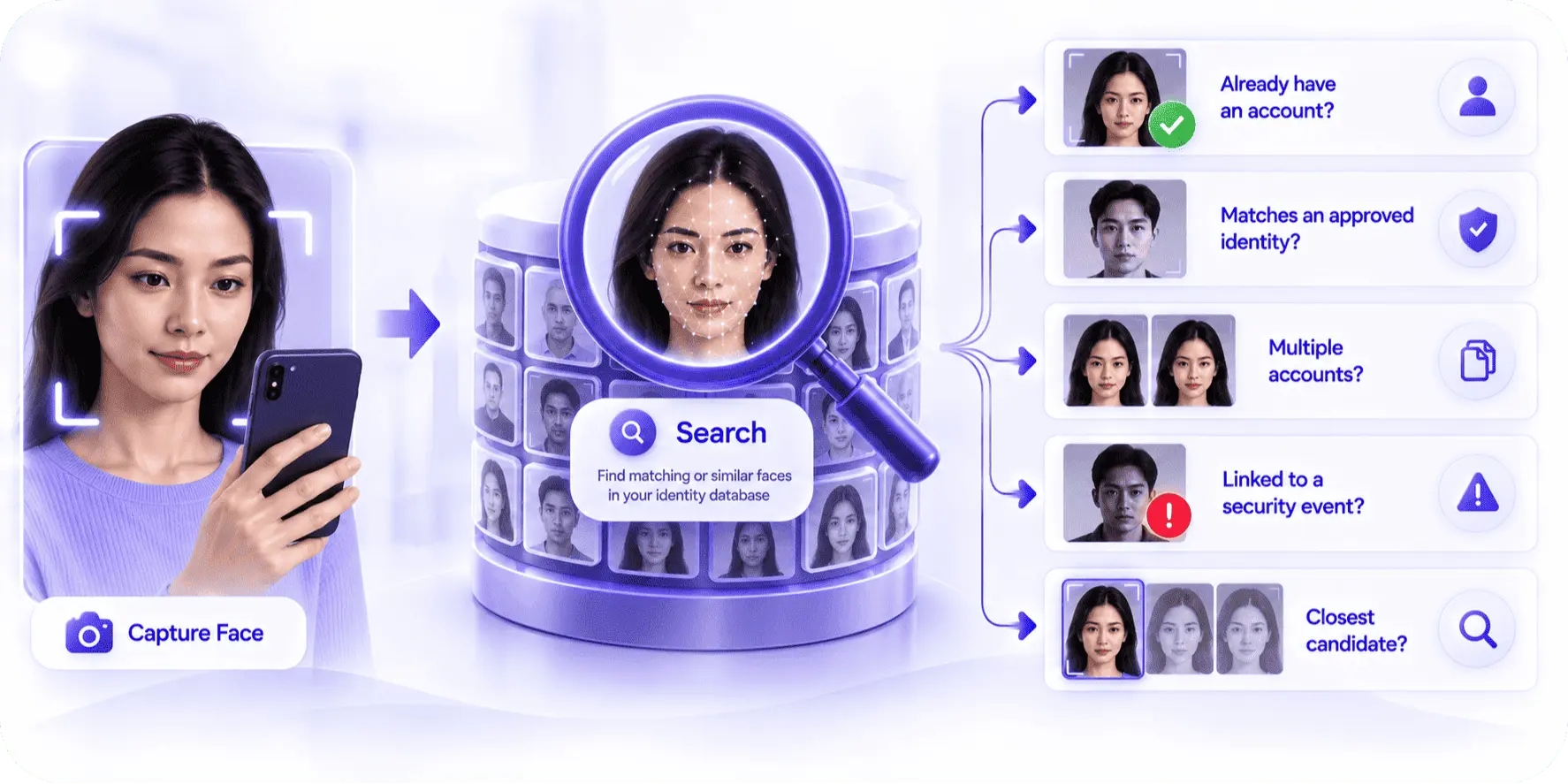
That is especially useful when an organization needs to answer questions such as:
- Does this person already have an account?
- Does this face correspond to an identity in our approved database?
- Is the same person registered multiple times?
- Does a captured face match someone already associated with a security event?
- Which enrolled identity is the closest candidate?
The practical value comes from connecting an image to an existing identity repository rather than treating every facial capture as an isolated event. Facial recognition search for finding people provides broader context on where this model fits.
How Facial Recognition Search Works
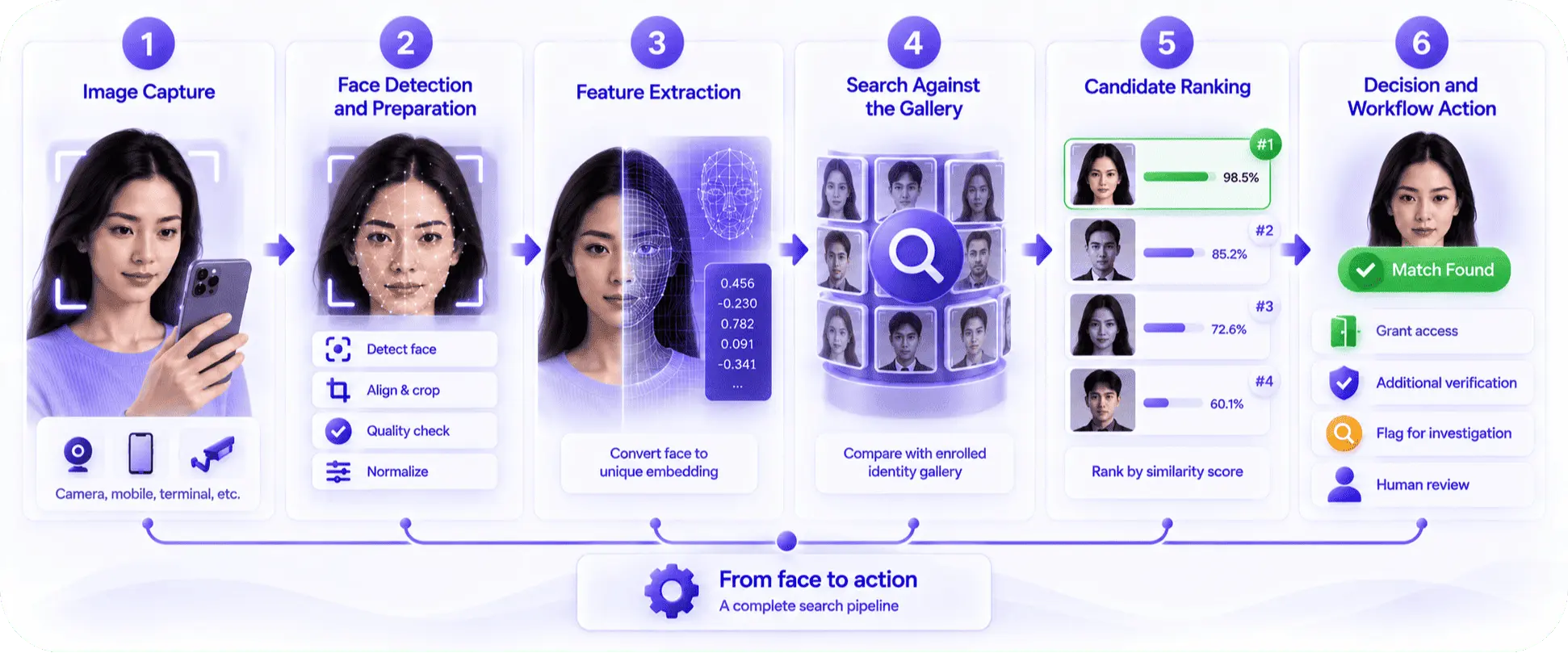
A typical search pipeline involves several distinct stages.
1. Image Capture
The system receives a facial image or video frame from a camera, mobile device, access terminal, or another source. Image quality matters immediately because the quality of the probe affects everything that follows.
2. Face Detection and Preparation
Computer vision locates the face and prepares it for comparison. Depending on the implementation, this can include alignment, cropping, quality assessment, and normalization.
3. Feature Extraction
The recognition model converts the facial appearance into a mathematical representation often called a template or embedding. The system does not simply compare pixels. It compares learned facial features.
4. Search Against the Gallery
The generated representation is compared with templates stored in a gallery. The gallery may contain employees, customers, members, visitors, or other enrolled identities.
5. Candidate Ranking
The system produces similarity scores and ranks possible matches. A threshold then determines whether a candidate is strong enough to return.
6. Decision and Workflow Action
The application uses the search result within a larger workflow. A match might trigger access, request additional verification, flag a case for investigation, or simply provide a candidate for human review.
NIST’s current FRTE 1:N identification evaluation measures this type of search using metrics including false negative identification rate and false positive identification rate.
The architecture is therefore not simply “camera plus AI.” It is a pipeline in which capture quality, model performance, threshold selection, gallery design, and downstream decision logic all influence the outcome.
1:N Search Is Different From 1:1 Verification
This distinction is one of the most important concepts when evaluating facial recognition systems.
A 1:1 system compares one face against one claimed identity. If a customer says they are account holder A, the system checks whether the captured face sufficiently matches account A’s reference.
A 1:N search compares a probe against many enrolled identities. The system may return the strongest candidate, several candidates, or no candidate depending on the threshold.
The increase in gallery size changes the risk profile. Even when an individual comparison looks strong, searching thousands or millions of identities creates more opportunities for an incorrect candidate to appear.
That is why NIST evaluates 1:N identification separately from 1:1 verification. Results from one scenario should not automatically be used as evidence for the other.
Where Businesses Use Facial Recognition Search
The most valuable applications are those where finding a person within a known population solves a specific operational problem.
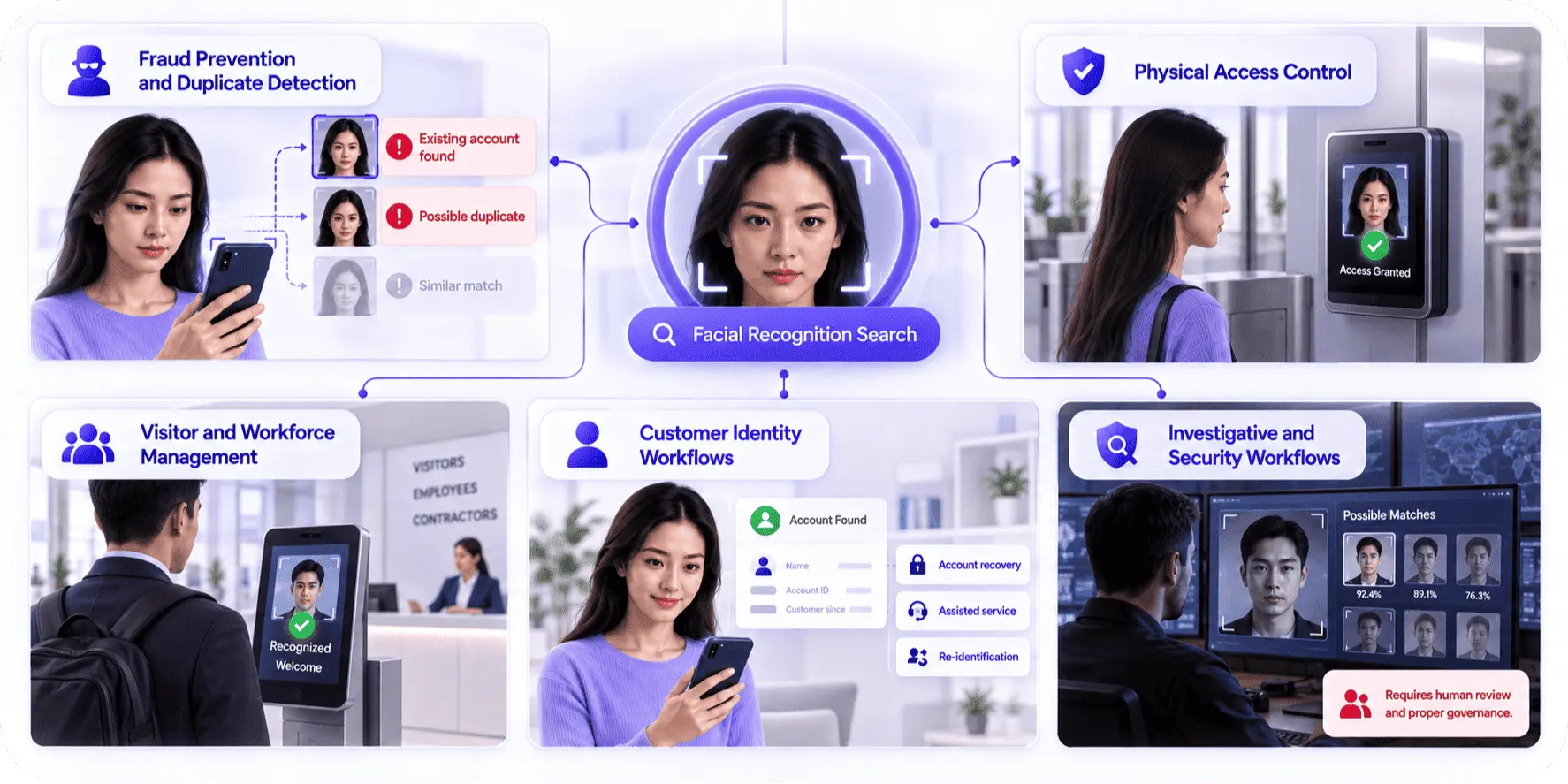
Fraud Prevention and Duplicate Detection
A financial service may use facial search during onboarding to identify whether a new applicant is already associated with an existing identity. This can help uncover multiple registrations that share the same biometric characteristics.
Search can be especially useful when identifiers have been changed, reused, or deliberately manipulated.
Physical Access Control
Organizations can search a captured face against an employee or authorized-user gallery. A positive result can support a controlled access decision without requiring a person to type a credential.
For higher-risk environments, facial search should normally be combined with other controls rather than serving as the only security decision.
Visitor and Workforce Management
Large sites can maintain galleries of authorized employees or registered visitors. Facial search can help locate a known identity when a traditional badge or lookup process is inconvenient.
Customer Identity Workflows
A company may already have enrolled customers and need to locate an account from a facial capture. This can be useful for account recovery, assisted service, or controlled re-identification workflows.
Investigative and Security Workflows
Security teams may use facial search to generate candidate identities from imagery. Because false positives can have significant consequences, these workflows require careful thresholding, human review, and governance.
The Benefits Are More Than Speed
Faster Identity Discovery
Searching a gallery can reduce the need for manual lookups when the face itself is the most convenient identifier available.
Reduced Dependence on Passwords and Physical Credentials
A facial search interface can provide another route to an identity when credentials are unavailable or inconvenient, especially in controlled environments.
Better Duplicate Detection
A biometric search can connect multiple records that would otherwise look unrelated because names, emails, or other identifiers differ.
Scalable Matching
Automated search can process large galleries far more efficiently than manually inspecting images. NIST’s ongoing FRTE program includes hundreds of submitted algorithms, illustrating the scale at which modern recognition systems can be evaluated and compared.
Context-Aware Security
Search results can feed broader risk systems. Instead of immediately granting access based on one score, the application can use a candidate identity as one signal among several.
This is particularly important in fraud prevention. Face recognition for preventing online account fraud provides related context on how facial biometrics can be incorporated into account-security workflows.
Accuracy Depends on More Than the Model
A high-performing algorithm can still produce poor results when the input data or operating conditions are weak.
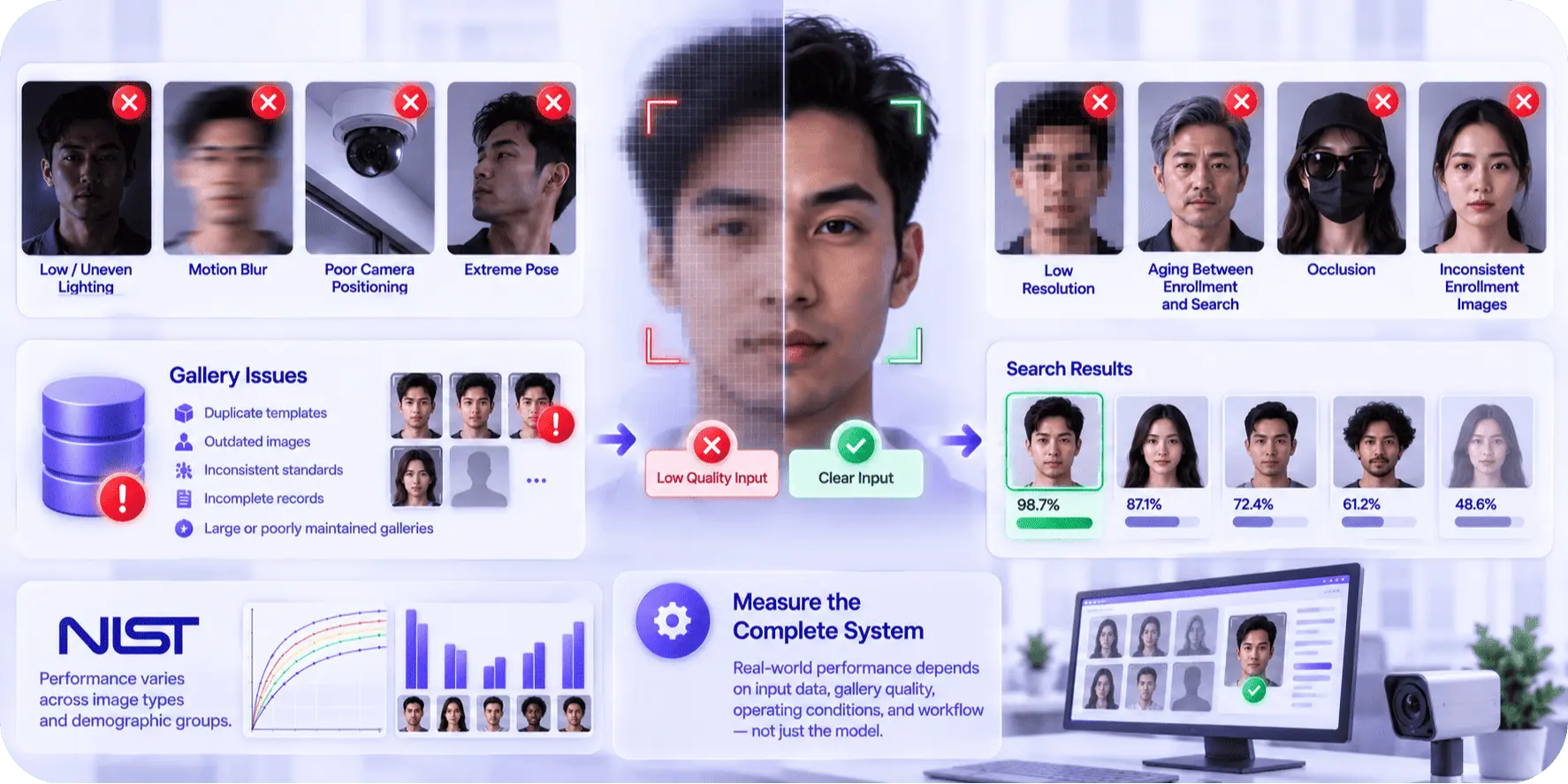
Common factors include:
- low or uneven lighting
- motion blur
- poor camera positioning
- extreme pose
- low-resolution imagery
- aging between enrollment and search
- occlusion
- inconsistent enrollment images
- large or poorly maintained galleries
The gallery itself is also important. Duplicate templates, outdated images, inconsistent enrollment standards, and incomplete records can complicate search outcomes.
This is why organizations should measure the complete system rather than relying on a vendor’s best-case benchmark.
The current NIST 1:N evaluation reports false negative identification and false positive identification metrics at defined operating conditions. Its results also show that performance can vary substantially across image types and demographic groups.
False Positives Are a Critical Business Risk
In facial recognition search, a false positive means the system returns an incorrect candidate.
The consequences depend on the application.
An incorrect suggestion in a low-risk customer-assistance workflow may simply create another verification step. The same error in access control, fraud investigation, or another high-consequence setting could result in an improper denial, unnecessary investigation, or incorrect security action.
A robust implementation defines what happens when similarity is high but not conclusive. Options may include stronger authentication, document verification, manual review, or another biometric check.
Thresholds should be selected according to the cost of errors, not simply to maximize the number of matches.
Demographic Performance Needs Attention
Aggregate accuracy can hide meaningful differences between groups.
NIST’s FRTE reporting examines demographic variation in false-match and false-non-match behavior. Its current 1:N evaluation also reports demographic measures for false-positive identification performance across several regional and sex categories.
That makes demographic testing a practical business requirement, not just a research topic.
An organization should test the populations it actually serves and inspect whether differences are driven by the algorithm, capture quality, image composition, enrollment practices, or a combination of factors.
This matters especially when facial search influences access, fraud decisions, or other outcomes affecting individuals.
Organizations evaluating broader face recognition capabilities can also review top advantages and disadvantages of facial recognition technology for a wider view of operational and governance trade-offs.
Security: Search Should Be One Layer
Facial recognition search is vulnerable to more than inaccurate matching.
Attackers may attempt to present photographs, replay video, use masks, manipulate images, or interfere with the input before it reaches the recognition engine.
That makes presentation attack detection and liveness important for many deployments. A matching model determines whether two biometric representations are similar; it does not automatically establish that the input came from a genuine, live subject.
FIDO’s biometric certification requirements for face verification provide a useful example of how matching, liveness, and related biometric security controls can be treated as distinct evaluation areas.
In higher-risk environments, the application should also consider device integrity, encrypted communications, template protection, access controls, audit logging, rate limits, and secure fallback methods.
Privacy and Governance Cannot Be Added Later
Facial search requires a gallery of biometric references, which means organizations must define clear rules for collection, purpose, retention, access, and deletion.
The appropriate architecture depends on the use case. A workforce access system with a limited employee gallery has a different privacy profile from a large customer database or an investigative application.
Governance should establish:
- why the gallery exists
- who may search it
- which purposes are permitted
- how identities are enrolled
- how long templates are retained
- how access and searches are logged
- how individuals can be handled when the system produces uncertainty
Purpose limitation is especially important. A biometric gallery created for employee authentication should not automatically become a general-purpose identification database without a separate legal, security, and governance assessment.
How Businesses Should Evaluate Facial Search Technology
Procurement teams should evaluate the entire workflow, not just the recognition engine.
| Evaluation area | Questions to ask | Why it matters |
| Search accuracy | What are FNIR and FPIR at the operating point we need? | Quantifies identification risk |
| Gallery scale | How does performance change as the gallery grows? | Large searches create different error dynamics |
| Image conditions | Which camera, pose, lighting, and image types were tested? | Shows how benchmark results may transfer to production |
| Demographics | What performance variation is observed across relevant groups? | Helps identify fairness and operational risks |
| Presentation attacks | How are photos, replays, masks, and manipulated inputs handled? | Separates matching from spoofing resistance |
| Integration | What APIs, SDKs, latency, and failure states are supported? | Determines deployment complexity |
| Governance | How are templates protected, retained, audited, and deleted? | Controls privacy and operational exposure |
The comparison should then move beyond NIST.
Ask vendors to demonstrate performance using your intended devices, customer populations, capture conditions, latency requirements, and fraud scenarios. A benchmark can narrow the shortlist; production testing should make the final decision.
For software teams, a facial recognition SDK can provide the recognition layer inside an application. A practical technical evaluation should then test the SDK under the same devices, image conditions, gallery sizes, and failure scenarios expected in production.
Teams interested in hands-on experimentation can also use the face biometric playground to explore biometric capabilities before deeper integration work.
Search Quality Depends on Enrollment Quality
One of the most overlooked factors in facial recognition search is the gallery itself.
A search system cannot consistently identify someone when the enrolled reference is poor. Blurred photographs, inconsistent poses, extreme age differences, missing metadata, or duplicate enrollment records can reduce the quality of the matching process.
Strong enrollment practices therefore matter as much as the search model.
Organizations should define acceptable reference-image quality, prevent duplicate enrollment where appropriate, establish re-enrollment procedures, and monitor gallery health over time.
The system should also distinguish between “no reliable match” and “not found.” Those are not necessarily the same outcome. A poor capture may simply fail to produce enough evidence for a confident search.
Implementation Considerations
Moving from a proof of concept to production requires attention to the surrounding infrastructure.
First, establish the purpose of the search and define the population included in the gallery.
Second, select thresholds based on the consequences of false positives and false negatives.
Third, test realistic capture conditions instead of relying exclusively on curated images.
Fourth, design a fallback path for uncertain matches. A search engine should be allowed to say that it does not have enough evidence.
Fifth, monitor outcomes continuously. Changes in camera hardware, enrollment quality, customer demographics, or gallery composition can affect system behavior over time.
For technical teams, the Recognito GitHub repository can provide additional developer-oriented resources alongside formal testing and integration work.
What Facial Recognition Search Does Not Solve
Facial search is not a complete identity solution.
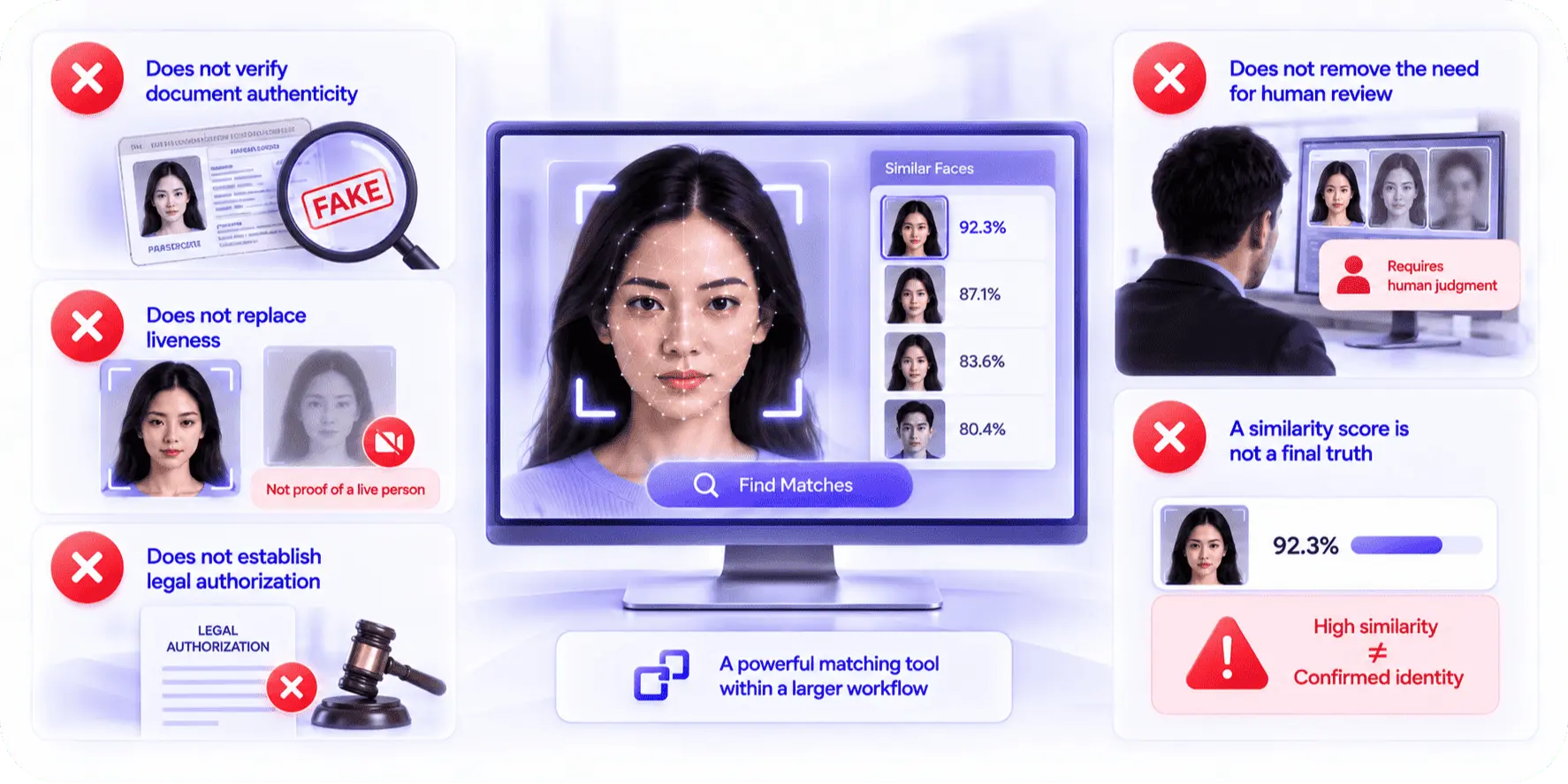
It does not automatically verify that an identity document is genuine. It does not replace liveness. It does not establish legal authorization for every use case. It does not remove the need for human review when the consequences of a wrong match are high.
It is best understood as a powerful retrieval and matching capability that becomes valuable when connected to a larger identity or security workflow.
That perspective prevents one of the most common implementation mistakes: treating a similarity score as a final truth.
Conclusion
Facial recognition search allows organizations to start with a face and locate possible identities within an enrolled gallery. That capability can support fraud prevention, access control, identity management, customer workflows, duplicate detection, and security operations.
Its value depends on the quality of the entire system. Recognition performance, gallery quality, thresholds, demographic behavior, presentation-attack defenses, integration, and governance all influence whether a search result is useful and trustworthy.
The right question is therefore not whether facial recognition search is accurate in isolation. It is whether the technology can produce sufficiently reliable candidates for the specific decisions an organization needs to make.
For organizations evaluating biometric search and identity technologies, Recognito can support facial recognition implementations as part of a broader security and identity architecture.
Frequently Asked Questions
Is facial recognition search the same as facial verification?
No. Verification is normally a 1:1 comparison against a claimed identity. Facial recognition search is usually a 1:N process that compares a probe against a gallery of identities.
What happens when there is no strong match?
A well-designed system should be able to return no confident match rather than forcing the closest candidate to be accepted. Higher-risk workflows may then trigger additional verification or human review.
Is facial recognition search accurate enough for business use?
It can be, but suitability depends on the use case, image conditions, gallery size, threshold, demographics, and security controls. Production testing is essential.
Does facial recognition search require liveness detection?
Not every use case does, but liveness or presentation-attack detection is important when an attacker could benefit from submitting a photograph, replay, mask, or manipulated biometric input.
What is the biggest mistake when deploying facial recognition search?
Treating a similarity score as proof of identity. A search result should be interpreted within a larger workflow that considers confidence thresholds, attack resistance, contextual evidence, and appropriate human oversight.