
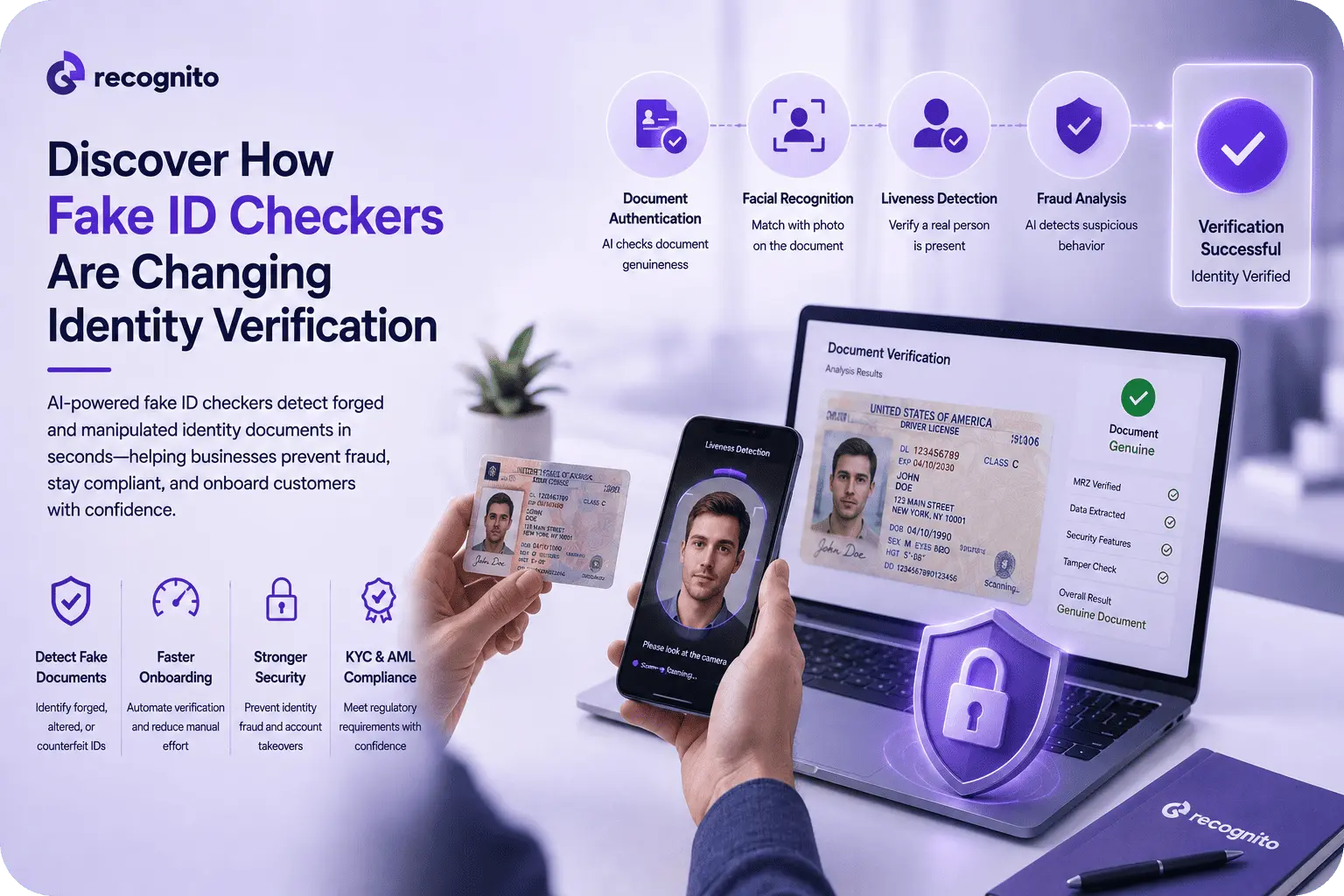
A fake ID checker now goes beyond checking whether a document looks convincing. Modern identity verification combines document recognition, OCR, image analysis, authenticity checks, and biometric signals to determine whether an identity document should be trusted.
For banks, fintechs, marketplaces, telecom providers, and other businesses verifying customers remotely, the question has changed from “Can we read this ID?” to “Can we establish that this document is legitimate and belongs to the claimed identity?”
Why Fake ID Checking Has Become More Difficult
Remote identity verification removes the physical inspection that traditionally happened across a counter. A customer now captures an ID with a smartphone camera and submits digital evidence to a verification system.
That convenience creates several attack opportunities.
A fraudster might alter a name or date of birth, replace a portrait, reuse a genuine document belonging to another person, submit a screenshot, or provide an image that has been digitally manipulated. A basic OCR engine may still extract all the fields correctly because OCR answers a different question: What text appears in this image?
A modern fake ID checker needs to go further and assess the evidence itself.
The FIDO Document Authenticity certification framework identifies threats such as counterfeit documents, digital and physical tampering, expired or invalid documents, presentation attacks, and face morphing as relevant risks in remote document authentication.
That is why document verification is becoming an evidence-validation problem rather than a simple scanning task.
What a Modern Fake ID Checker Actually Does
The phrase “fake ID checker” covers several technologies working together.
First, document recognition identifies what type of identity document has been captured. The system may determine whether it is a passport, identity card, driver’s licence, residence permit, or another supported credential.
Next, OCR and document parsing extract structured information. This can include names, document numbers, dates, nationality, and machine-readable-zone data where applicable.
Then comes the more important security layer: document analysis.
A verification engine can compare visual patterns, layouts, security elements, portrait regions, field consistency, and other document characteristics against expected properties. Advanced systems can also examine whether the captured evidence shows signs of manipulation.
The workflow may then compare the document portrait with a selfie and run facial liveness checks. This creates a chain of evidence:
document exists → document appears authentic → information is consistent → person resembles the document portrait → person appears live
Each stage answers a different question.
For implementation teams, an identity document recognition SDK can provide the document-processing component needed to incorporate these checks into an onboarding or verification flow.
The Difference Between Reading an ID and Verifying It
This distinction is central to understanding modern fake ID checking.
OCR reads information. Document verification evaluates whether that information should be trusted.
Imagine a criminal edits a genuine identity document image and changes the birth date. OCR may extract the fraudulent date perfectly. A simple field-validation system may also see nothing unusual because the data is correctly formatted.
A stronger checker looks at the complete document context. Does the portrait region remain consistent with the document? Do the visual and machine-readable fields agree? Are expected features present? Are there indications of digital manipulation?
Where Fake ID Checkers Fit Into Identity Verification
A document checker is only one layer of an identity proofing process.
NIST’s current SP 800-63A-4 guidance on identity proofing defines identity-proofing requirements and emphasizes obtaining evidence that can reliably support a claimed identity.
That means the document itself is evidence, not the final identity decision.
A typical remote workflow may contain:
- Document capture: The customer photographs the identity document.
- Quality assessment: The system checks whether the images are usable.
- Document recognition: The document type and relevant fields are identified.
- Authenticity analysis: Security characteristics and consistency signals are evaluated.
- Presence or capture checks: The workflow determines whether the evidence was genuinely presented during the verification session.
- Biometric comparison: The customer’s face is compared with the document portrait.
- Liveness assessment: The system checks whether the biometric input appears to come from a live person.
- Risk decisioning: All relevant signals are combined to approve, reject, or escalate the application.
For a broader look at the surrounding identity workflow, eKYC requirements for fintech platforms provides additional context on digital verification and compliance requirements.
The Most Common Fake ID Attack Paths
Counterfeit documents
A counterfeit attempts to reproduce a genuine document without being issued by the legitimate authority. Quality varies widely, which is why verification needs to look beyond obvious visual defects.
ICAO’s current Doc 9303 specifications for machine-readable travel documents describe document-security measures intended to protect travel documents against unauthorized reproduction, alteration, and other forms of tampering.
Altered genuine documents
This attack starts with a legitimate document and changes selected fields, such as the name, address, date of birth, or portrait.
It can be difficult to detect because much of the document is genuine. Strong analysis therefore looks for inconsistencies between fields and expected document characteristics rather than relying only on whether the ID looks broadly authentic.
Stolen identity documents
A genuine passport or ID can be used by someone other than the rightful owner.
This is why document authentication should be connected to biometric verification. Confirming that the document is genuine does not establish that the person holding it is the legitimate owner.
Digitally manipulated submissions
A customer may submit a screenshot, edited image, or other manipulated representation instead of a trustworthy capture.
FIDO’s document-authenticity testing specifically includes digital tampering and presentation attacks, showing why the capture path itself deserves security attention.
Why Face Matching Strengthens Fake ID Detection
Document verification answers questions about the credential. Facial verification helps answer questions about the person using it.
A typical workflow compares the applicant’s selfie with the portrait on the document. A strong match provides evidence that the person presenting the document resembles its holder.
But facial similarity alone does not establish physical presence. A photograph or replayed video may look sufficiently similar to pass a weak system.
That is where facial liveness becomes important.
A related facial recognition and ID document verification comparison explains why these technologies solve different parts of the identity problem and are often stronger when combined.
Why Document Liveness Matters
A fake ID checker may correctly identify a document type and even detect some visual anomalies while still accepting a static digital representation.
Document liveness or document-presence detection helps address that gap by assessing whether the physical document is actually being presented during live capture.
This becomes particularly important for remote onboarding, where an attacker controls the device used to submit evidence.
The objective is to increase confidence that the evidence originates from the physical credential expected by the workflow.
That concept is closely related to the broader document liveness and identity-fraud problem, where document presence becomes another layer alongside authenticity and biometric checks.
How AI Is Changing the Checker
The major improvement is not simply adding AI to OCR. Modern systems can use computer vision and machine-learning models to interpret relationships across the entire document.
For example, AI can help identify unusual visual structures, detect inconsistencies between regions, classify document variants, and compare captured evidence with expected characteristics.
Machine learning can also support risk-based workflows. A straightforward application with consistent evidence may pass automatically, while an application showing anomalies can be routed for further review.
That reduces the need to send every customer through manual verification.
However, AI should not become an unquestioned black box. A high-confidence score still needs to be understood within the context of capture quality, document type, fraud patterns, and the organization’s risk policy.
Where Fake ID Checkers Can Fail
No automated checker is perfect.
Poor camera quality can obscure important document details. Glare may hide security elements. Motion blur can distort text or visual patterns. An unsupported document variant may produce a false failure.
False positives also matter. Rejecting legitimate customers creates friction, support costs, and potentially lost business.
False negatives are more concerning from a security perspective because a fraudulent document can enter the customer lifecycle.
For that reason, organizations should evaluate both sides of performance and define what happens when the system cannot reach a reliable conclusion.
What Businesses Should Evaluate Before Choosing a Fake ID Checker
A procurement team should test the entire verification workflow rather than relying on a vendor’s headline accuracy number.
| Evaluation area | What to check | Why it matters |
| Document coverage | Supported countries, types, and variants | Determines whether customers can actually be verified |
| Authenticity detection | Counterfeit, alteration, and consistency checks | Measures protection against document fraud |
| Capture security | Presence, presentation, and injection defenses | Protects the evidence-collection stage |
| Biometric layer | Face matching and liveness | Connects the document to the person |
| Usability | Capture guidance, retries, and failure handling | Reduces legitimate-user abandonment |
| Integration | SDKs, APIs, platforms, latency | Determines implementation effort |
| Governance | Data handling, retention, access, auditability | Supports privacy and compliance requirements |
FIDO’s certification approach is useful as a reference because it provides independent testing around document authenticity and common threats. Businesses should also review document fraud detection techniques and perform their own testing using the document populations, devices, and operating environments expected in production.
Fake ID Checking and KYC Compliance
A fake ID checker supports KYC; it does not replace KYC.
The broader compliance process may require customer identification, customer due diligence, risk assessment, record keeping, and ongoing monitoring.
FATF’s Guidance on Digital Identity explains how reliable digital identity systems can support customer identification and verification while emphasizing the need to assess the assurance and reliability of the systems being used.
This distinction is important during vendor selection. A highly capable document checker may strengthen one part of KYC while leaving gaps in sanctions screening, customer-risk assessment, fraud monitoring, or data governance.
Building a Layered Identity Defense
The strongest identity-verification architecture gives each technology a defined role.
Document recognition determines what credential has been submitted.
Document authenticity analysis evaluates whether the credential appears genuine.
Document liveness helps establish physical presence during capture.
Facial verification connects the applicant to the document portrait.
Facial liveness helps defend against biometric presentation attacks.
Risk orchestration combines these signals with other relevant evidence.
Manual review handles uncertain cases that should not be decided automatically.
Developers working on biometric and identity workflows can also review the Recognito GitHub repository for technical resources relevant to implementation.
Conclusion
Fake ID checkers are changing identity verification because modern fraud is no longer limited to crude counterfeit documents.
A successful verification process needs to distinguish readable information from trustworthy information, genuine documents from altered ones, physical credentials from digital representations, and legitimate document holders from impostors.
That requires layers: document recognition, authenticity analysis, document presence checks, facial verification, liveness, risk decisioning, and human escalation where necessary.
For businesses deploying these capabilities, the goal should not be simply to detect more fake IDs. It should be to create a verification process that produces stronger identity evidence while keeping legitimate customers moving through onboarding.
For organizations building that infrastructure, Recognito provides biometric and identity-verification technologies that can support a layered approach to digital identity security.
Frequently Asked Questions
What is a fake ID checker?
A fake ID checker is software that analyzes an identity document to determine whether it appears valid, authentic, and consistent with expected document characteristics. Modern systems may combine document recognition, OCR, computer vision, authenticity analysis, and biometric verification.
Can a fake ID checker detect altered genuine documents?
Advanced systems can identify certain signs of alteration or inconsistency, but no automated solution should be treated as capable of detecting every fraud technique. Testing against realistic attacks remains important.
Is document verification enough for KYC?
No. Document verification is one part of KYC and identity proofing. Depending on the use case, organizations may also need facial verification, liveness, risk assessment, AML controls, and additional due diligence.
Why combine document checks with facial recognition?
Document checks evaluate the credential, while facial verification helps establish that the person presenting the credential matches its portrait. Combining both creates stronger evidence than relying on either signal alone.
What should businesses look for in a fake ID checker?
Evaluate document coverage, authenticity detection, presentation and capture defenses, biometric integration, false-accept and false-reject behavior, usability, APIs or SDKs, privacy controls, independent testing, and performance under realistic production conditions.