
Financial institutions are entering a period where identity verification is becoming more than a one-time onboarding requirement.
Banks, fintech companies, payment providers, insurers, and digital financial platforms increasingly need to establish who a customer is, determine whether that person is genuinely present, assess risk throughout the relationship, and respond quickly when fraud signals appear.
At the same time, customers expect onboarding to be fast and convenient. They do not want to repeatedly upload documents, complete unnecessary verification steps, or wait for manual reviews.
This creates a difficult balance between security, compliance, fraud prevention, and customer experience.
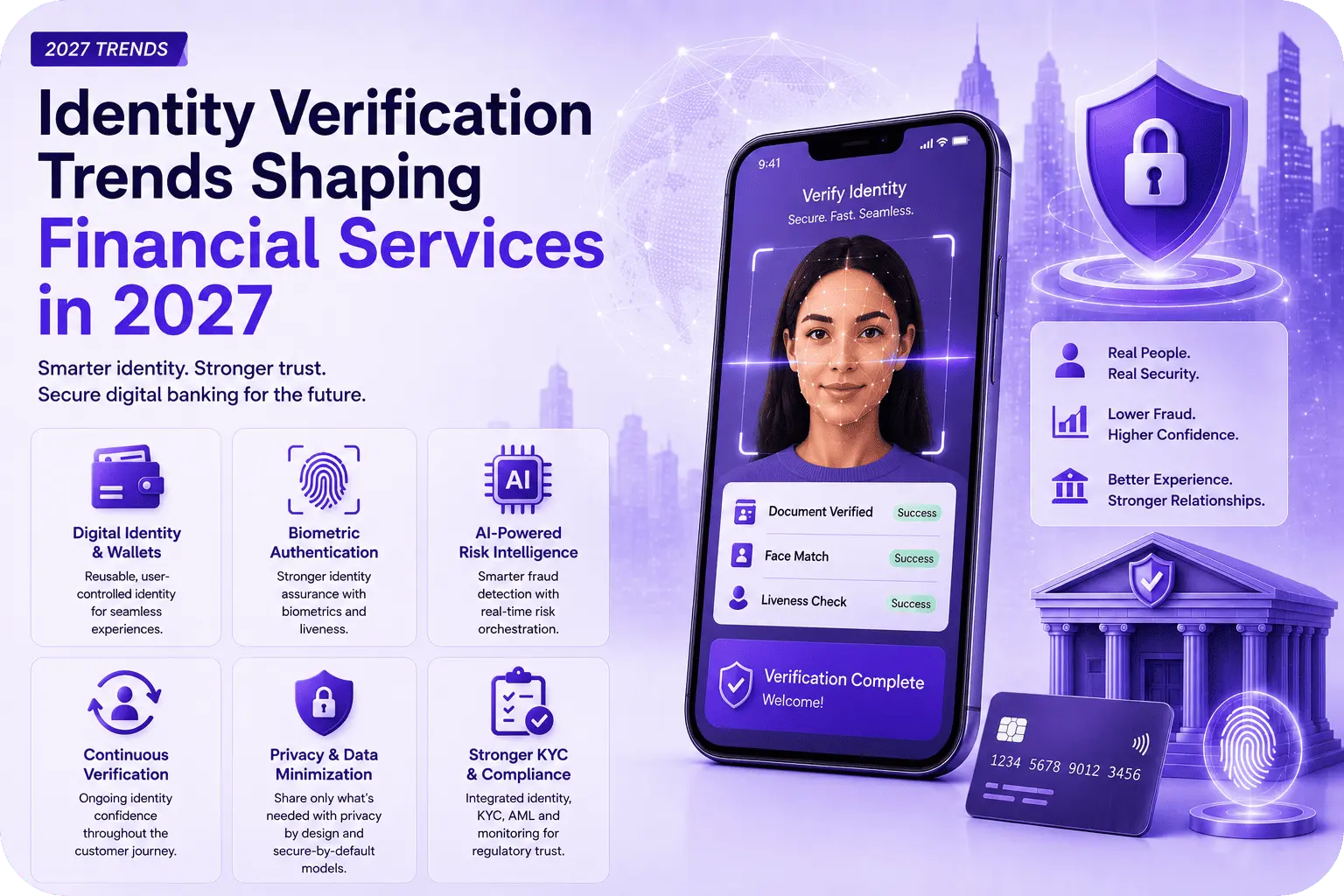
Several technologies are beginning to reshape that balance. Digital identity wallets, verifiable credentials, biometric authentication, AI-powered fraud detection, continuous identity verification, and more privacy-conscious identity architectures are all becoming increasingly relevant.
Recent industry research also shows that financial and professional services remain a major customer sector for digital identity providers, while use cases such as KYC, AML, fraud prevention, secure access, and digital identity wallets continue to expand. (GOV.UK)
This article examines the major identity verification trends financial institutions should prepare for in 2027 and what they mean for the future of fintech verification and fraud prevention.
Why Identity Verification Is Changing
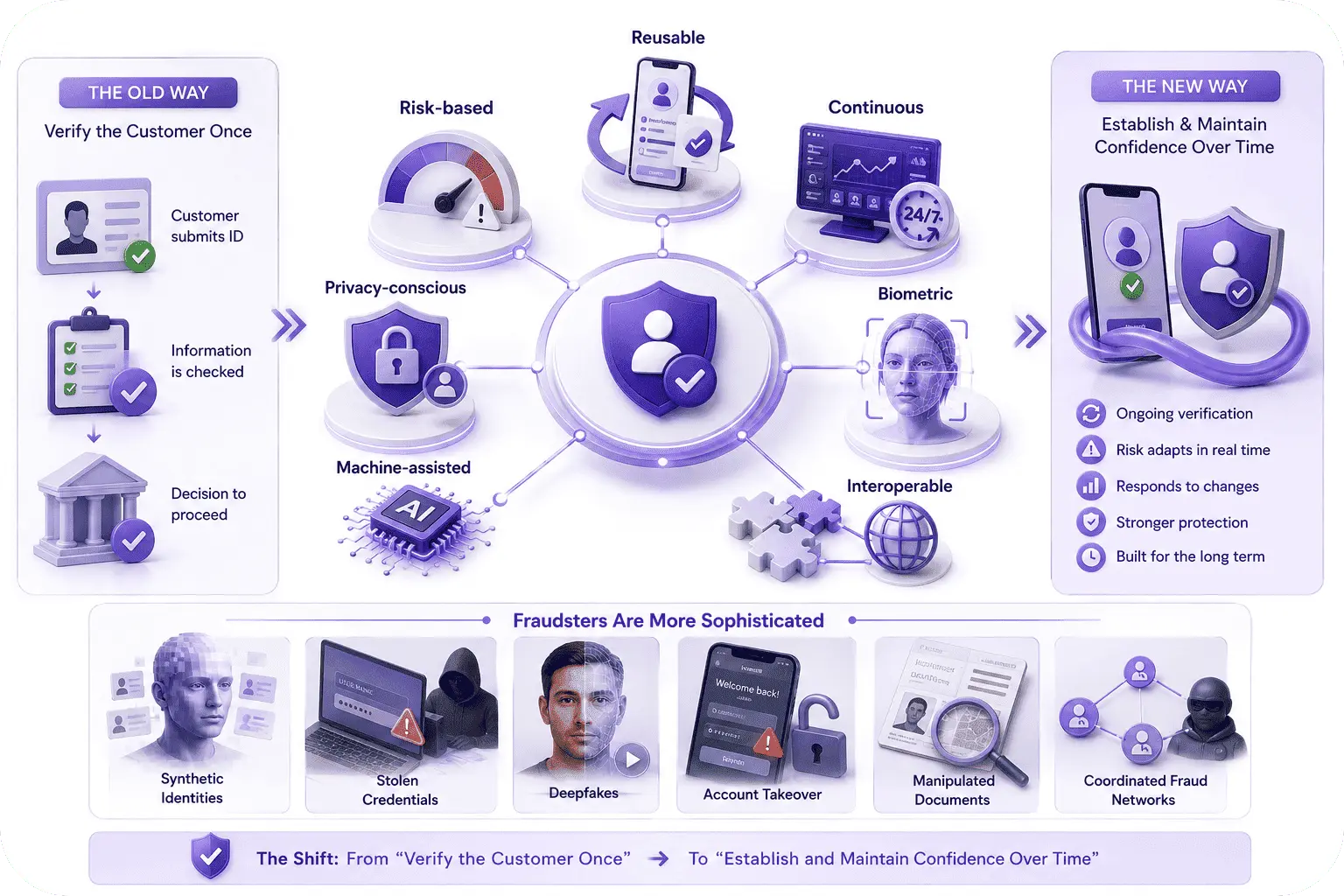
Traditional identity verification was largely designed around establishing identity at a specific moment.
A customer provides an identity document, personal information is checked, and the institution decides whether the application can proceed.
That approach remains important, but financial fraud has become considerably more sophisticated.
Fraudsters now use synthetic identities, stolen credentials, deepfakes, account takeover techniques, manipulated documents, and coordinated fraud networks. At the same time, digital services have created more opportunities for fraud to occur after onboarding rather than only during account creation.
Financial institutions therefore increasingly need identity systems that are:
- Reusable
- Risk-based
- Continuous
- Privacy-conscious
- Biometric
- Machine-assisted
- Interoperable
The shift is essentially from “verify the customer once” toward “establish and maintain confidence in the customer’s identity over time.”
1. Digital Identity Will Become More Reusable
One of the biggest developments for financial services is the move toward reusable digital identity.
Instead of asking a customer to repeat the entire verification process with every organization, digital identity systems can allow trusted identity information or credentials to be presented across multiple services.
This is particularly relevant as governments and financial ecosystems develop digital identity infrastructure.
The European Commission’s Digital Identity Wallet initiative is designed to allow people to identify themselves to public and private services and store and present digital documents. (JPMorgan Chase)
This model could reduce repetitive verification while giving customers more control over the information they share.
For financial institutions, however, reusable identity does not mean eliminating verification.
The institution still needs to determine whether the credential is trustworthy, whether it remains valid, and whether the person presenting it is genuinely associated with the identity.
That means reusable credentials are likely to become an additional trust layer rather than an immediate replacement for existing identity verification technologies.
Recognito’s guide on digital identity verification challenges and solutions provides additional context on the wider challenges businesses face when building digital identity workflows.
2. Digital Identity Wallets and Verifiable Credentials Will Mature
Digital identity wallets are closely connected to the growth of verifiable credentials.
The W3C Verifiable Credentials 2.0 family became a W3C Recommendation in 2025, providing standardized mechanisms for expressing credentials in cryptographically secure, privacy-conscious, and machine-verifiable formats. (W3C)
This matters because interoperability is essential if digital credentials are going to become useful across different organizations.
A financial institution could potentially receive a trusted credential from an approved issuer rather than repeatedly collecting and validating the same underlying identity information.
This can create a more streamlined relationship between the customer and the financial service provider.
However, the quality of the credential ecosystem matters. Institutions will still need trusted issuers, reliable revocation or status mechanisms, secure wallet infrastructure, and clear governance.
The World Bank’s 2026 work on digital wallets also highlights the growing importance of wallets, verifiable credentials, data sharing, digital payments, and user-centric identity architectures. (World Bank)
3. Biometric Authentication Will Become More Integrated Into Identity Systems
Biometric authentication will remain important even as digital identity becomes more reusable.
A credential can prove that an issuer made a particular claim about an individual. It does not necessarily prove that the person currently presenting the credential is the legitimate holder.
Biometrics help address that problem.
Facial verification can connect a digital identity to the individual presenting it, particularly in remote environments where there is no physical interaction.
This is why financial institutions are increasingly combining digital identity credentials with facial recognition, liveness detection, and risk-based authentication rather than treating these technologies as competing approaches.
A face recognition SDK can form part of this biometric layer when an institution needs to compare a customer’s live facial sample with a trusted reference identity.
Similarly, a face liveness detection SDK can help determine whether the biometric presentation comes from a genuine live subject rather than a photograph, replay, or other presentation attack.
The broader direction is toward identity plus biometric assurance, rather than identity information alone.
4. Identity Verification Will Become More Continuous
Another major trend is the movement from one-time identity checks toward continuous identity assurance.
Traditional onboarding asks:
“Who is this customer?”
A more advanced risk model increasingly asks:
“Does this customer’s activity remain consistent with the identity and risk profile we established?”
That can involve signals such as device behavior, transaction patterns, login activity, authentication history, and unusual account changes.
J.P. Morgan’s 2026 payments research highlights the growing role of digital identity alongside behavioral analysis and other controls in financial transactions. (JPMorgan Chase)
Continuous verification does not necessarily mean repeatedly asking customers to perform a facial scan.
In many cases, it can involve passive risk signals and only trigger stronger verification when the risk increases.
This creates an important opportunity to improve security without forcing legitimate customers through unnecessary friction.
5. AI Will Move From Verification Assistance to Risk Orchestration
Artificial intelligence is already being used throughout identity verification, but its role is becoming broader.
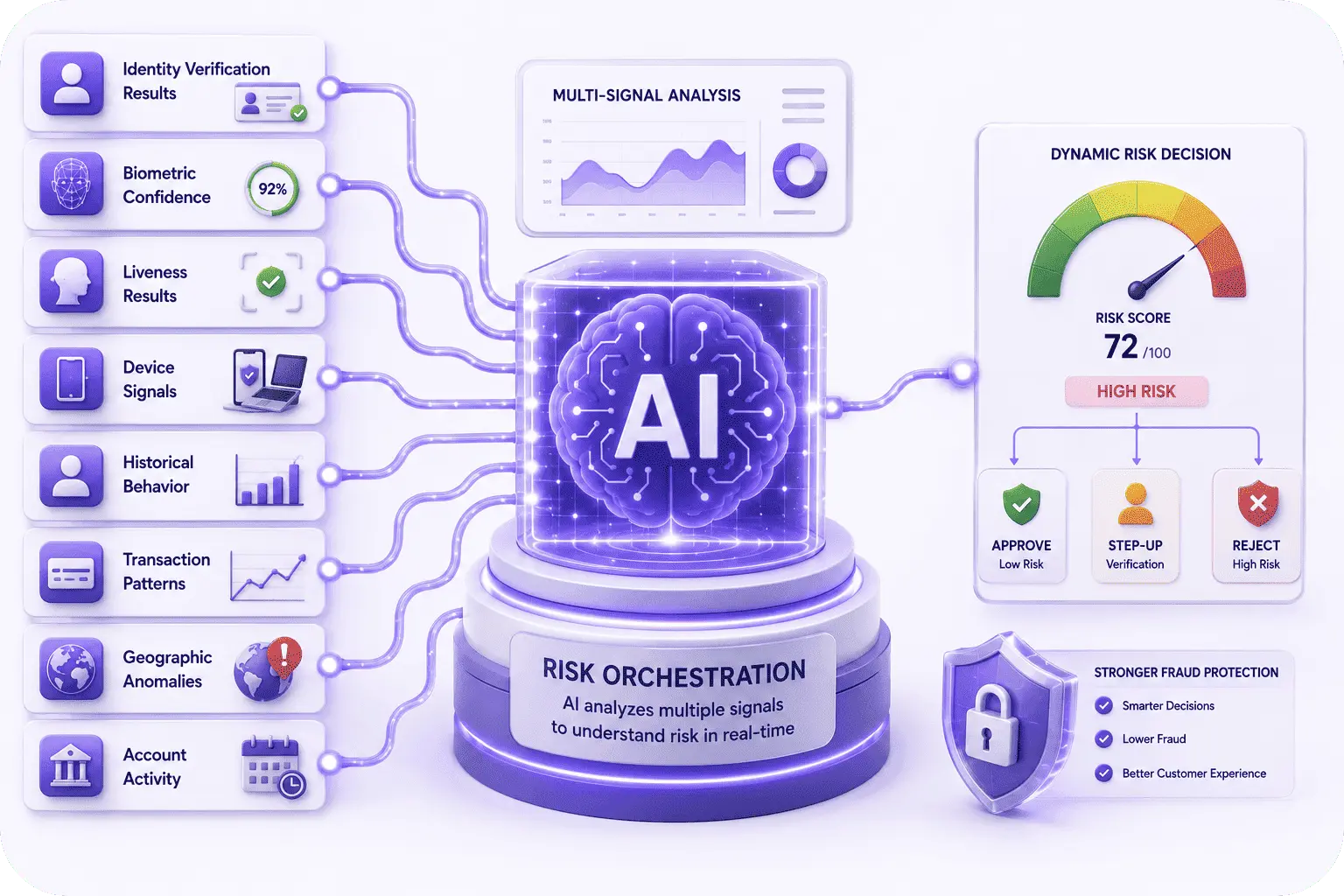
Instead of using AI for one isolated task, financial institutions can increasingly use models to analyze multiple signals at once.
A modern fraud decision might consider:
- Identity verification results
- Biometric confidence
- Liveness results
- Device signals
- Historical behavior
- Transaction patterns
- Geographic anomalies
- Account activity
This allows organizations to move from simple pass-or-fail verification toward dynamic risk decisions.
Recent research on responsible AI in financial identity verification highlights the growing use of AI for identity verification and risk mitigation while also emphasizing the need to address new risks associated with synthetic identities and deepfake-enabled impersonation. (Springer)
The important development is not simply “more AI.”
It is better orchestration of multiple identity and fraud signals.
6. Deepfake Detection Will Become a Standard Fraud-Control Layer
Deepfakes are changing the threat landscape for digital financial services.
Fraudsters can use manipulated images, synthetic faces, altered video, and increasingly sophisticated generative AI techniques to attack biometric verification systems.
Financial institutions therefore need to consider whether a biometric system can distinguish between a genuine user and an artificial presentation.
This is closely related to presentation attack detection and liveness verification.
Financial institutions evaluating their defenses can also review Recognito’s resources on deepfake attack prevention strategies and deepfake fraud trends in financial institutions.
The important trend for 2027 is that deepfake protection will increasingly become part of the normal biometric security architecture rather than an optional advanced feature.
7. Risk-Based Verification Will Replace One-Size-Fits-All Onboarding
A major opportunity for financial institutions is making identity verification proportional to risk.
Not every customer or transaction creates the same level of fraud exposure.
A low-risk account opening may require a relatively simple verification process, while unusual behavior, a high-value transaction, suspicious device activity, or inconsistent identity information may trigger stronger controls.
A risk-based architecture can therefore balance security and user experience.
For example, the initial workflow might rely on document and biometric verification. A higher-risk event could then require additional liveness verification or another authentication step.
This approach reduces unnecessary friction for legitimate users while allowing the institution to apply stronger controls when risk increases.
8. Privacy and Data Minimization Will Become More Important
The growth of digital identity and biometrics creates another important trend: organizations will face increasing pressure to collect and retain only the information they genuinely need.
Traditional verification can involve collecting complete identity documents even when a service only needs a specific attribute.
Digital identity wallets and verifiable credentials create opportunities for more selective disclosure.
Instead of receiving an entire identity record, a verifier could potentially receive a cryptographically verifiable statement that a particular requirement has been met.
This could reduce unnecessary data sharing, but the underlying architecture still needs strong privacy and security controls.
Financial institutions should therefore evaluate not only whether a technology improves verification, but also what personal information it requires and where that information goes.
9. eKYC and AML Verification Will Become More Connected
Identity verification does not exist separately from financial crime compliance.
Financial institutions need to connect customer identity information with broader KYC, AML, customer due diligence, screening, and monitoring processes.
Recent digital identity sector research found KYC and AML compliance to be among the most common commercial uses of digital identity services. (GOV.UK)
This means the next generation of fintech verification platforms will increasingly connect identity verification with downstream compliance decisions.
Recognito’s article on eKYC requirements for fintech platforms in 2026 explores the broader verification requirements fintech organizations need to consider.
The identity check becomes the beginning of a risk workflow rather than the end of onboarding.
10. Fraud Prevention Will Become More Multilayered
The financial industry is moving away from relying on a single fraud signal.
Modern fraud prevention increasingly combines identity, biometrics, device intelligence, behavior, transaction analysis, and risk scoring.
A strong architecture might therefore use:
- Document verification
- Biometric authentication
- Liveness detection
- Device intelligence
- Behavioral analytics
- Risk scoring
- Transaction monitoring
CGAP’s 2026 research on digital finance fraud highlights the increasing complexity of fraud and the use of layered and AI-powered approaches across prevention, detection, disruption, and recovery. (CGAP)
This layered approach is important because sophisticated fraud rarely depends on only one weakness.
What These Trends Mean for Financial Institutions
The individual technologies are important, but the bigger change is architectural.
Financial institutions increasingly need identity infrastructures that can combine trusted credentials, biometric verification, fraud intelligence, and ongoing risk assessment.
This means technology decisions should be made with the entire identity lifecycle in mind.
| Trend | Likely Impact on Financial Services |
| Digital identity wallets | More reusable identity evidence and less repetitive onboarding |
| Verifiable credentials | Machine-verifiable and potentially more selective identity sharing |
| Biometrics | Stronger connection between identity and the person presenting it |
| AI risk orchestration | More dynamic fraud and identity decisions |
| Continuous verification | Identity assurance beyond initial onboarding |
| Deepfake detection | Stronger protection against synthetic biometric attacks |
| Risk-based verification | Better balance between security and customer friction |
| Privacy-focused identity | Reduced unnecessary collection and sharing of personal data |
| Connected KYC/AML | Identity verification integrated with wider compliance workflows |
The organizations that benefit most will be those that connect these capabilities rather than implementing each one as an isolated system.
How Financial Institutions Should Prepare for 2027
Financial institutions do not need to replace their entire identity infrastructure immediately.
A more practical approach is to identify where the existing architecture has the greatest friction or risk.
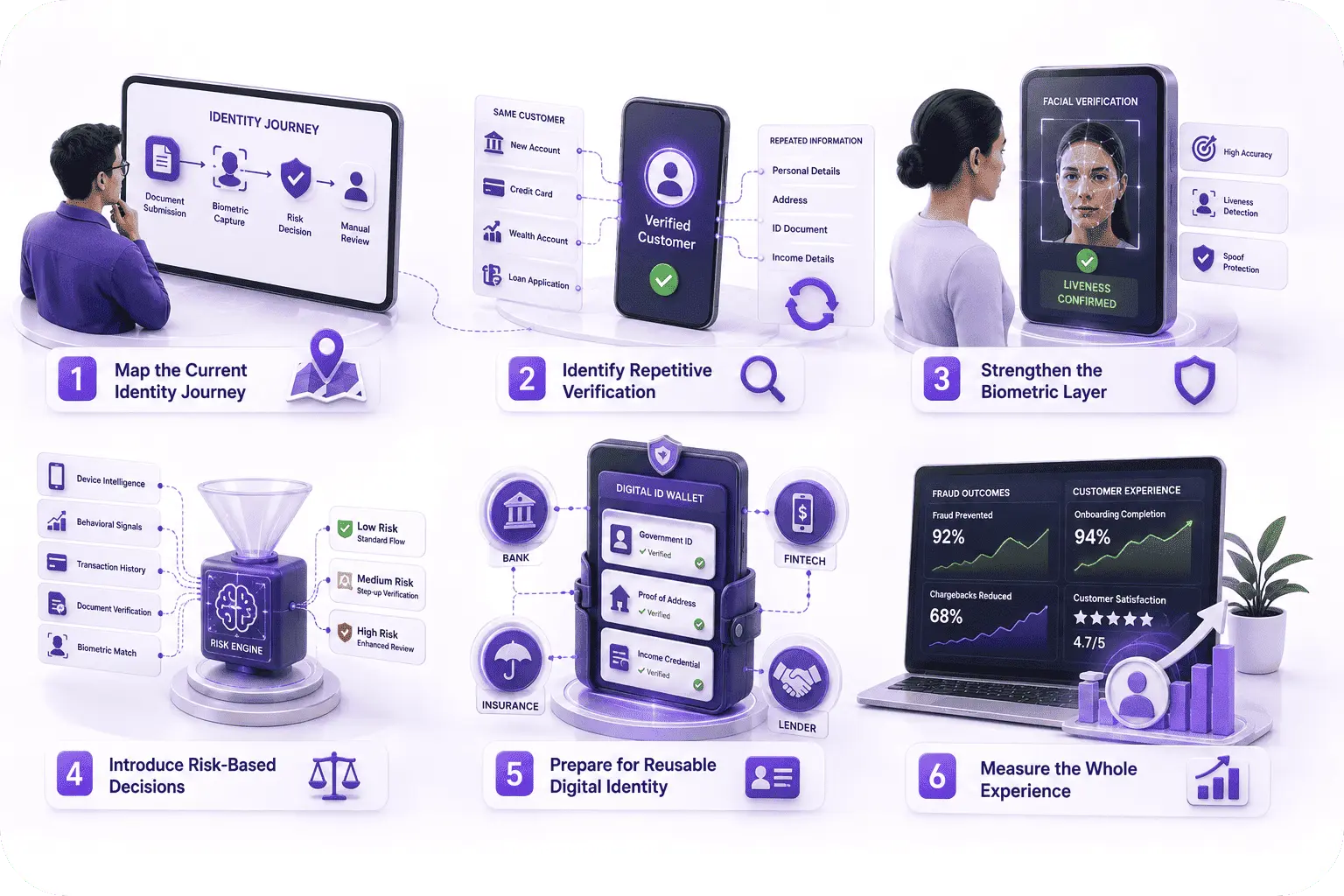
1. Map the Current Identity Journey
Understand where customers provide documents, where biometrics are captured, where risk decisions occur, and where manual reviews are introduced.
2. Identify Repetitive Verification
Look for situations where trusted customers repeatedly provide the same information to different parts of the organization.
3. Strengthen the Biometric Layer
Evaluate whether facial verification and liveness capabilities provide adequate protection for higher-risk digital workflows.
4. Introduce Risk-Based Decisions
Use multiple signals to determine when stronger verification is actually necessary.
5. Prepare for Reusable Digital Identity
Monitor wallet and credential ecosystems that could eventually reduce repetitive identity collection.
6. Measure the Whole Experience
Track both fraud outcomes and customer experience. A verification system that prevents fraud but drives legitimate customers away is not an effective long-term solution.
The Role of Biometric SDKs in the Next Generation of Fintech Verification
Financial institutions do not necessarily need to build every biometric capability internally.
An SDK can provide the biometric component while the financial institution focuses on its own application architecture, fraud strategy, compliance model, and customer experience.
For organizations evaluating facial biometrics, Recognito’s facial recognition capabilities can be considered as one part of a broader identity architecture.
Where customer onboarding requires identity documents, ID document recognition can support document-based identity workflows.
Development teams can also examine the Recognito GitHub repository when assessing implementation resources and the surrounding developer ecosystem.
The goal should not be to add technology simply because it is considered a trend.
Each component should solve a real identity, security, compliance, or customer-experience problem.
What Will Identity Verification Look Like in 2027?
The likely direction is not a single replacement for traditional identity verification.
Instead, financial services will increasingly operate through interconnected identity layers.
A customer may hold reusable credentials in a digital wallet, present selected information to a financial institution, authenticate using a biometric factor, and then be assessed using continuous risk signals throughout the relationship.
Behind the scenes, artificial intelligence may orchestrate these signals and determine when additional verification is necessary.
The result could be an identity experience that feels simpler to the customer while becoming significantly more sophisticated behind the scenes.
The challenge will be ensuring that this sophistication does not introduce new privacy, interoperability, exclusion, or security problems.
Conclusion
The most important identity verification trends shaping financial services in 2027 are not isolated technologies. They represent a broader shift toward reusable digital identity, stronger biometric assurance, AI-driven risk decisions, continuous verification, privacy-conscious data sharing, and multilayered fraud prevention.
Digital identity wallets and verifiable credentials can make trusted identity information more portable. Biometrics can help connect that information to the person presenting it. Liveness and deepfake defenses can strengthen biometric security, while AI and behavioral signals can help institutions respond to changing risk.
At the same time, KYC, AML, customer due diligence, privacy, and regulatory requirements will remain fundamental.
Financial institutions that prepare for this shift should focus on building an identity architecture that can incorporate new technologies without abandoning the security controls that already work.
Organizations evaluating the next generation of digital identity and biometric verification can explore the broader capabilities available from Recognito as part of their technology strategy.
Frequently Asked Questions
What are the biggest identity verification trends for financial services in 2027?
Major trends include digital identity wallets, verifiable credentials, biometric authentication, continuous identity verification, AI-powered risk assessment, deepfake detection, privacy-focused identity systems, and more integrated KYC and fraud prevention.
Will digital identity wallets replace traditional identity verification?
Not completely. Wallets and verifiable credentials may reduce repetitive identity checks, but financial institutions will still need risk-based verification, biometrics, fraud controls, and compliance processes depending on the customer and transaction.
Why will biometric authentication remain important?
Digital credentials can prove that information was issued by a trusted source, but biometrics can help establish that the person presenting the identity is the legitimate holder. This makes the technologies complementary.
How will AI change identity verification?
AI will increasingly analyze multiple identity, biometric, behavioral, device, and transaction signals together to support dynamic risk decisions rather than relying on isolated verification checks.
What should financial institutions do now to prepare for 2027?
Organizations should map their current identity journey, identify repetitive or high-risk verification steps, strengthen biometric and fraud controls where necessary, monitor digital identity standards, and build an architecture capable of incorporating reusable credentials and new verification technologies.