
A customer can submit a perfectly authentic passport image and still present a fraudulent onboarding request.
That distinction is easy to miss in a digital KYC process. Traditional document verification checks whether an ID looks genuine, whether its fields are readable, and whether the information is consistent. But another question matters first: Was the document actually captured from a real, physically present document during the verification session?
Without that check, a fraudster may submit a manipulated file, screenshot, scan, photograph, or other digital representation instead of presenting the original. The underlying document may be genuine, yet the onboarding attempt can still be fraudulent.
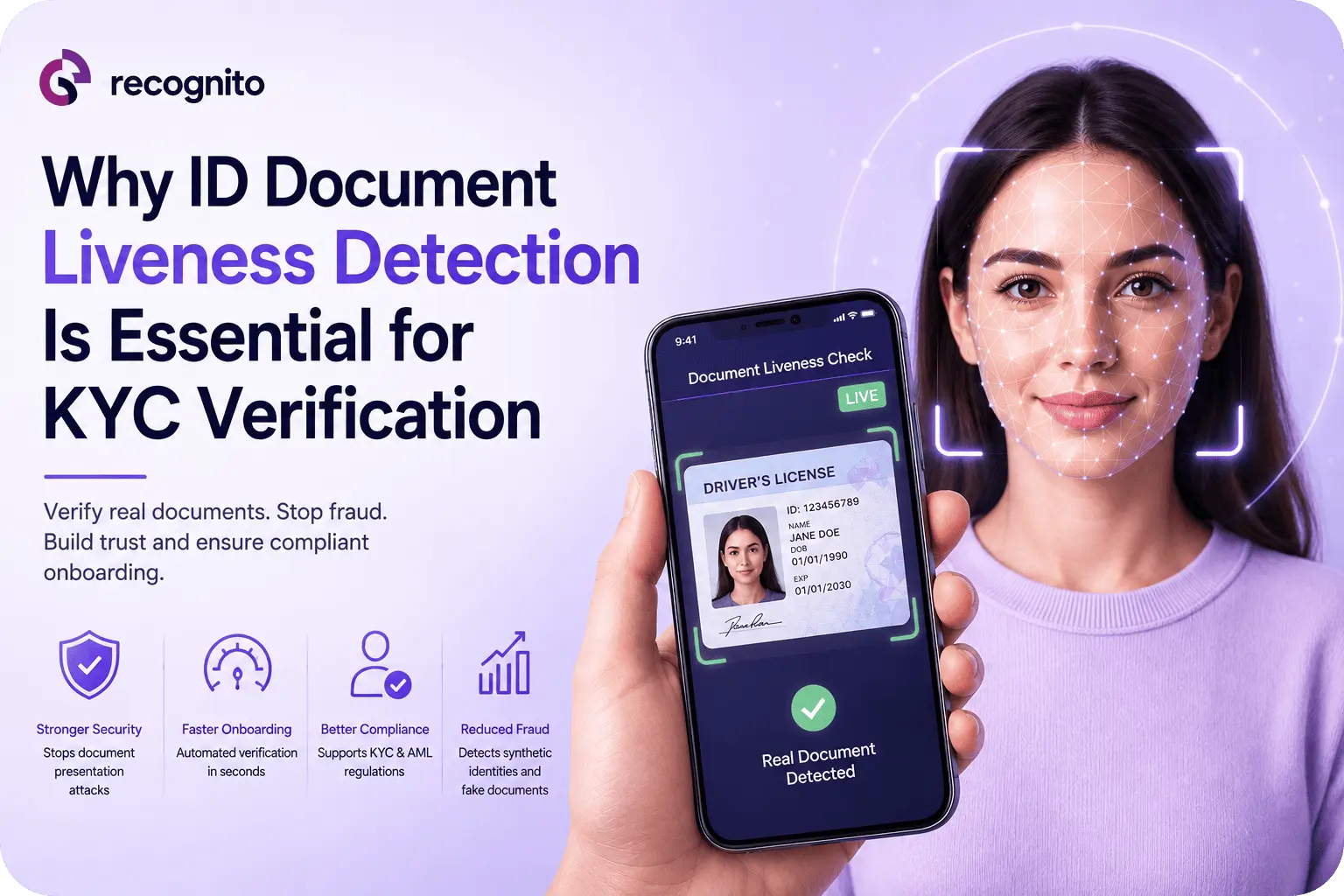
ID document liveness detection addresses this gap by checking document presence during live capture. For remote KYC, it turns document verification from a static image-inspection problem into a live evidence-validation process.
The Problem With Treating Every Document Image as Genuine
A conventional document workflow often starts when a customer uploads an image. OCR extracts the name, date of birth, document number, and other fields. Security features may then be inspected, and the result can be compared with a selfie or additional identity evidence.
The weakness appears when the system assumes that the uploaded image came directly from a physical document.
A fraudster does not necessarily need to forge an entire passport or national ID. They can start with a genuine document belonging to another person and manipulate its image before submission. They can also present a photograph, scan, screenshot, or digitally generated representation that resembles legitimate evidence.
That is why document authenticity and document presence are related but different questions.
FIDO’s Document Authenticity certification program treats document authentication as a critical component of remote identity verification and addresses risks involving forged, tampered, and invalid government-issued documents.
For KYC teams, the implication is straightforward: validating what a document looks like is not always enough. The system also needs confidence that the document being analyzed was physically present when the evidence was captured.
What ID Document Liveness Detection Actually Checks
ID document liveness detection, sometimes called document presence detection, is designed to establish that the physical identity document is present during the verification session.
A remote workflow may ask the customer to hold a passport or ID card in front of a smartphone camera. Instead of simply accepting an arbitrary uploaded image, the system analyzes the live capture.
Depending on the implementation, document liveness may use passive or active techniques. Passive approaches examine visual and capture characteristics without requiring a specific action. Active approaches may use guided movements or capture sequences to provide additional evidence that the document is physically present.
The exact technology varies, but the security objective is consistent:
Do not treat a static digital representation as equivalent to a live capture of physical identity evidence.
That principle is now reflected in current digital identity guidance. NIST’s Identity Proofing Requirements require live document capture and passive or active document presence checks when optical capture and inspection are used to validate physical identity evidence.
For KYC architecture, that makes document liveness much more than a user-interface feature. It is part of the evidence-validation process.
Why Document Liveness Matters for KYC
KYC depends on reliable identity evidence. If the evidence entering the workflow can be digitally manipulated before inspection, downstream checks may be operating on an unreliable input.
Document liveness helps close that gap.
It Raises the Cost of Digital Manipulation
A fraudster who modifies a document image outside the capture process may find it harder to submit that representation when the system expects evidence from a live capture session.
This does not make document fraud impossible. NIST’s identity-proofing guidance recognizes that remote processes remain exposed to digital injection and forged-media attacks. Live capture and attack-detection mechanisms make successful manipulation more difficult, but they do not eliminate every attack path.
That distinction matters when setting security expectations. Document liveness is one control within a layered KYC architecture, not a guarantee against fraud.
It Separates Physical Evidence From Digital Representations
A genuine passport displayed as a static image and a genuine passport physically held in front of the camera are not equivalent from a security perspective.
Live capture gives the verification system an opportunity to evaluate the evidence while it is being presented. This helps establish whether the document exists in the capture environment rather than merely as a file submitted to the service.
It Strengthens Remote Onboarding
Branch-based KYC has an inherent advantage: an employee can see both the customer and the document.
Remote onboarding has to recreate part of that assurance through technology. Document liveness helps bridge the physical-to-digital gap by providing evidence that the document is present during the remote interaction.
How Document Liveness Fits Into a Modern KYC Workflow
Document liveness should not operate as an isolated check. Its value increases when combined with other identity controls.
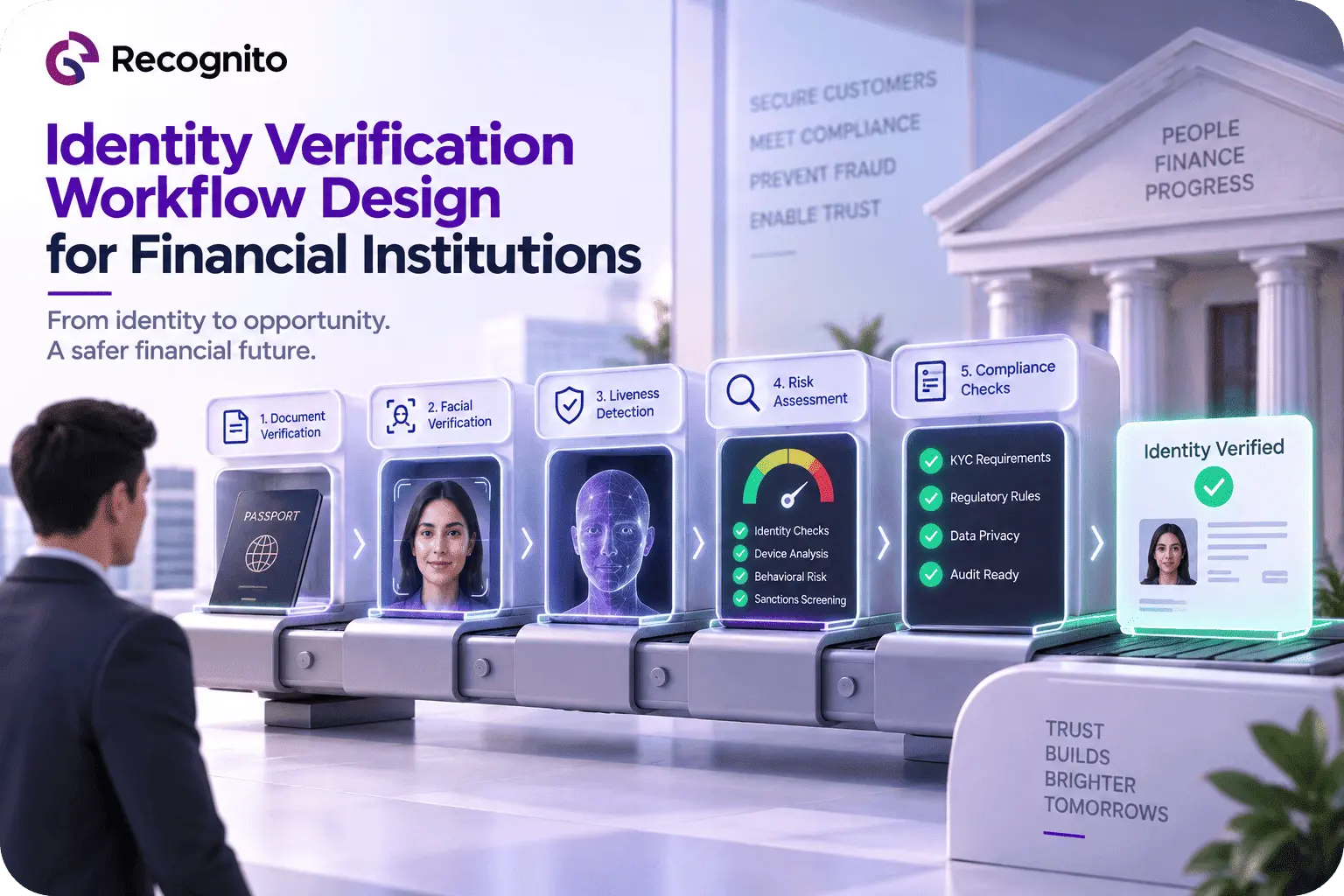
A strong remote flow may look like this:
- Capture the physical document. The customer is guided to position the ID inside the camera frame.
- Check image quality. The system determines whether the document is sufficiently visible and readable.
- Check document presence. Liveness technology evaluates whether the evidence appears to come from a physically present document.
- Analyze authenticity. Document-recognition technology examines format, visual characteristics, fields, and available security indicators.
- Extract identity information. OCR or document intelligence converts the evidence into structured data.
- Verify the person. A selfie or video can be compared with the portrait associated with the document.
- Assess biometric liveness. When face verification is used, a separate liveness layer can determine whether the biometric input represents a live person.
- Apply risk rules. The KYC platform combines verification results with other risk indicators before making a decision.
The separation between document liveness and facial liveness is important. One checks the evidence source; the other checks the biometric subject.
For teams integrating document intelligence into their applications, an identity document recognition SDK can provide the document-processing layer needed to connect capture, recognition, and verification.
Document Liveness vs. Document Authenticity
These concepts are sometimes treated as interchangeable, but they address different failure modes.
Document liveness asks: Is the physical document actually present during capture?
Document authenticity asks: Does the document itself appear genuine and unaltered?
A genuine passport displayed as a static image could pass some authenticity checks while failing a document-presence check.
Conversely, a physically present document could still be counterfeit, altered, or otherwise invalid.
That is why the controls complement each other.
| Control | Primary question | Example threat addressed | Role in KYC |
| Document liveness | Is the physical document present? | Screenshot, uploaded scan, digital representation | Validates the capture source |
| Document authenticity | Is the document genuine? | Counterfeit or altered ID | Validates document integrity |
| OCR and extraction | What information does it contain? | Misread or inconsistent fields | Structures identity evidence |
| Face matching | Does the applicant resemble the document portrait? | Impersonation | Connects person to document |
| Face liveness | Is the applicant physically present? | Photo or video presentation attack | Protects biometric capture |
The strongest KYC workflows treat these controls as complementary rather than expecting one check to solve every fraud problem.
The Threat Is Also Moving Into Digital Injection
Remote identity proofing now faces a wider attack surface than simple image editing.
An attacker may attempt to interfere with media before it reaches the verification engine. A manipulated image or video can be injected through a compromised or emulated environment, making the downstream system analyze forged content that appears to originate from legitimate capture.
Current NIST identity-proofing requirements address this risk directly. Remote proofing services using optical capture and recognition are expected to implement controls that increase confidence that digital media is produced by a genuine sensor and to analyze submitted media for modification, tampering, or forgery.
This means document liveness should be considered alongside device integrity, media analysis, and protected communications.
It also explains why adding a “live capture” button to a KYC interface is not enough. The security value comes from the detection mechanisms behind that capture experience and how their results affect the final decision.
Document Liveness and the Customer Experience
A security control can create unnecessary friction when the capture flow is poorly designed.
A customer who is asked to hold an ID at an exact angle, repeat captures multiple times, or perform confusing movements may abandon onboarding even though the identity is legitimate.
The objective should be controlled capture with minimal unnecessary interaction.
Good implementation typically includes clear framing guidance, immediate feedback when the document is poorly positioned, sensible retry handling, and support for different mobile cameras and lighting conditions.
Exception handling matters just as much. A failed liveness check does not automatically mean fraud. The problem could be glare, motion blur, camera limitations, poor lighting, or an unsupported document condition.
That is why KYC teams need a defined path for failed captures, manual review, and alternate verification methods rather than an unconditional rejection.
What KYC Teams Should Evaluate
Selecting a document liveness solution should involve more than watching a successful demonstration with a few common passports.
Capture coverage
Test the document types and formats customers actually present. Passports, identity cards, driving licences, residence permits, and other credentials can have very different visual and physical characteristics.
Attack coverage
Ask which types of digital representations, manipulated media, replay attempts, and injection scenarios have been tested.
Real-world performance
Test the technology using realistic devices, lighting, network conditions, and user behavior. NIST requires evidence-validation technologies to be assessed in conditions substantially similar to the operational environment and user base.
False acceptance and false rejection
Security teams need to understand both sides of the error trade-off. A system that accepts too many fraudulent representations weakens KYC assurance, while one that rejects too many legitimate applicants creates friction and unnecessary manual work.
Integration
Verification results should be understandable to the KYC platform. The system should distinguish between poor image quality, document-presence failure, authenticity concerns, and other outcomes.
Independent assessment
Independent testing provides stronger assurance than vendor marketing claims. The FIDO framework provides a structured route for evaluating document-authentication technologies against defined performance and security requirements.
Teams can also explore document fraud detection techniques when designing controls around counterfeit, modified, and suspicious identity evidence.
The Importance of Testing Against the Real User Base
A laboratory result is useful only when it is interpreted correctly.
Document liveness performance can vary according to device cameras, lighting, document condition, capture distance, user behavior, and the types of evidence accepted.
That means a fintech serving customers across multiple regions should test its own expected document population rather than assuming that performance on a small set of common IDs will generalize.
NIST’s requirements explicitly call for testing evidence-validation technology under conditions substantially similar to its operational environment. The same principle is valuable for commercial KYC systems.
Real-world testing should answer questions such as:
- Which document types generate the highest failure rate?
- Which devices produce poor captures?
- How often do legitimate users need to retry?
- Which attacks are being detected?
- Which failures require human review?
- How does the system behave when network or capture services are unavailable?
Those metrics provide a much more meaningful picture than a single accuracy percentage.
Privacy and Data Governance Still Matter
Document liveness operates on identity evidence and often involves highly sensitive personal information.
The organization should understand what is captured, what is transmitted, what is stored, how long it is retained, who can access it, and whether service providers or subprocessors receive the data.
It is also important to separate security from retention. Keeping every captured document indefinitely does not automatically improve KYC assurance. Data should be retained according to legal, regulatory, operational, and security requirements.
For broader identity architecture, document verification vs biometric verification helps illustrate why document evidence and biometric evidence often perform different roles within the final identity decision.
Document Liveness and the Economics of KYC
The business value of document liveness extends beyond fraud prevention.
Automated live capture and document assessment can reduce the number of applications that require full manual inspection. That becomes particularly important when onboarding volume grows faster than compliance teams can scale.
Better evidence collection can also reduce unnecessary reviews caused by incomplete or poor-quality submissions.
The business case should therefore consider multiple outcomes:
- fewer fraudulent accounts
- fewer manual reviews
- faster onboarding
- fewer legitimate-user failures
- more consistent evidence validation
- better auditability
The goal is not maximum automation. It is reliable evidence processing at a level of cost and friction that matches the organization’s risk tolerance.
Compliance Guidance Supports a Risk-Based Approach
Document liveness should be understood within the broader digital identity and customer-due-diligence framework.
FATF’s Guidance on Digital Identity explains how regulated entities can assess digital identity systems for reliability and independence when using them to support customer due diligence.
The European Banking Authority’s guidelines on remote customer onboarding similarly set expectations for safe and effective remote onboarding consistent with applicable AML/CFT and data-protection requirements.
These frameworks do not require every organization to implement an identical technical architecture. They reinforce a more important principle: financial institutions need sufficient confidence in the identity evidence used to make customer decisions.
Why Document Liveness Belongs in the Default Design
A KYC system has a fundamental dependency: the quality and trustworthiness of the evidence entering the workflow.
If the system accepts any digital image of an identity document, authenticity analysis begins after the evidence has already crossed a potential attack boundary.
Document liveness moves part of the security boundary closer to the point of capture.
It does not replace document authentication, facial matching, biometric liveness, fraud analytics, or human review. Instead, it helps ensure that those downstream controls are operating on evidence captured from a physical document rather than an arbitrary digital representation.
For remote KYC, that distinction can materially strengthen the confidence behind the identity decision.
Building a More Resilient KYC Architecture
The practical approach is to give each control a defined role.
Capture layer: obtain usable evidence from the customer and physical document.
Presence layer: determine whether the physical document is actually present.
Authenticity layer: assess whether the document appears genuine and unaltered.
Identity layer: connect document attributes and biometric evidence to the applicant.
Attack-detection layer: address presentation attacks, manipulated media, and injection risks.
Decision layer: combine evidence and apply risk-based rules.
Review layer: escalate uncertain cases and provide a secure path for legitimate exceptions.
This layered model makes failures easier to understand. A rejected application can be traced to image quality, document presence, authenticity, biometric verification, or another stage instead of simply producing an unexplained “failed” result.
For development teams working on these verification components, the Recognito GitHub repository can complement technical evaluation and integration work.
Conclusion
ID document liveness detection is essential for modern remote KYC because a genuine document image is not necessarily proof that the physical document was presented during verification.
By checking document presence during live capture, organizations add an important defense against static digital representations and strengthen the evidence pipeline supporting identity verification.
The strongest approach is layered: combine document liveness with authenticity checks, biometric verification, biometric liveness, media and device controls, risk-based decisioning, and appropriate human review.
For organizations building this type of identity infrastructure, Recognito provides technologies that can fit into a broader document and biometric verification architecture.
Frequently Asked Questions
Is document liveness the same as document authenticity?
No. Liveness focuses on whether the physical document is present during capture. Authenticity focuses on whether the document itself appears genuine and unaltered. Both address different attack paths.
Can document liveness stop all KYC fraud?
No. It is one component of a larger security architecture. Counterfeit documents, stolen identities, biometric attacks, account abuse, and digital injection require additional controls.
Why is document liveness important for remote onboarding?
A remote reviewer cannot physically inspect the customer and document. Live capture and document-presence checks provide additional evidence that the identity document is actually being presented during the verification session.
Does document liveness increase customer friction?
It can when the capture experience is poorly designed. Clear guidance, quality feedback, sensible retries, and appropriate exception handling can keep the security step relatively lightweight.
What should businesses ask a document liveness vendor?
Ask about supported document types, attack coverage, false-accept and false-reject performance, testing conditions, independent assessments, integration options, privacy controls, and how failed or uncertain cases are handled.