
For decades, boarding a flight has meant presenting a boarding pass, showing identification, and repeating those steps at different airport checkpoints. That process is familiar, but it also creates queues, manual work, and repeated identity checks.
Airports are increasingly moving toward a different model: use the passenger’s face as the identity interface.
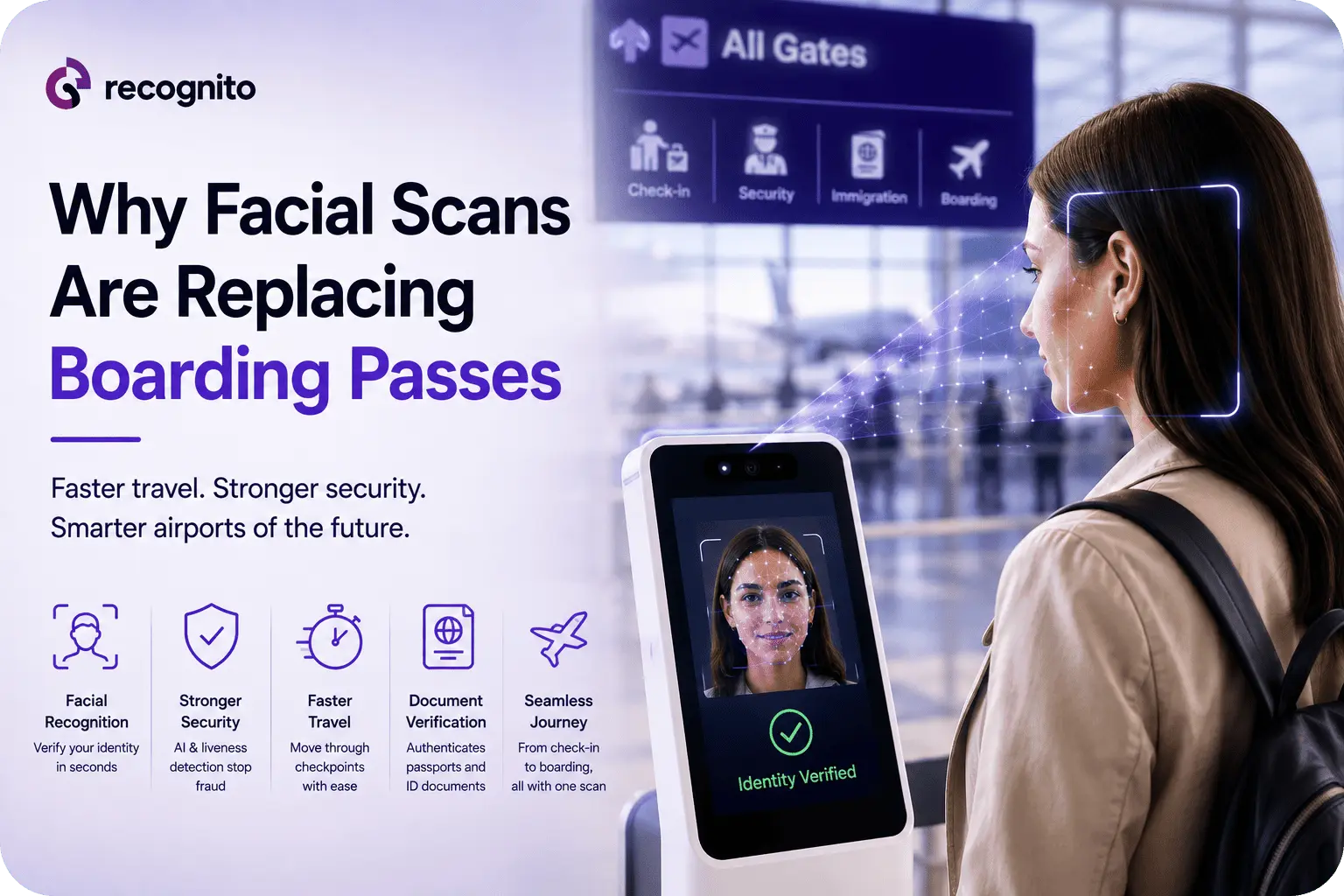
Instead of repeatedly scanning a barcode or handing over a passport, an eligible traveler may approach a camera, look into it, and continue. The system compares the live facial image with a trusted identity reference connected to the passenger’s journey.
This is more than replacing a paper document with a camera. It is part of a wider shift toward digital identity, biometric verification, and contactless travel. IATA’s One ID program describes an end-state in which travelers complete identity and travel checks in advance and then move through airport touchpoints using biometric recognition.
The opportunity is significant, but so are the questions around security, privacy, accuracy, interoperability, and what happens when a biometric match fails.
Why Airports Are Moving Beyond the Boarding Pass
A boarding pass is primarily a travel credential. It shows that a passenger has checked in for a particular flight, but the barcode itself does not prove that the person presenting it is the rightful traveler.
Airports therefore combine boarding credentials with identity documents and other checks.
The problem is repetition. A passenger may interact with check-in, bag drop, security, immigration, a lounge, and a boarding gate, with each touchpoint requiring some form of identity or travel-document presentation.
Facial biometrics can reduce that repetition. Once the passenger’s identity has been established and linked to the journey, the face can become the quick way to retrieve or confirm the relevant travel context.
The boarding pass does not necessarily disappear from the underlying system. Instead, its role at supported touchpoints can be replaced by biometric identity verification.
How Facial Boarding Works
A biometric boarding workflow typically establishes the passenger’s identity, captures a facial image, compares it with a trusted reference, retrieves the relevant journey information, and provides a manual fallback when matching fails.
The important technical point is that several systems work together. The camera supplies the biometric input, the matching engine compares it with a trusted reference, and the airline or airport platform determines what travel action should follow.
That distinction matters because facial recognition is not itself a boarding authorization system. It becomes useful when connected securely to identity, reservation, security, and operational systems.
Facial Recognition Is Expanding Across the Airport
Biometric travel is not limited to the gate.
Depending on the airport and program, facial recognition can support:
- check-in
- self-service bag drop
- airport security
- immigration
- lounge access
- boarding
U.S. Customs and Border Protection says biometric facial comparison is already used at many airport locations for entry and exit processing, while TSA programs have introduced touchless identity experiences for eligible travelers.
For a broader technical understanding of how facial recognition systems operate, face recognition system fundamentals provide useful context on detection, representation, matching, and practical deployment.
The larger benefit comes from connecting these individual touchpoints. A passenger should ideally be recognized consistently throughout a journey instead of repeatedly proving identity from scratch.
Why Airlines and Airports Want Biometric Boarding
The strongest argument is operational efficiency. Airport processing is highly sensitive to throughput, and delays at one checkpoint can create queues elsewhere.
Biometric recognition can reduce physical interactions and document handling. A traveler may not need to retrieve a phone, open an airline app, find a barcode, and position it at every supported checkpoint.
IATA’s 2026 proof-of-concept results reported that digital identity and biometric verification can support international journeys without repeated presentation of physical travel documents.
For airports, the potential benefits include more predictable passenger flow and better use of terminal capacity.
The Security Benefit Is More Nuanced
Replacing a barcode with a face does not automatically make air travel secure.
The security advantage comes from linking the person physically present to a trusted identity. A boarding pass can potentially be shown to someone else, while biometric comparison attempts to connect the person at the camera with the passenger identity.
ICAO’s Biometrics in the Traveller Identification Programme describes biometrics as central to reliable traveler identification and notes that ICAO standards make the facial image the primary biometric for ePassports.
That existing connection between travel documents and facial identity gives the aviation sector a strong foundation for biometric processing. The broader role of facial biometrics in identity checks is also explored in why facial ID recognition is becoming central to identity checks.
The security chain still depends on trusted identity sources, secure enrollment, reliable matching, protected communications, and data integrity.
Accuracy Still Determines Whether the Experience Works
A biometric airport journey is useful only when legitimate passengers are recognized consistently. A false match can create a security problem, while a false non-match can delay a legitimate traveler or trigger manual processing.
Performance may vary with lighting, movement, camera placement, image quality, facial pose, and the reference image used during enrollment. Airport operators should therefore evaluate facial systems under real operating conditions rather than relying on a headline accuracy figure. The practical face recognition accuracy factors are especially relevant when designing camera placement and capture.
Liveness and Presentation Attacks Matter
A facial match is not the same as proving that the biometric sample came from a genuine live traveler.
Attackers may attempt to use photographs, replayed video, masks, manipulated imagery, or other methods to influence the capture process. Digital injection attacks can also target the path between a camera and the biometric engine.
Airport security therefore needs controls beyond facial matching. Presentation-attack detection, secure capture, device protections, monitoring, and human fallback processes all contribute to the security architecture.
This distinction becomes particularly important as synthetic and manipulated media improve. A strong recognition model can still be exposed if the system accepts untrusted biometric input.
Privacy Has to Be Designed Into the Journey
Facial recognition improves convenience, but biometric processing remains sensitive.
Passengers need clear information about what is collected, why it is used, who receives it, how long it is retained, and what alternative is available where opt-out applies.
IATA’s One ID approach emphasizes informed consent, passenger control, and selective sharing. TSA’s digital identification guidance states that digital identification is provided at supported checkpoints with passenger consent and that TSA does not generally create a national database of travelers’ digital IDs.
Privacy therefore affects architecture, data flows, retention, access control, and passenger communication—not just policy.
What Happens When Facial Recognition Fails?
A successful biometric program needs a clear exception path. Travelers may fail verification because of poor lighting, camera positioning, motion, technical errors, appearance changes, or service outages.
A failure should lead to a practical alternative, such as presenting a passport, identity document, or boarding credential. Biometric processing should be the faster path, not the only path.
If fallback processing is slow, biometric failures can simply move the queue to another part of the airport.
Interoperability Is the Harder Problem
Airports are multi-organization environments involving airlines, airport operators, border authorities, security agencies, ground handlers, and technology providers. International travel adds different identity systems and legal frameworks.
The technology therefore has to work across organizational boundaries.
IATA’s 2026 trials demonstrated interoperability across multiple airlines, airports, digital identity wallets, and national identity programs. But global adoption still requires coordinated standards, government participation, and compatible infrastructure.
The long-term vision is therefore broader than facial recognition: the face is the interface, while digital identity provides the infrastructure underneath it.
Digital Travel Credentials Change the Model
The next stage involves Digital Travel Credentials and digital identity wallets.
A digital credential can carry verified travel identity information that is shared with the relevant parties before the trip. Facial recognition can then connect that trusted identity with the person at the airport.
ICAO’s Digital Travel Credential work focuses on secure, trustworthy, and interoperable digital representations of passport information. This makes biometrics the human-facing authentication layer for a broader digital identity ecosystem.
The result is a shift in architecture. Instead of treating the passenger journey as a sequence of document checks, airports can treat identity as a reusable trust layer that supports multiple travel interactions.
What Airport Operators Should Evaluate
Airport organizations should assess more than whether a face-matching algorithm performs well in a controlled demonstration.
| Evaluation area | Key question | Business implication |
| Identity source | What trusted identity is the face linked to? | Determines the strength of the verification chain |
| Recognition | How reliably are legitimate passengers matched? | Affects security and throughput |
| Capture | Does performance hold in real airport conditions? | Reduces avoidable failures |
| Attack resistance | How are presentation and injection attacks addressed? | Protects the biometric pathway |
| Privacy | What data is collected, shared, and retained? | Supports trust and governance |
| Interoperability | Can participating systems exchange trusted identity data? | Enables end-to-end journeys |
| Fallback | What happens after a failed match? | Prevents biometric failures from creating disruption |
| Monitoring | Can errors and operational trends be measured? | Supports continuous improvement |
Engineering teams also need reliable integration. APIs, latency, camera compatibility, error handling, and monitoring can materially affect the passenger experience. A facial biometric SDK can provide the recognition layer, but airport operators still need to validate the complete journey across their own devices, networks, and operational systems.
For developers assessing biometric integration options, the Recognito GitHub repository provides a useful technical resource alongside formal testing and architecture reviews.
The Business Case Goes Beyond Faster Boarding
Speed is only the most visible benefit. Biometric processing can reduce repetitive identity checks, manual document handling, and friction at high-volume touchpoints.
Digital systems can also show where verification fails and where manual intervention is concentrated, giving operators data for improving capture, staffing, and routing.
IATA’s current One ID ecosystem reports participation from more than 50 airlines, 40 airports, and 25 government entities across proofs of concept, pilots, and implementations. The direction is increasingly toward coordinated digital identity rather than isolated biometric checkpoints.
This can change airport planning as well. When fewer passengers need to stop for document inspection, operators can redesign queues, checkpoints, and passenger-routing strategies around continuous verification rather than repeated credential presentation.
What Could Slow Adoption?
Several practical barriers remain: privacy concerns, legacy infrastructure, cross-border interoperability, accuracy problems, evolving attack techniques, and the need to provide a practical alternative for travelers who do not participate.
These challenges do not invalidate biometric boarding. They determine whether it becomes reliable infrastructure or remains a collection of disconnected pilots.
There is also a strategic risk in deploying biometrics as isolated projects. An airport may improve one checkpoint while leaving the rest of the passenger journey dependent on older systems. The strongest results come when biometric identity is planned as part of an end-to-end architecture.
Where Airport Identity Is Heading
The broader trajectory is toward identity-first travel.
Digital travel credentials, trusted data exchange, facial biometrics, secure matching, and risk-based verification can work together across supported touchpoints.
For the passenger, the interaction becomes simple: look at the camera and continue. Underneath is a complex system of identity credentials, biometric comparison, security controls, and governance.
The important transformation is not the disappearance of a boarding pass; it is the move from repeatedly presenting credentials to repeatedly proving a trusted identity.
Conclusion
Facial scans are replacing boarding-pass interactions because they allow airports and airlines to connect a passenger’s identity with the journey without repeatedly asking the traveler to present a physical or digital credential.
The operational benefits are clear, particularly for high-volume airport environments. But successful biometric boarding requires more than accurate face matching. Identity sources, liveness and attack resistance, privacy, interoperability, fallback procedures, and system reliability all determine whether the experience works at scale.
As digital travel credentials mature, facial biometrics are likely to become one of the most visible parts of a much larger identity infrastructure.
For organizations developing secure biometric identity experiences, Recognito can support facial verification technologies that fit into broader identity architectures.
Frequently Asked Questions
Are boarding passes disappearing completely?
No. In many current implementations, a digital boarding pass still exists in the airline or airport systems. Facial recognition changes how the passenger is identified at supported touchpoints.
Is biometric boarding more secure than showing a boarding pass?
It can strengthen identity assurance by linking the person physically present to a trusted identity. Overall security still depends on enrollment, matching, attack detection, data integrity, and the surrounding system.
What happens when facial recognition fails?
A robust system should provide a fallback such as manual inspection of a passport, identity document, or boarding credential. The exact process depends on the airport and travel program.
Do passengers have to use facial recognition?
Requirements vary by program and jurisdiction. Some biometric airport programs are opt-in and provide a manual alternative.
What is the future of facial boarding?
The direction is toward integrated digital identity and Digital Travel Credentials, where biometric recognition helps travelers move through multiple airport and border touchpoints without repeatedly presenting physical documents.