
Facial recognition has moved from a specialized computer-vision capability to a practical identity technology used in banking, access control, travel, retail, workforce systems, and digital onboarding. Its appeal is straightforward: a face is already available to a camera, so users may not need a card, password, or dedicated biometric reader.
But convenience is only one side of the decision.
A business considering facial recognition must weigh faster verification and contactless access against false matches, presentation attacks, privacy obligations, demographic performance, infrastructure requirements, and customer trust. The technology can be effective in the right environment, yet a poorly designed deployment can create security and operational problems.
The right question is therefore not whether facial recognition is simply “good” or “bad.” It is whether the technology fits a specific risk model, user journey, and operating environment.
The Main Advantages of Facial Recognition
1. Low-friction user verification
One of the strongest benefits is usability. Most customers already have a device with a camera, so facial verification can be completed without a physical token or specialized reader.
That makes it useful for remote onboarding, authentication, account recovery, and identity re-verification. A customer can present their face instead of remembering another password or carrying another credential.
For organizations evaluating implementation options, the practical capabilities of a facial recognition SDK can matter as much as algorithm accuracy. The SDK must work across supported devices, handle capture errors, and fit naturally into the user journey.
2. Remote verification without dedicated hardware
Fingerprint systems generally depend on a compatible sensor. Facial recognition can use an ordinary camera, making deployment easier across consumer devices and distributed environments.
That advantage is especially important when a business does not control the customer’s hardware. A fintech cannot assume every applicant has the same fingerprint reader, but it can usually expect access to a smartphone camera.
3. Contactless interaction
Facial recognition does not require physical contact with a sensor. That can be useful in airports, offices, venues, retail systems, and other controlled locations where speed and contactless interaction matter.
4. Fast matching and automation
Modern systems can compare a captured face with a reference quickly enough for near-real-time applications.
That enables automated decisions at scale. Straightforward cases can move through the workflow automatically while uncertain cases are sent for additional review. Properly governed automation can also make decision processes more consistent.
5. Integration with broader identity workflows
Facial recognition becomes more valuable when combined with other evidence.
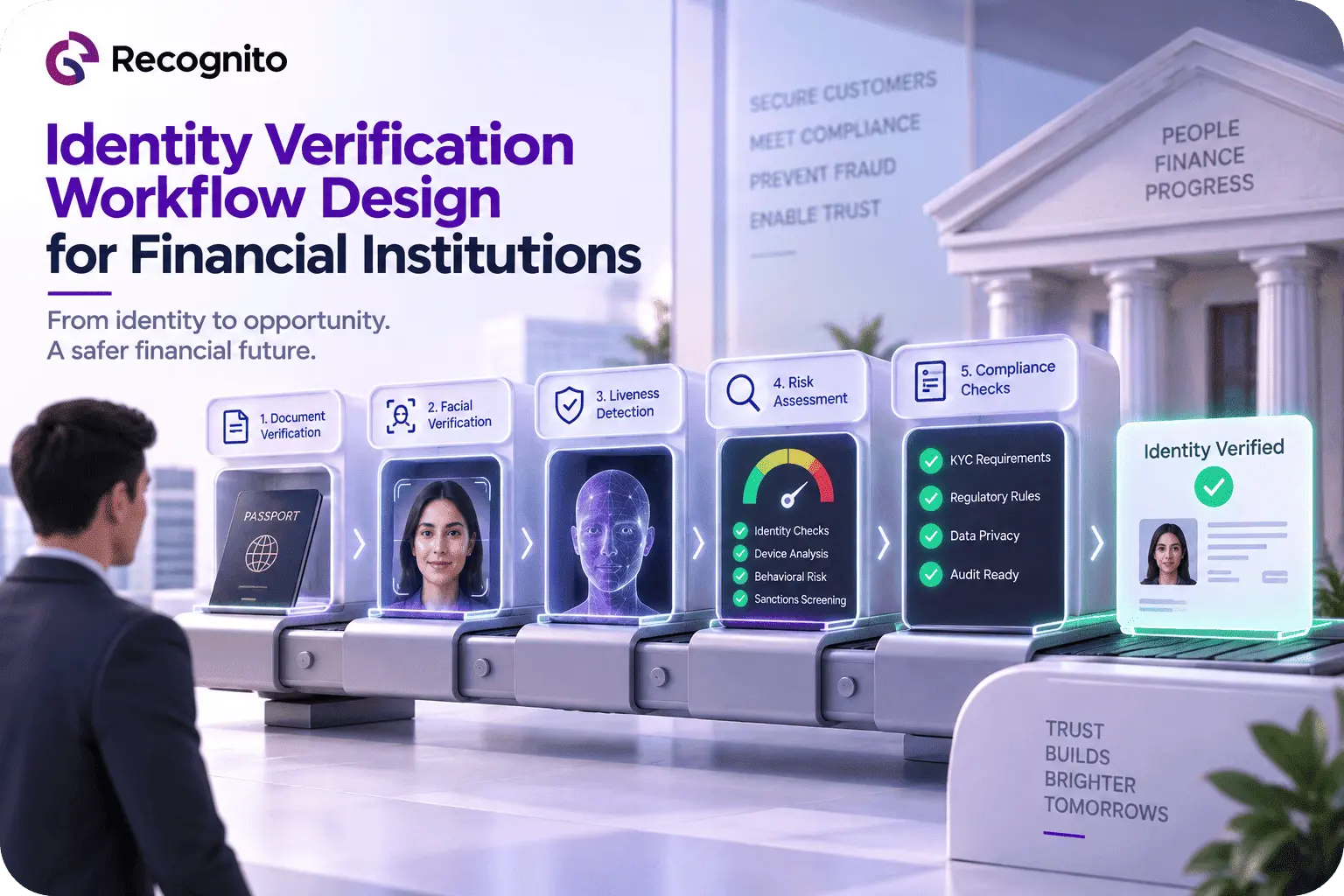
A digital onboarding flow, for example, can connect an identity document to a selfie, use facial matching to compare the two, add liveness detection, and then apply risk rules before approving the customer.
Matching a face does not by itself prove that the person is trustworthy or that the biometric input is genuine. A useful related comparison is face recognition vs. ID document verification, which explains why many identity workflows use both.
The Main Disadvantages and Risks
1. Accuracy depends on conditions
“Facial recognition accuracy” is not a single fixed number.
Performance depends on the algorithm, image quality, camera characteristics, pose, lighting, resolution, elapsed time between images, and the population being evaluated. NIST research has documented multiple factors that affect performance, while its current evaluation program continues to report results under defined conditions.
The business implication is direct: an algorithm that performs well in controlled testing may produce more failures when customers use poor cameras, low light, unusual angles, or inconsistent capture behavior.
A deeper look at face recognition accuracy factors helps put benchmark results into a real-world context.
2. False matches can create security problems
A false match occurs when the system incorrectly associates two different people.
The consequence depends on the application. In a low-risk convenience feature, the impact may be limited. In financial authentication, access control, or identity search, an incorrect match can be much more serious.
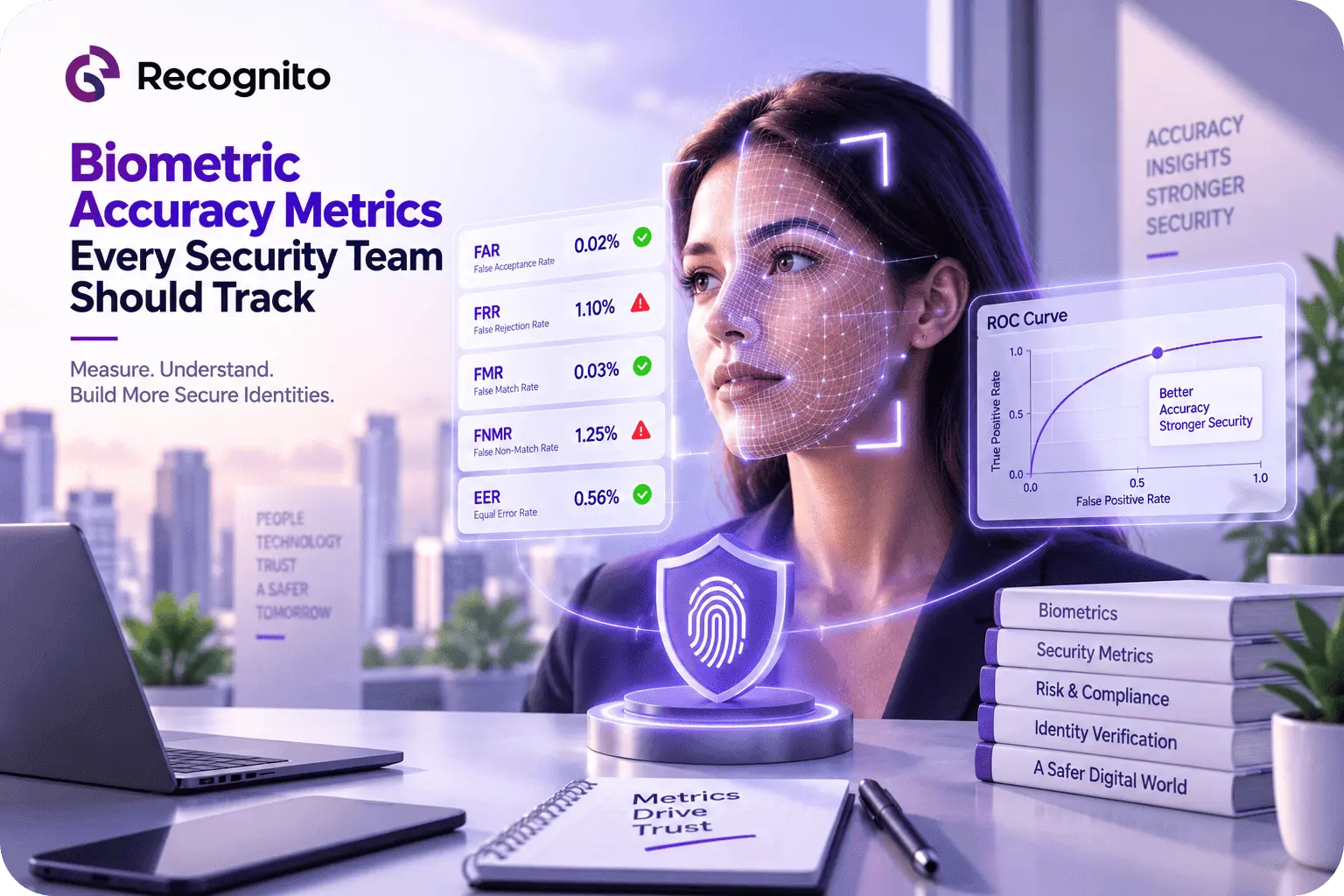
NIST’s current FRTE 1:1 evaluation reports false-match and false-non-match behavior so performance can be considered in terms of security and legitimate-user acceptance rather than one generic accuracy percentage.
3. False non-matches create customer friction
A legitimate customer can be rejected because their captured image differs sufficiently from the reference. Poor lighting, motion, camera placement, facial changes, or a low-quality reference image may contribute.
Repeated failures increase support costs and can encourage customers to abandon the journey. A strong implementation therefore needs capture guidance, sensible retries, and secure alternatives for legitimate users who cannot complete biometric verification.
4. Presentation attacks and deepfakes
A face-recognition system can identify similarity without necessarily knowing whether the submitted input comes from a live person.
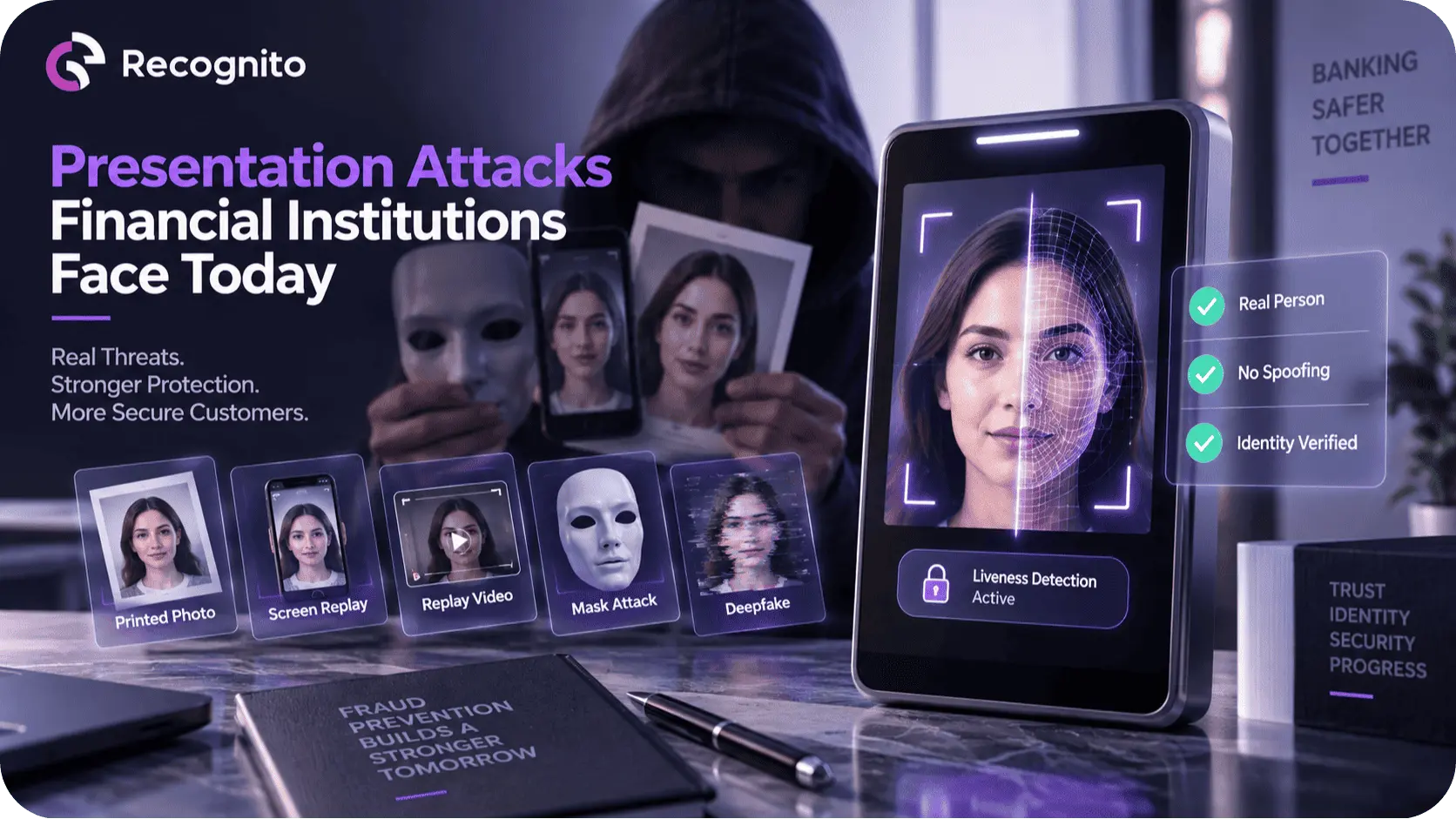
Attackers may attempt to use photographs, replayed video, masks, synthetic imagery, or manipulated media. More advanced attacks may target the application before the recognition model receives the input.
A dedicated liveness layer can help address this problem. Businesses researching the threat side of facial biometrics can review presentation attack detection in biometric security.
FIDO’s face-verification certification framework also evaluates biometric matching, liveness, deepfakes, injection attacks, and demographic performance, illustrating why secure face verification involves more than matching accuracy.
5. Demographic performance can vary
NIST has reported demographic differentials in face-recognition performance and emphasizes that results vary by algorithm, application, and data. Its current reporting includes demographic summaries for false-match and false-non-match behavior.
This does not mean every algorithm performs identically. In fact, performance can vary substantially between algorithms.
The practical response is testing. A deployment should be evaluated using representative users, devices, image conditions, and operating thresholds rather than relying on one aggregate score.
6. Privacy and biometric-data concerns
Facial data is closely linked to identity, which makes collection and storage a sensitive issue.
A business needs to decide what data is necessary, whether raw images are retained, how biometric templates are protected, who can access them, and when information is deleted.
The FTC’s facial recognition best-practices guidance advises companies to consider privacy, reasonable security, retention, disposal, and transparency. These concerns make biometric deployment a data-governance decision as well as a technical one.
7. Public trust and regulatory complexity
Users may be comfortable with facial recognition during an explicit security check but less comfortable with passive identification in a public environment.
Businesses should communicate what the technology is doing, why it is necessary, and how biometric information is handled. Regulatory requirements also vary by jurisdiction and use case, so technical feasibility does not automatically mean a deployment is legally appropriate.
Where Facial Recognition Works Best
The technology is most compelling when users already have access to a camera and the organization needs remote or contactless verification.
| Use case | Main advantage | Main challenge | Best fit |
| Digital onboarding | Remote identity verification | Liveness and document integrity | Fintech, banking, marketplaces |
| Account recovery | Additional biometric evidence | False rejection handling | Consumer applications |
| Workforce access | Contactless verification | Privacy and enrollment governance | Controlled facilities |
| Travel and airports | Fast, hands-free processing | Infrastructure and privacy | Large controlled environments |
| Retail payments | Convenient authentication | Fraud and transaction security | High-volume customer journeys |
| Identity search | Rapid matching against galleries | False-positive consequences | Specialized controlled use cases |
These applications do not have identical requirements. A mobile onboarding system prioritizes camera compatibility and fraud resistance, while a controlled access system may prioritize speed, environmental performance, and physical integration.
When the Risks Become More Serious
Facial recognition becomes harder to justify when the business cannot control image quality, cannot establish a clear purpose, or plans to make high-impact decisions from an automated match without review.
Large-scale identification also requires caution. Searching a face against a large gallery can create more opportunities for false candidates, making threshold selection and human review especially important.
NIST emphasizes that the consequences of false positives and false negatives are application-dependent. A false negative during one-to-one phone access may be inconvenient; a false positive in a one-to-many identification workflow can be far more consequential.
How to Reduce the Risks
A well-designed deployment can address many weaknesses without pretending they do not exist.
Establish a narrow purpose
Define exactly what the system is supposed to do. Verification, authentication, deduplication, and identification have different performance requirements and risk profiles.
Test realistic conditions
Use the devices, lighting, populations, and workflows users will encounter in production. Benchmark data is valuable, but it should be treated as evidence rather than a guarantee.
Add liveness where appropriate
When a face is used for identity verification, assess whether the biometric input comes from a live user rather than assuming the match itself provides that assurance.
Calibrate thresholds
Do not choose thresholds simply because they produce a strong-looking accuracy number. Consider the cost of false acceptance and false rejection.
Protect biometric information
Minimize collection, secure stored representations, control access, define retention periods, and document how biometric data is handled.
Maintain fallback and human review
Not every failed match is fraud, and not every successful match is trustworthy. Escalation paths help handle ambiguous cases without turning automation into unquestioned authority.
How Businesses Should Evaluate Facial Recognition Technology
A practical evaluation should cover five dimensions.
Performance: Examine false-match and false-non-match behavior, not only overall accuracy.
Security: Test liveness, presentation attacks, manipulation, and relevant injection scenarios.
Usability: Measure completion rate, retries, capture failures, and time required to verify a legitimate user.
Governance: Review privacy, retention, access control, auditability, and jurisdiction-specific requirements.
Integration: Test APIs or SDKs, supported devices, latency, network behavior, error handling, and monitoring.
Organizations that need hands-on validation can use a face biometric playground to examine facial-biometric behavior before committing to a production integration.
For technical teams building or testing related workflows, the Recognito GitHub repository provides an additional developer resource.
Is Facial Recognition Worth the Trade-Off?
For remote identity verification, facial recognition can provide a compelling combination of accessibility, speed, and software-based deployment. For controlled environments, it can support contactless access and automated identification.
But those advantages are meaningful only when the surrounding controls are strong.
The business case weakens when deployment relies on poor captures, ignores liveness, stores excessive biometric information, uses inappropriate thresholds, or treats benchmark performance as proof of production safety.
The better way to view facial recognition is as one component within a broader identity and risk-management system.
Conclusion
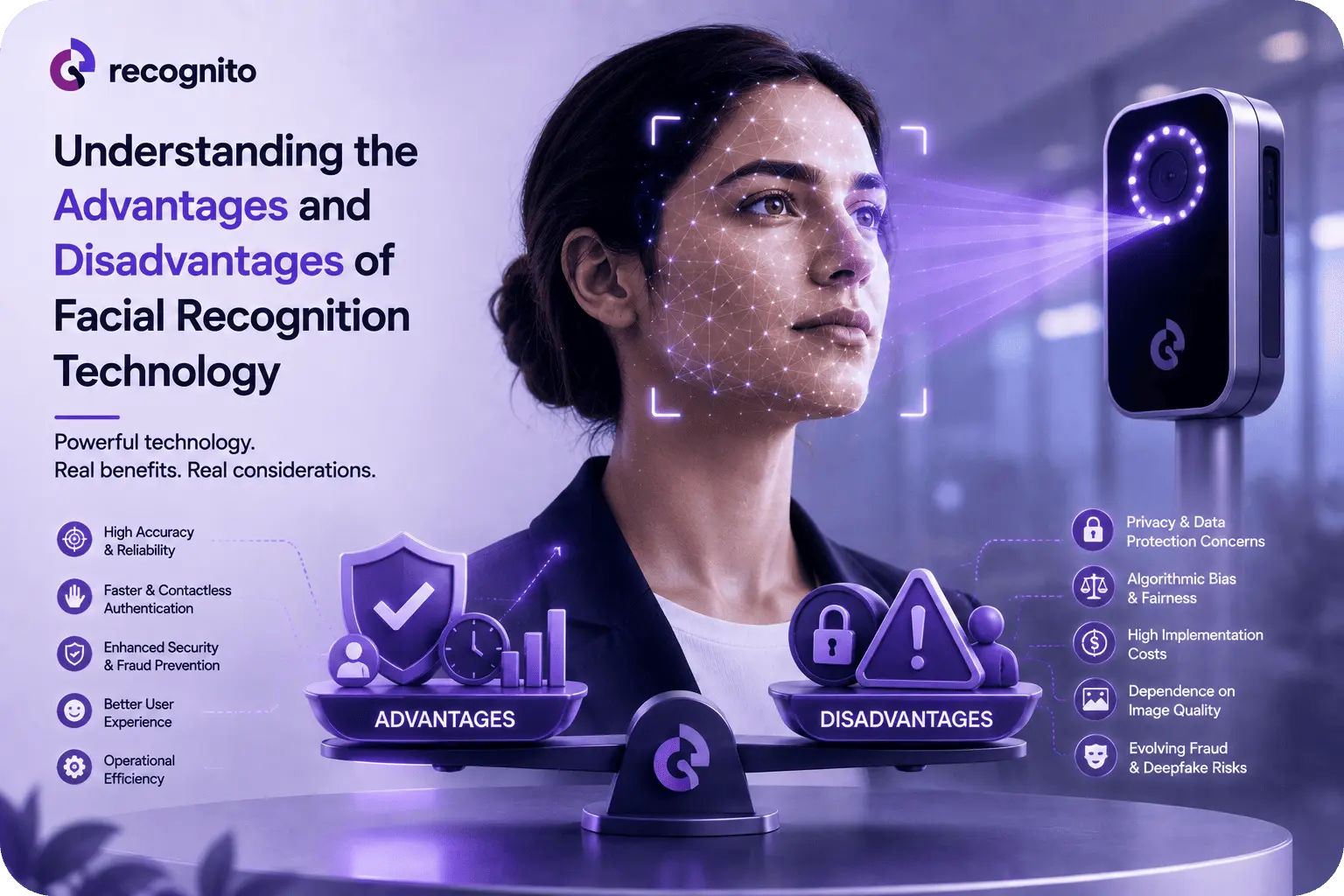
Facial recognition offers genuine advantages: low hardware requirements, contactless interaction, fast matching, remote accessibility, and integration potential with digital identity workflows.
Its disadvantages are equally practical. Performance varies with conditions, false matches and false rejections have different consequences, presentation attacks remain a concern, demographic differences require testing, and biometric data creates privacy and governance responsibilities.
The technology is strongest when organizations define a clear purpose, validate realistic conditions, use complementary security controls, protect biometric data, and design fallback processes.
For businesses evaluating facial biometrics as part of a broader identity strategy, Recognito can support practical face-verification and biometric workflows built around these considerations.
Frequently Asked Questions
What is the biggest advantage of facial recognition?
Its biggest advantage is that it can provide convenient, camera-based identity verification without requiring specialized hardware, making it particularly useful for remote and contactless workflows.
What is the biggest disadvantage?
Privacy concerns, variable performance, false matches, presentation attacks, and demographic differences are among the most important issues businesses need to evaluate.
Is facial recognition accurate enough for business use?
It can be, but suitability depends on the algorithm, operating threshold, image conditions, user population, and security architecture. Production testing remains essential.
Can facial recognition be spoofed?
Yes. Photographs, replayed media, masks, manipulated content, and other presentation or injection attacks can create risks. Liveness and additional security controls are important defenses.
Should businesses use facial recognition alone?
Usually not for high-risk identity decisions. A layered approach that combines facial matching with liveness, identity evidence, risk controls, and appropriate human review provides stronger assurance.