
Organizations operating in high-risk and regulated industries cannot treat identity verification as a simple login or onboarding feature.
Banks, fintech companies, insurance providers, healthcare organizations, telecommunications businesses, government services, travel platforms, and other regulated organizations often need to establish that a person is who they claim to be while also protecting the process from impersonation and fraud.
This becomes particularly difficult when verification happens remotely.
A customer may be thousands of miles away from the organization. The company may only have a camera, an identity document, and information submitted through a digital interface to establish trust.
That is where liveness detection and biometric verification become important.
Face recognition can help determine whether a person’s facial sample corresponds with a trusted identity. Liveness detection adds another layer by assessing whether the biometric presentation appears to come from a genuine live person rather than a photograph, replay, mask, or other presentation attack.
For high-risk industries, these capabilities are most effective when they are combined with identity verification, document analysis, fraud controls, risk assessment, and appropriate compliance processes.
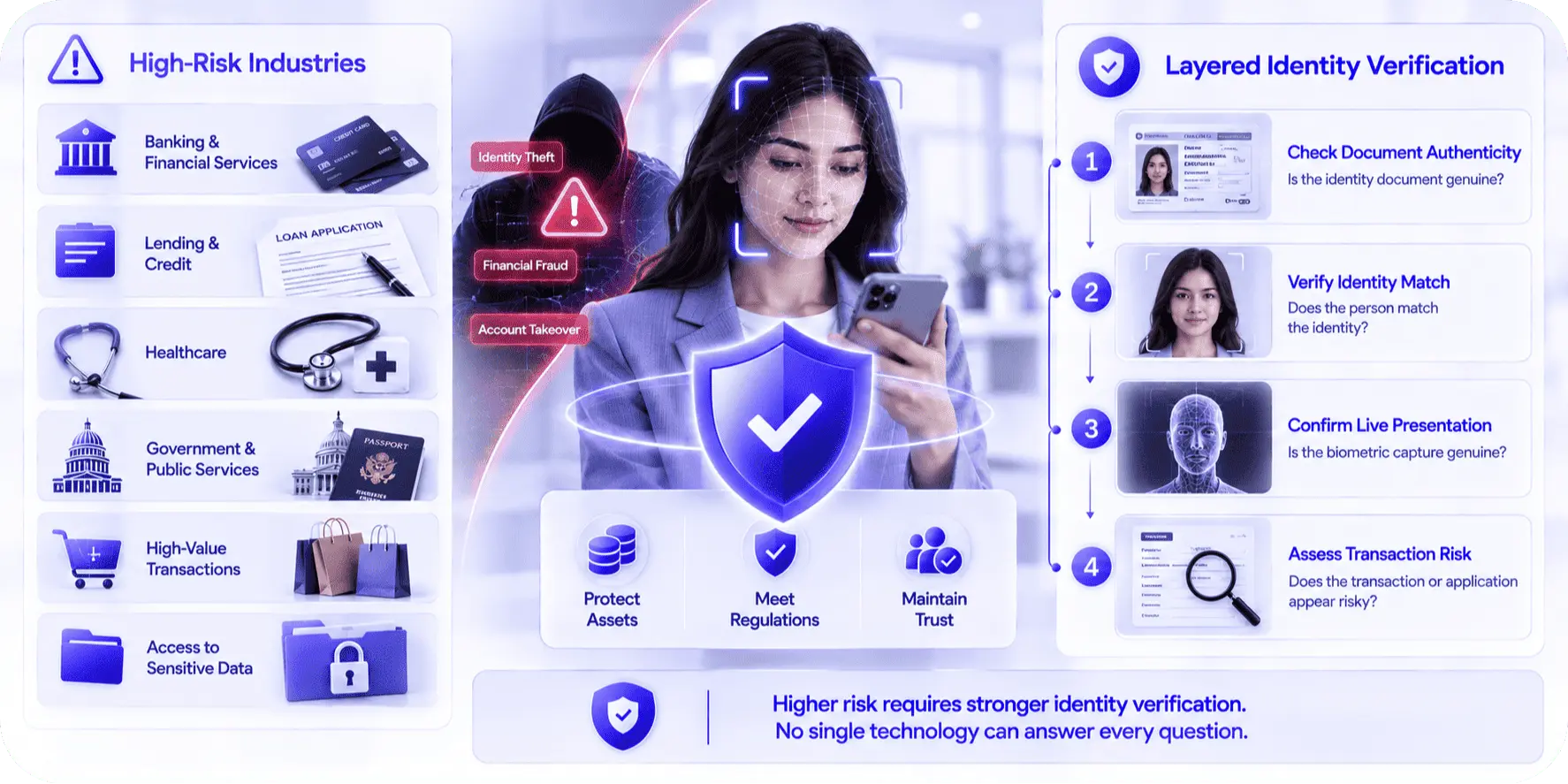
Why High Risk Industries Need Stronger Identity Verification
Not every digital transaction carries the same level of risk.
A user registering for a low-value service may not require the same assurance as someone opening a bank account, applying for a large loan, accessing sensitive medical records, or performing a high-value financial transaction.
High-risk environments generally have three characteristics in common.
First, successful impersonation can produce significant financial, legal, or operational consequences.
Second, the organization often has regulatory or contractual obligations around identity assurance.
Third, attackers have a stronger incentive to invest in techniques that bypass weak verification.
This makes a layered approach important.
A high-assurance identity workflow may need to establish:
- Whether the identity document is genuine
- Whether the person matches the identity
- Whether the biometric presentation is genuine
- Whether the transaction or application appears risky
No single technology should be expected to answer every question.
What Is Liveness Detection?
Liveness detection is designed to assess whether a biometric presentation appears to originate from a genuine live subject.
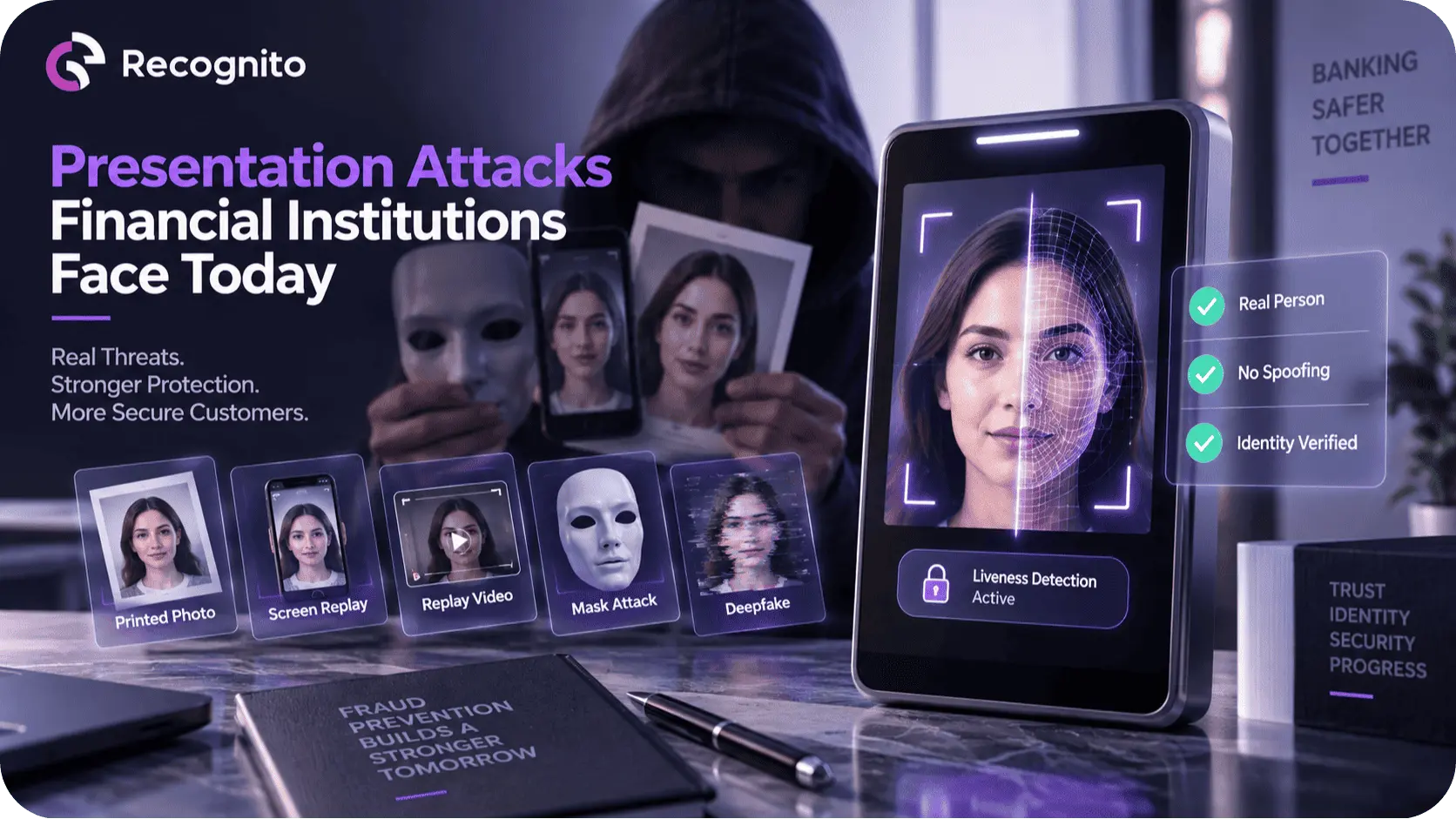
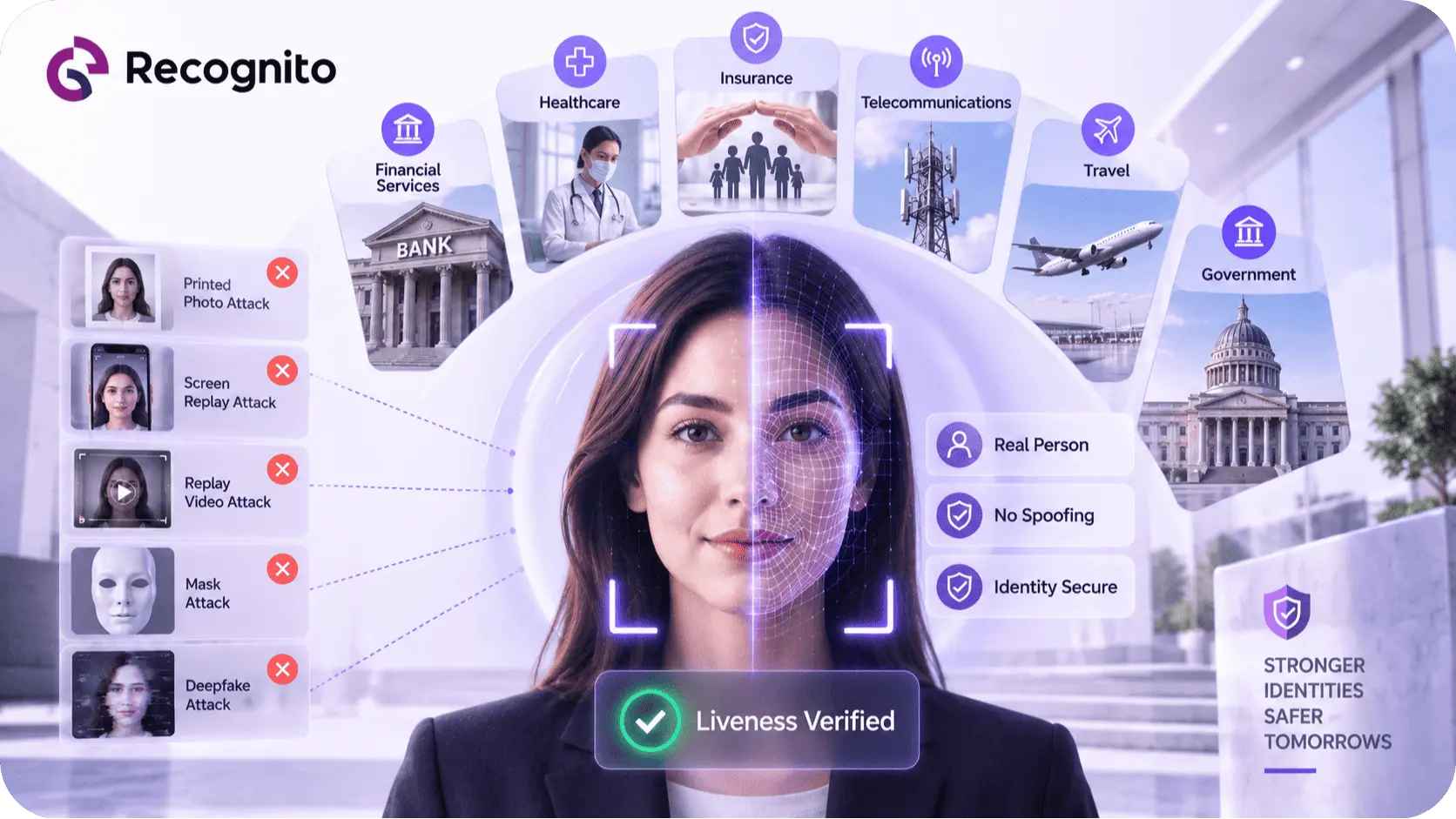
During remote facial verification, an attacker may attempt to present a printed photograph, an image on another screen, replayed video, a mask, or synthetic facial content.
A liveness mechanism adds a dedicated layer for assessing the authenticity of that presentation.
This is different from facial recognition.
Facial recognition primarily asks:
Does this face correspond with the trusted reference?
Liveness detection asks:
Does this biometric presentation appear to come from a genuine live person?
The distinction is important because a system can produce an accurate facial match while still accepting a fraudulent presentation.
Recognito’s resource on presentation attack detection and biometric security provides additional context on this distinction.
How Face Recognition and Liveness Work Together
A stronger biometric verification process combines the two capabilities.
Imagine a customer applying for a financial account remotely.
The customer submits an identity document and then captures their face. The system can compare the facial sample against the trusted photograph associated with the identity.
That answers the identity-matching question.
The liveness layer then evaluates whether the face being presented appears genuine.
Together, the controls establish two separate forms of confidence:
Identity consistency: the person appears to correspond with the claimed identity.
Presentation authenticity: the biometric sample appears to come from a live subject.
Organizations building this type of workflow can use an enterprise face recognition SDK for biometric matching and a biometric liveness SDK as an additional security layer.
Why Liveness Matters in Financial Services
Financial institutions are among the clearest examples of organizations that need strong remote identity assurance.
Banks and fintech platforms may use biometrics during account opening, customer verification, authentication, account recovery, lending, or other high-risk events.
The problem is that criminals can combine stolen identity information with genuine documents or synthetic media.
A document may be real while the person presenting it is not the owner.
A facial match may be technically strong while the underlying sample is a replay or another presentation attack.
This is why financial institutions increasingly need layered identity verification.
A workflow might combine document verification, facial matching, liveness, device intelligence, and risk-based decisioning rather than relying on one control.
Liveness Detection in Healthcare
Healthcare creates a different form of identity risk.
Organizations may need to protect access to medical records, telehealth services, prescription systems, insurance information, or other sensitive resources.
The impact of successful impersonation can extend beyond financial loss.
Patient identity errors can result in privacy breaches, unauthorized access, fraud, and potentially inappropriate access to health information.
Biometric verification can help strengthen identity assurance in remote environments, while liveness can provide additional protection when facial capture is used.
The workflow still needs to account for accessibility, usability, privacy, and the consequences of false rejection.
In healthcare, making a legitimate patient repeatedly fail a biometric check can be especially problematic.
That means accuracy and user experience need to be evaluated alongside security.
Liveness Detection in Insurance
Insurance providers increasingly use digital onboarding and remote claims workflows.
Identity verification may be required when opening an account, submitting a claim, changing important information, or performing another high-risk activity.
Fraud can involve stolen identities, manipulated documents, coordinated claims activity, or impersonation.
Biometric verification can strengthen the link between the individual and the identity associated with the account.
Liveness can then provide additional protection against attempts to manipulate the facial capture process.
A useful approach is to apply stronger controls when the risk of fraud is higher rather than requiring the most complex verification for every customer interaction.
Liveness Detection in Telecommunications
Telecommunications providers also face identity-related fraud.
Customers may need identity verification when activating services, changing account ownership, recovering accounts, or managing high-risk account settings.
Account takeover can be particularly damaging when a fraudster gains control of a customer’s telecommunications account and uses it to facilitate attacks against other services.
Biometric verification can provide another layer of identity assurance, especially for remote or high-risk operations.
A facial verification SDK can provide the biometric component while the wider telecommunications platform maintains its own authentication, device, and fraud controls.
The goal should be to strengthen the overall identity architecture rather than depend entirely on biometrics.
Liveness Detection in Travel and Border-Related Services
Travel and identity services increasingly use biometrics to streamline verification.
Airports, travel operators, and related services may use facial technologies to connect a traveler with previously established identity information.
Because these environments can involve high volumes of users, the system needs to balance verification speed with security.
Presentation attacks remain relevant because an attacker who can successfully deceive a biometric capture system may be able to bypass part of the identity process.
Liveness can therefore complement face matching when the operational environment and risk model require stronger biometric presentation protection.
Testing is particularly important because travel environments can involve unusual lighting, movement, varied camera positions, and high throughput.
Liveness Detection in Government and Public Services
Government services can involve particularly sensitive identity processes.
Citizens may access digital tax services, benefits, licenses, identity programs, or other services where establishing the correct person is important.
The consequences of identity fraud can extend beyond one account.
For this reason, governments and public-sector organizations may need strong identity assurance while also considering accessibility, privacy, transparency, and equal access.
Biometric verification can strengthen identity proofing, but the surrounding governance is equally important.
Organizations should define what data is collected, why it is necessary, how long it is retained, and how exceptions and failed verification are handled.
Liveness Detection in Financial Technology and Digital Payments
Fintech platforms often prioritize rapid onboarding while handling significant fraud exposure.
This creates a difficult balance.
Customers want to open accounts quickly. Fraud teams need strong identity controls. Compliance teams need defensible verification processes. Engineering teams need technology that can scale.
A layered architecture can help.
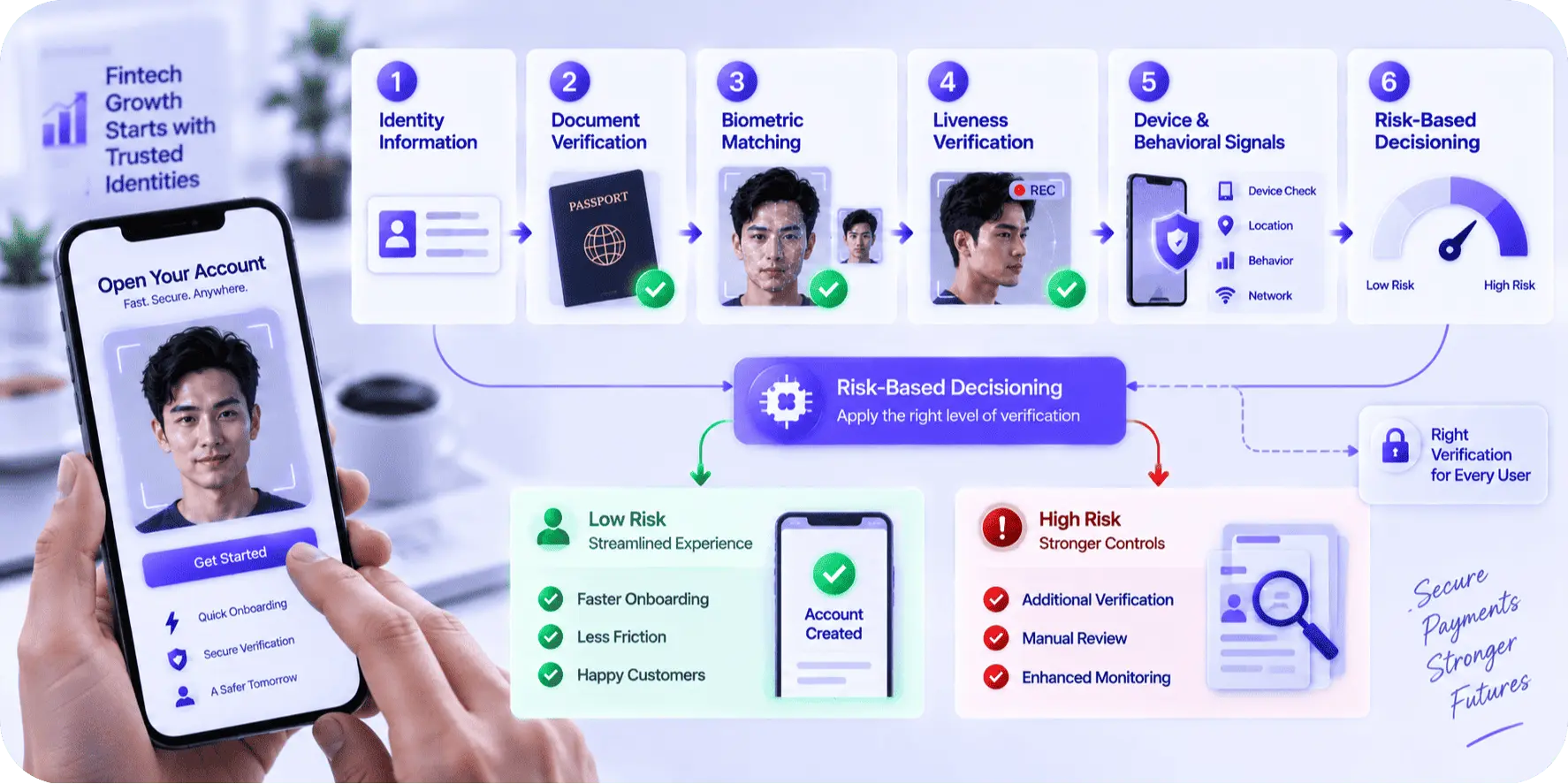
A fintech workflow might combine:
- Identity information collection
- Document verification
- Biometric matching
- Liveness verification
- Device and behavioral signals
- Risk-based decisioning
The key is that not every user has to receive the same level of verification.
Higher-risk situations can trigger stronger controls while routine applications remain relatively streamlined.
Comparing High Risk Industry Applications
Different sectors apply biometrics for different purposes, so the security architecture should reflect the actual risk.
| Industry | Typical Identity Risk | Role of Face Recognition and Liveness |
| Banking and fintech | Account fraud, impersonation, stolen identities | Strong remote onboarding and authentication |
| Healthcare | Unauthorized access and patient identity misuse | Identity assurance for sensitive services |
| Insurance | Identity and claims fraud | Stronger claimant verification |
| Telecommunications | Account takeover and identity fraud | High-risk account changes and recovery |
| Travel | Identity mismatch and presentation attacks | Faster identity confirmation with stronger biometric assurance |
| Government | Misuse of public services and identity credentials | Higher-assurance digital identity workflows |
The table illustrates an important point: the technology can be similar while the risk model is very different.
The Role of Identity Verification
Liveness should not be separated from identity verification.
For most high-risk workflows, organizations need a trusted identity reference before biometric matching can provide meaningful assurance.
That reference could come from a government identity document, an existing account, a trusted digital identity, or another verified source.
Where identity documents are part of the workflow, an ID document recognition SDK can support the document verification stage before biometric comparison.
The overall chain can therefore look like:
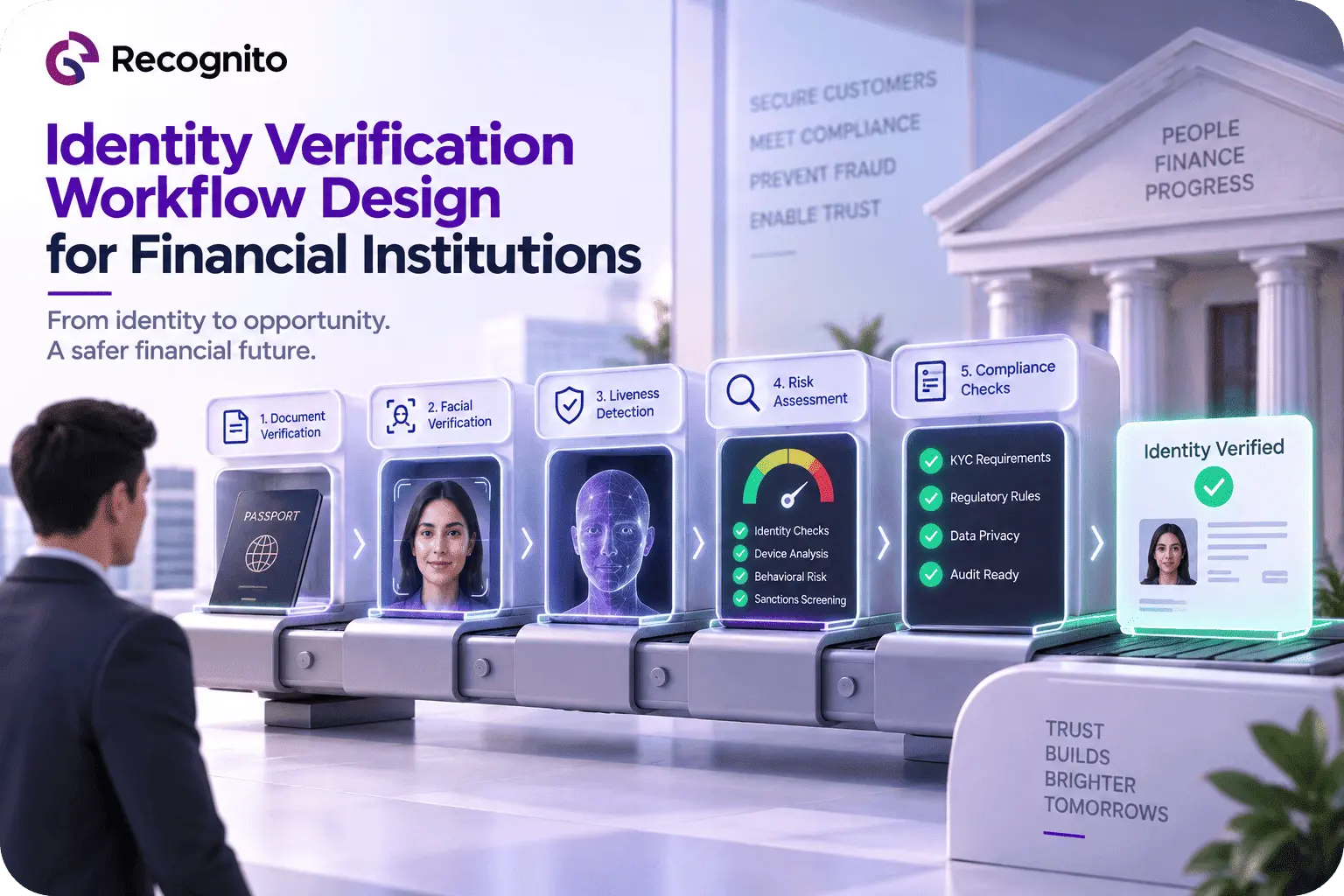
Identity evidence → biometric verification → liveness → risk decision
Each stage answers a different question.
Presentation Attacks and Biometric Security
The growth of synthetic media makes presentation attack protection increasingly important.
Attackers can use photographs, screen replays, manipulated videos, masks, or AI-generated media to attempt to deceive biometric systems.
This means an organization’s security team should understand the attack classes relevant to its application and evaluate whether the liveness implementation addresses the appropriate threats.
The ISO/IEC 30107-3:2023 standard provides principles and methods for assessing presentation attack detection mechanisms and reporting evaluation results.
It should not, however, be treated as a blanket guarantee that an entire identity platform is secure.
PAD addresses one part of biometric security.
The surrounding application, device, APIs, authentication controls, data security, and fraud monitoring still need appropriate protection.
Active and Passive Liveness in High Risk Environments
The right liveness approach depends partly on the user journey.
An active approach may ask the user to follow a prompt or perform a particular action.
A passive approach aims to assess the biometric presentation without requiring the same level of deliberate interaction.
Both approaches can have different implications for security, user experience, processing speed, and accessibility.
Organizations evaluating these options can review active and passive liveness detection before deciding which model best fits the application.
The objective should be to choose an approach that delivers appropriate assurance without introducing unnecessary friction.
Challenges When Deploying Biometrics in Regulated Industries
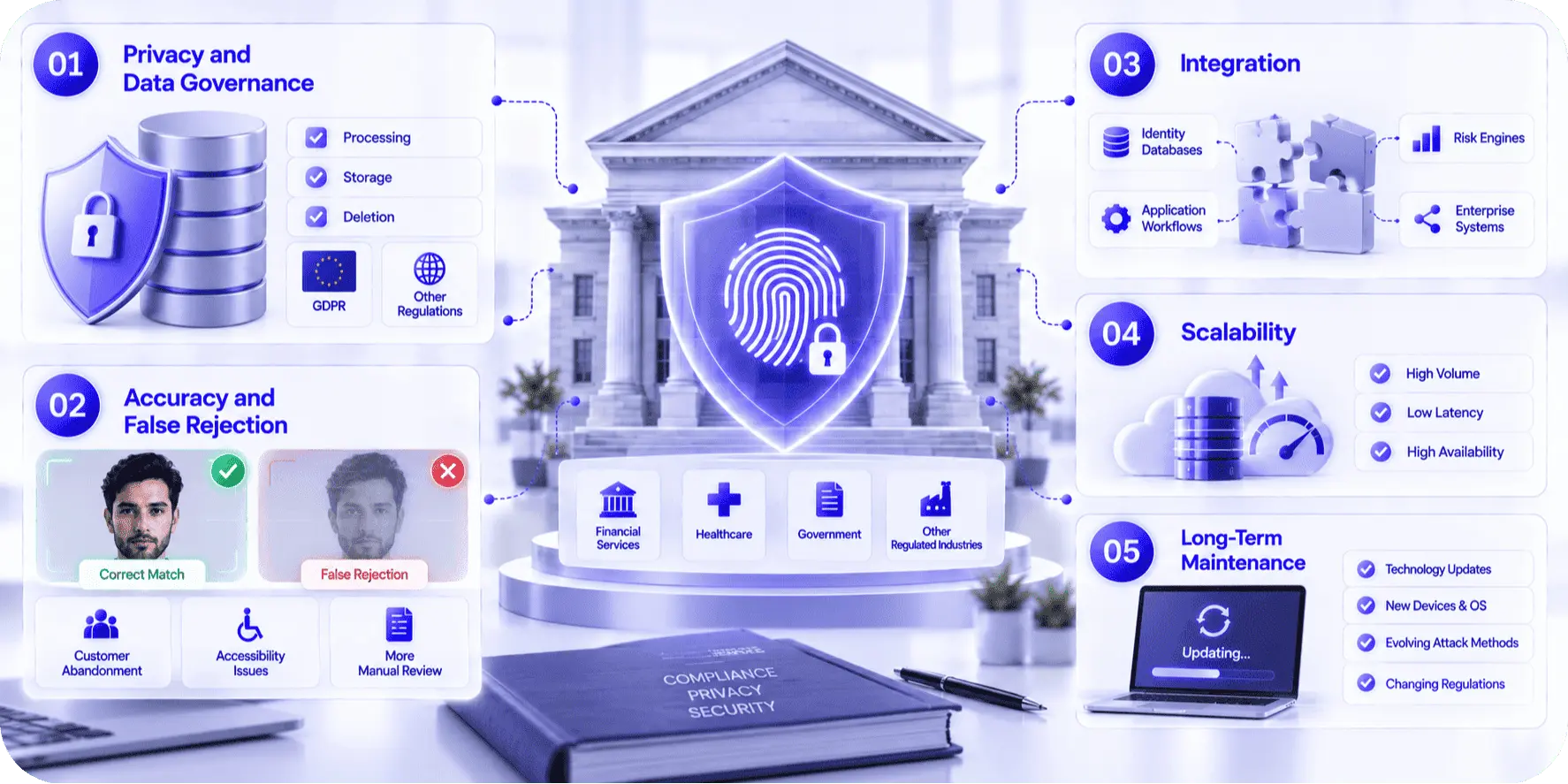
High-risk industries face several implementation challenges beyond the biometric algorithm itself.
Privacy and Data Governance
Organizations need to understand where biometric data is processed, stored, and deleted.
The GDPR framework is particularly relevant to organizations processing European personal data, while other jurisdictions may impose their own biometric or privacy requirements.
Accuracy and False Rejection
Security teams need to balance unauthorized acceptance with legitimate-user rejection.
A system that is too strict can create customer abandonment, accessibility issues, and unnecessary manual review.
Integration
Biometric systems need to work with identity databases, application workflows, risk engines, and other enterprise systems.
Scalability
High-risk industries may process large numbers of verification events, creating requirements around latency and availability.
Long-Term Maintenance
Biometric technology needs ongoing updates as devices, operating systems, attack methods, and security requirements evolve.
How Organizations Should Evaluate Liveness Technology
A high-risk organization should not select a liveness solution simply because the vendor describes it as “advanced” or “AI-powered.”
The evaluation should establish what the technology actually does.
Security and procurement teams should consider:
- Presentation attack coverage
- Testing methodology
- Independent evidence
- Supported devices
- Mobile and server environments
- Processing time
- False rejection behavior
- Privacy controls
- Deployment options
- Vendor support
- Long-term maintenance
A proof of concept should use representative users, devices, applications, and threat scenarios.
The goal is to determine how the technology behaves in the environment where it will actually be deployed.
SDK-Based Biometric Implementation
High-risk organizations often need control over how biometric functionality is integrated into their existing applications.
An SDK-based approach can allow internal engineering teams to control the customer journey while using specialized biometric components for face matching and liveness.
For example, a facial biometric SDK can provide the recognition layer while a separate liveness detection SDK supports presentation attack protection.
This architecture can be useful when the organization needs to connect biometric results with its own fraud engine, KYC process, identity database, or authentication logic.
For developers evaluating integration possibilities, the Recognito GitHub repository can provide additional implementation resources.
A practical evaluation should still be performed using the organization’s actual application architecture.
Building a Layered Verification Architecture
The strongest high-risk identity workflows typically combine multiple controls.
A customer might move through:
Identity Verification
Establish that the identity evidence appears legitimate.
Biometric Verification
Connect the person to the trusted identity.
Liveness Detection
Assess whether the biometric presentation appears genuine.
Risk Assessment
Combine biometric, device, behavioral, and identity signals.
Manual Review
Escalate ambiguous or high-risk cases.
This architecture reduces the chance that one failed control becomes a complete security failure.
Measuring Biometric Performance After Deployment
Production monitoring is essential.
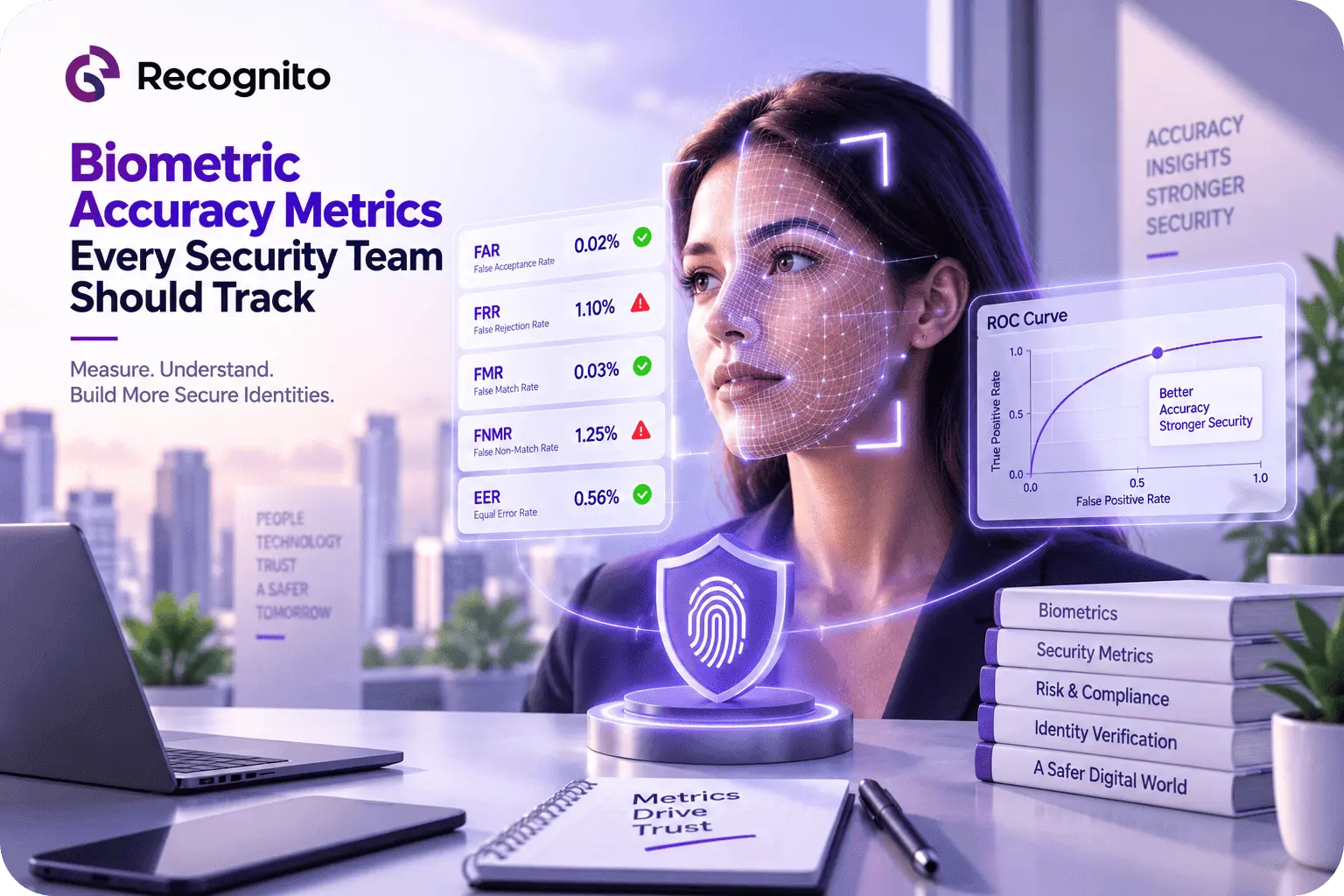
Organizations should track:
- Verification completion rate
- False rejection rate
- Liveness failure rate
- Processing time
- Manual review volume
- Fraud detection outcomes
- Device-specific failures
- Customer abandonment
These measures help security teams understand whether the solution is performing as expected.
A biometric system that works well in testing may behave differently after a new application release, device expansion, market entry, or workflow change.
Continuous monitoring allows the organization to identify those changes early.
How Recognito Fits Into High Risk Biometric Workflows
Recognito’s biometric technologies can be integrated into different stages of a high-assurance identity workflow.
The face recognition capability can support biometric matching, while liveness technology can add protection against presentation attacks.
Where document-based onboarding is required, ID document recognition can support the identity evidence stage.
Technical teams can also use the Face Biometric Playground to explore facial biometric functionality during evaluation.
These technologies should still be selected and configured according to the organization’s risk model, regulatory environment, technical architecture, and customer journey.
What High Risk Organizations Should Ask Before Deployment
Before taking a biometric system into production, teams should be able to answer:
- What identity risk is the system intended to address?
- Which presentation attacks are relevant?
- What liveness evidence is available?
- How will biometric data be handled?
- What happens when verification fails?
- Which users require additional verification?
- How will the system scale?
- How will production performance be monitored?
- How will SDK and security updates be managed?
- What manual review process exists for ambiguous cases?
These questions help move biometric deployment from a technology purchase toward a complete risk-management strategy.
Conclusion
Face recognition and liveness detection can provide valuable security layers for industries where identity assurance and fraud prevention are particularly important.
Banks, fintech companies, healthcare organizations, insurers, telecommunications providers, travel services, and public-sector organizations can use biometric verification to strengthen the connection between a claimed identity and the person presenting it.
But high-risk deployment requires more than installing a biometric component.
Organizations need to evaluate presentation attacks, privacy, accuracy, scalability, integration, user experience, compliance, and long-term maintenance. They also need clear workflows for failed verification, elevated risk, and manual review.
The strongest architecture combines identity verification, biometric matching, liveness detection, and risk-based decisioning rather than expecting one technology to solve every problem.
Organizations evaluating biometric technologies for regulated and high-risk environments can explore the broader capabilities available from Recognito as part of their identity and security strategy.
Frequently Asked Questions
Why is liveness detection important in high risk industries?
Liveness detection helps determine whether a biometric presentation appears to come from a genuine live person. This can add protection against photographs, replayed media, masks, and other presentation attacks.
Is biometric verification enough for regulated industries?
No. Biometrics are one part of a broader identity and security architecture. Organizations may also need document verification, risk assessment, fraud monitoring, privacy controls, compliance processes, and manual review.
Which industries benefit most from liveness detection?
Financial services, healthcare, insurance, telecommunications, travel, government services, and other environments involving high-value transactions, sensitive information, or significant identity risk can benefit from stronger biometric presentation protection.
Should organizations use active or passive liveness detection?
The appropriate approach depends on the application’s risk, customer experience, device environment, accessibility requirements, and performance expectations. Neither approach is universally best for every deployment.
What should organizations evaluate before deploying biometric verification?
They should evaluate recognition performance, liveness and presentation attack protection, privacy, integration, scalability, false rejection, user experience, regulatory requirements, vendor support, and long-term maintenance.