
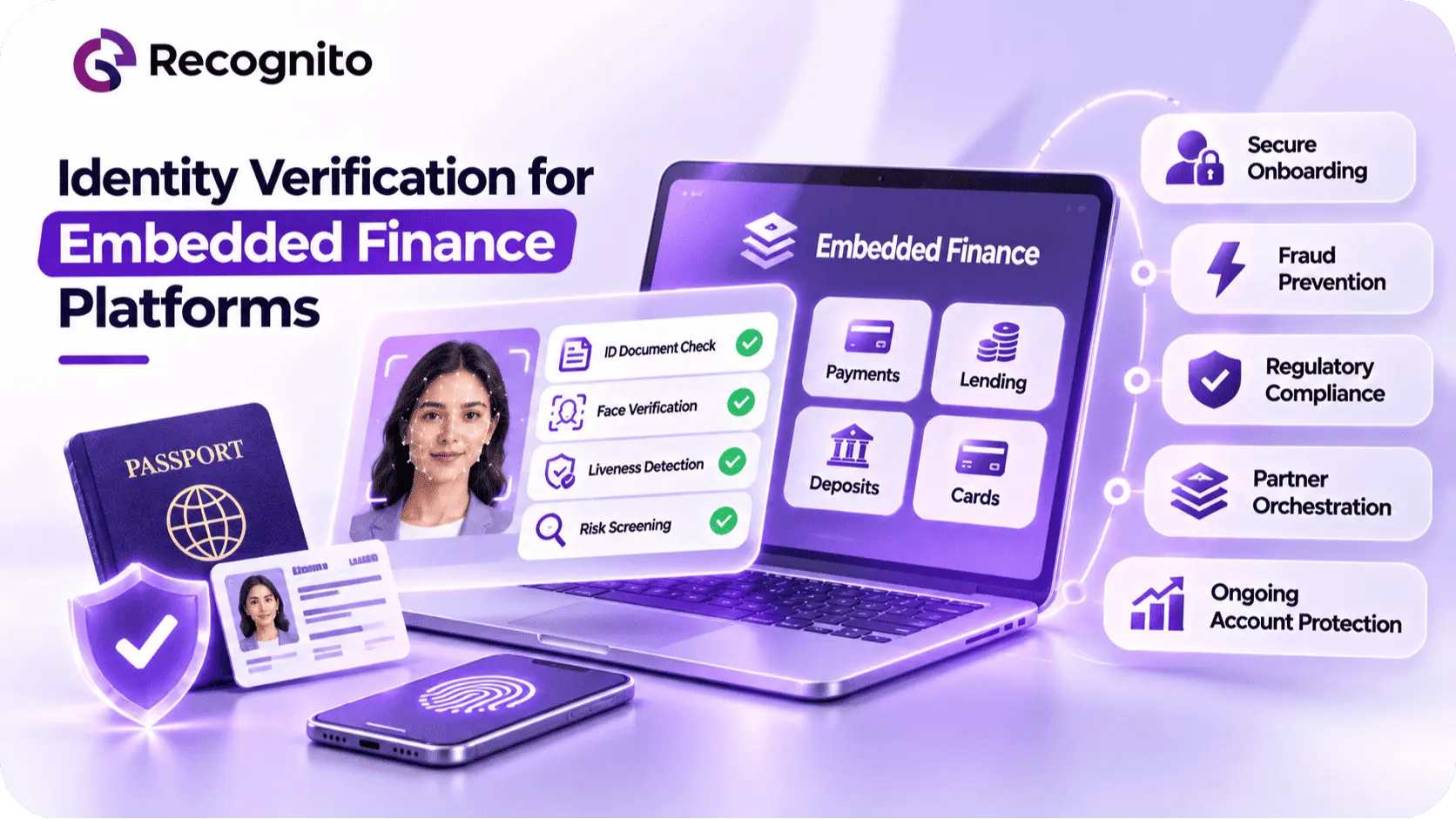
Embedded finance places payments, lending, deposits, and cards inside software customers already use. A loan application in a retail app or a business account in a marketplace may involve a platform, bank, lender, payment provider, and technology vendors.
The platform knows the customer in its own service context. The financial provider must establish whether that person or business is eligible for the product. Fragmented checks create gaps attackers can exploit, repeat work for customers, and uncertainty about who approved the application.
Identity verification must establish who is applying, whether they act personally or for a business, what assurance the product requires, and how risk will be managed afterwards. Each partner’s responsibility must be explicit.
Why embedded finance complicates identity verification
Embedded finance is a distribution model, not one regulatory category. A platform may own the interface while a bank provides an account, a lender makes credit decisions, or a payment provider processes transactions.
Each party sees only part of the customer. A marketplace’s verified email, address, purchase history, and device profile may support risk analysis, but do not automatically satisfy financial-sector checks. A provider may also need identity evidence, eligibility, ownership information, screening, records, and monitoring.
For businesses, verifying a director does not establish the legal entity, its beneficial owners, or the authority of each representative. The goal is not to repeat every check. It is to collect appropriate evidence, determine whether it can be reused, and share what each partner needs.
Set partner responsibilities before choosing technology
Agree responsibilities before selecting vendors. The platform, regulated provider, verification supplier, and operations teams should define who collects information, performs checks, approves customers, reviews exceptions, stores records, and escalates suspicious activity.
A platform may collect documents or call an API, while the financial institution retains responsibility for meeting its obligations. US banking agencies state that third-party use does not remove a bank’s legal responsibilities. Their interagency guidance on third-party relationships covers planning, due diligence, contracting, monitoring, and termination.
Document the operating model in a responsibility matrix:
- Platform: customer journey, initial data capture, status updates, and permitted data transfer.
- Financial provider: requirements, acceptance oversight, and required records.
- Vendors: defined checks such as document analysis, biometrics, screening, or device risk.
- Compliance and operations: exception review, authorised overrides, and alert investigation.
Also name the source of truth for key attributes. Partners must know where changes to ownership, contact details, or authorised representatives are recorded and whether they trigger new checks.
Match verification depth to the customer and product
One flow is rarely suitable for every service. A low-value payment feature, deposit account, and business loan carry different risks. Set evidence requirements according to the customer, product, jurisdiction, and intended activity. The eKYC requirements for fintech platforms provide related onboarding context.
Individuals applying for financial services
An individual journey may collect personal details, inspect an identity document, compare its portrait with a live capture, and validate details against permitted sources. Document checks can include classification, data extraction, expiry, field consistency, and authenticity indicators. Extracted data should be compared with applicant details and reliable records.
Face comparison checks whether a captured face resembles the document portrait or enrolled reference. Liveness detection assesses whether the capture appears to come from a live person rather than a printed image or replay. Neither proves identity on its own: a face match does not establish document authenticity, product eligibility, or future account security.
Businesses, owners, and authorised representatives
Business verification should identify the legal entity, confirm registration details, establish ownership and control, and verify authorised representatives. Ownership may pass through companies, trusts, or overseas entities, so a registry entry may not reveal the natural persons who ultimately control the business. Record the information source, date, ownership rationale, and manual decisions.
US rules require covered financial institutions to identify and verify beneficial owners of legal-entity customers within the rule’s scope and subject to exceptions. FinCEN’s CDD Rule FAQs explain these requirements. Other markets differ. The article on customer due diligence requirements for modern KYC programmes discusses the wider process.
Existing platform customers adding a financial product
Reuse earlier checks only when permitted and when the evidence meets the new provider’s standard. The recipient needs to know what was verified, by whom, when, and to what assurance level. A “verified” flag is insufficient: consider evidence age, document expiry, changed details, product risk, and the legal basis for sharing.

Design a layered identity workflow
Connect evidence collection, verification, risk assessment, decisions, and audit records in one coherent journey:
- Capture: collect required information and explain its use and sharing.
- Validate: inspect identity documents or business records, extract fields, and check consistency and authenticity.
- Bind person to evidence: where required, compare a live capture with the document and assess presentation attacks.
- Assess risk: use permitted data sources and applicable sanctions, PEP, fraud, or other screening.
- Decide: approve, decline, request more evidence, or route the case to a reviewer.
- Record: preserve evidence references, timestamps, vendor outputs, decisions, and later changes.
A central identity service or governed API layer keeps rules consistent across products. Separate vendor logic in each app creates uneven thresholds and makes changes harder. The article on identity verification APIs for digital customer onboarding explores the integration perspective.
API failure behaviour also needs deliberate design. Set timeouts, retry limits, idempotency rules, and safe handling for partial responses. A missing result should not silently become an approval. Depending on risk, the journey may pause, request another capture, use an approved alternative provider, or send the case for review. Log each attempt and decision so a later investigation can distinguish a genuine verification failure from an integration outage.
Preserve evidence, not just a pass or fail
A “pass” response rarely explains an approval. Keep an auditable record of the checks and decision, subject to privacy and retention rules. Relevant metadata may include document type, issuing country, expiry, biometric and liveness outcomes, screening status, rule version, timestamps, and reviewer actions. Restrict raw images and biometric templates more tightly than ordinary workflow data. Agreements should define who can access each data type, for what purpose, and for how long.
Extend fraud prevention beyond onboarding
Risk continues after approval. Criminals may use stolen details, synthetic identities, altered documents, account takeover, or mule accounts. Initial verification is a point-in-time assessment.
Platforms may observe unusual profile changes, new devices, or changed payout destinations. Use such signals only where lawful. Post-onboarding controls should include:
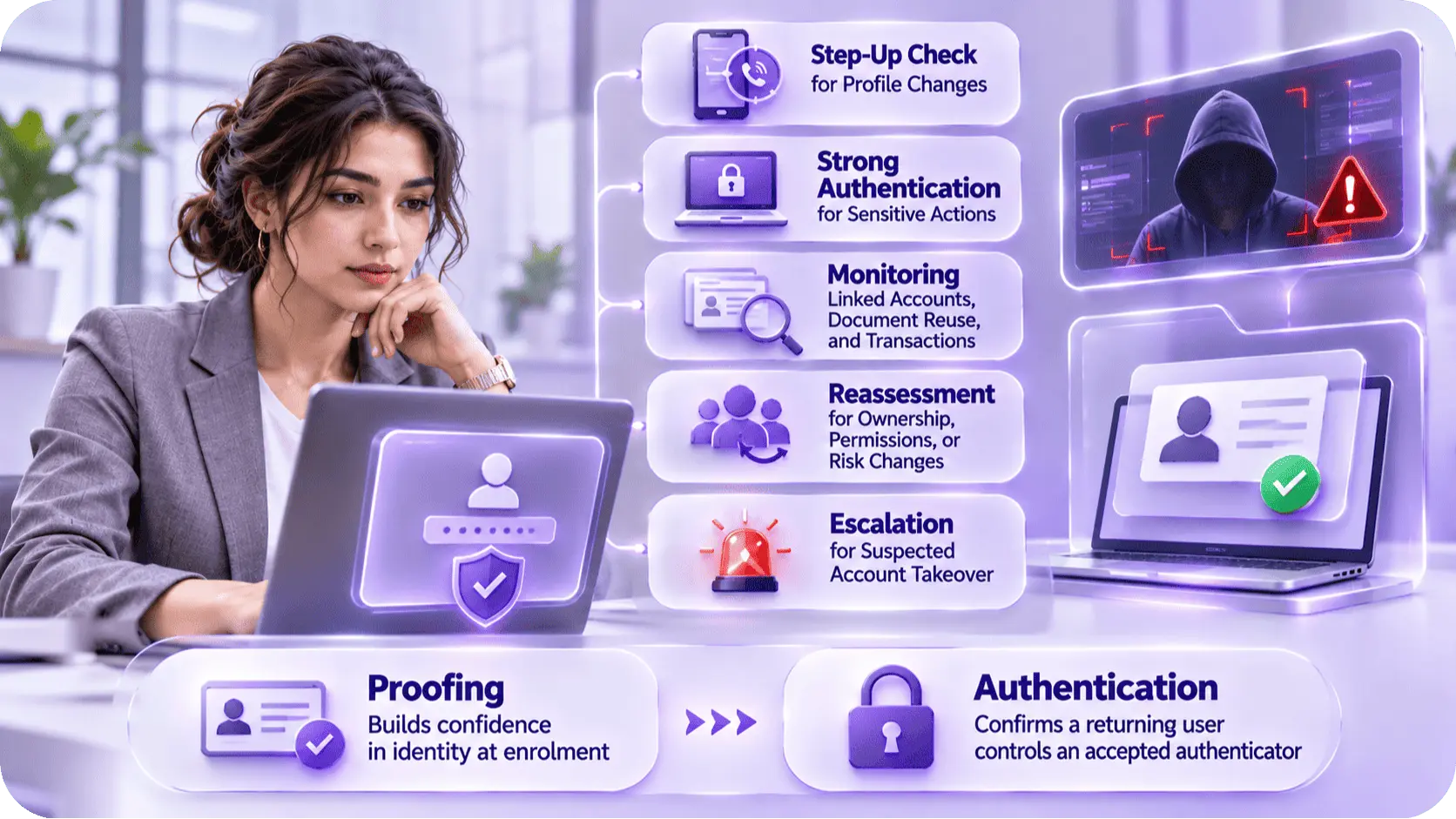
- Step-up checks for changes to phone numbers, recovery details, payout accounts, or representatives.
- Strong authentication for sensitive actions and unusual sessions.
- Monitoring for linked accounts, repeated document use, suspicious enrolment, and transactions.
- Reassessment when ownership, permissions, or risk indicators change.
- Clear escalation for suspected account takeover.
Proofing establishes confidence in identity during enrolment. Authentication checks whether a returning user controls an accepted authenticator. A selfie at onboarding should not be the only control for later logins or high-risk actions.
Choose biometric and document controls for specific jobs
Document recognition, face comparison, liveness, and authentication answer different questions; they are complementary controls.
| Control | Main question answered | Does not establish alone |
| Document recognition | Is the document readable, consistent, and plausibly authentic? | That the applicant is its rightful holder |
| Face comparison | Does the face resemble the document portrait or enrolled reference? | That the document or account is legitimate |
| Liveness detection | Does the capture appear to come from a live person rather than a spoof? | That the person has a legitimate claim to the identity |
| Registry and database checks | Do details match permitted records? | That the applicant controls the account or is low risk |
| Authentication | Is the returning user presenting an accepted authenticator? | That original identity proofing was correct |
An ID document recognition SDK may support document validation, while a face liveness detection SDK may assess presentation attacks. Test coverage, capture conditions, integration, and measured performance rather than relying on vendor labels. Evaluate false acceptance and rejection, spoof resistance, demographic performance, device compatibility, latency, uptime, accessibility, and support. Include poor lighting, low-end cameras, weak networks, and worn documents.
Align assurance with regulation, privacy, and partner oversight
There is no global checklist for embedded finance. Obligations depend on the product, customer, jurisdiction, and regulated entity. Use configurable rules and local legal review.
The FATF guidance on digital identity explains how reliable digital ID may support risk-based customer due diligence. In the EU, the EBA guidelines on remote customer onboarding set expectations for financial institutions under EU AML and data-protection frameworks. These are not universal rules.
The NIST SP 800-63-4 Digital Identity Guidelines cover proofing, authentication, and federation for US government digital services. They are not financial regulation, but their assurance concepts can help teams describe the confidence a journey should establish.
Build privacy into the design. Limit collection, define purpose and lawful basis, access, retention, deletion, cross-border transfers, and subprocessors. Biometrics require particular care because they cannot be replaced like passwords. Partner oversight should cover security, subcontractors, data locations, incident response, continuity, model updates, audit rights, service levels, evidence access, and exit arrangements. Where applicable, complete a data protection impact assessment before launch and define how applicants can challenge a failed check or request human review. Provide accessible alternatives where required, while ensuring that alternative routes do not create weaker fraud controls.
Measure the full onboarding system
Completion alone does not prove that controls work. Weak checks may approve more applicants but increase fraud; excessive checks may reject genuine customers. Track:
- Completion and abandonment: where applicants leave and why.
- Straight-through processing: cases resolved without review, alongside later fraud.
- Decision errors: false acceptance, false rejection, and review overturn rates.
- Fraud outcomes: account takeover, identity misuse, payment fraud, and losses.
- Operations: review queues, API latency, availability, missing evidence, and untraceable overrides.
Segment results by product, market, customer type, device, and method where lawful. Interpret changes carefully: fewer reviews may reflect permissive thresholds, while more rejections may reflect attacks, poor capture, or model changes. Product, fraud, compliance, and engineering teams should share the same view.
Avoid common implementation failures
- Treating a platform login as proof of financial identity.
- Relying on a face match without document and risk checks.
- Applying identical thresholds to low-risk payments and higher-risk lending or deposits.
- Leaving partner ownership of approvals, records, and alerts unclear.
- Ignoring changes to account control, ownership, or customer risk.
- Accepting vendor scores without evidence or version history.
Assign each control an owner, system response, and escalation route. More tools cannot fix unclear responsibilities.
A practical implementation sequence
- Map partners, customer types, jurisdictions, data flows, and decision ownership.
- Define evidence requirements for each product and customer type.
- Standardise API contracts, status handling, retries, audit events, and exceptions.
- Test genuine users, document variations, poor capture, accessibility, and simulated attacks.
- Pilot and tune conversion, decision errors, workload, fraud, and latency.
- Reassess when products, laws, vendors, threats, or partners change.
Developers can include the developer resources on GitHub in technical research, while validating integrations against current SDK documentation and security requirements.
Conclusion
Embedded finance needs identity controls that work across platform, financial institution, and vendor boundaries. A sound programme combines document and biometric checks with business due diligence, risk screening, authentication, monitoring, privacy, and clear decision ownership.
The best design applies proportionate assurance, keeps decisions traceable, shares only necessary data, and responds when risk changes. For teams building biometric workflows into financial products, Recognito offers SDK-focused technologies to assess as part of a wider strategy.