
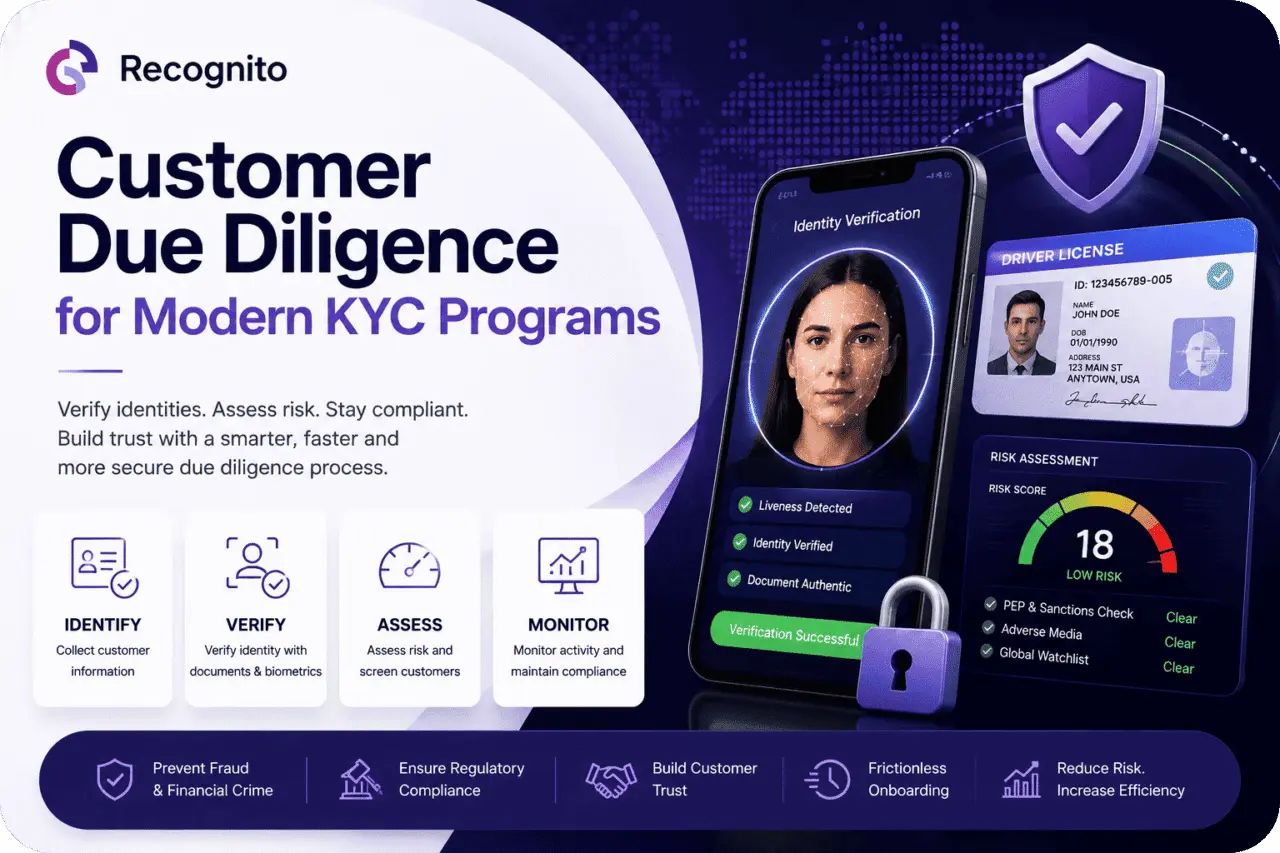
Customer Due Diligence (CDD) has become one of the most important pillars of modern KYC compliance and AML compliance programs. As financial institutions, fintech companies, cryptocurrency exchanges, lending platforms, and regulated businesses increasingly rely on digital onboarding, verifying customer identities accurately is no longer optional.
Regulators expect organizations to know who their customers are, understand the risks they present, and monitor their activities throughout the customer lifecycle. At the same time, customers demand a fast and seamless onboarding experience.
Balancing security, compliance, and customer experience requires a strong customer due diligence framework supported by advanced identity verification technologies.
Organizations that fail to implement effective due diligence procedures expose themselves to fraud, money laundering risks, regulatory penalties, and reputational damage.
What Is Customer Due Diligence?
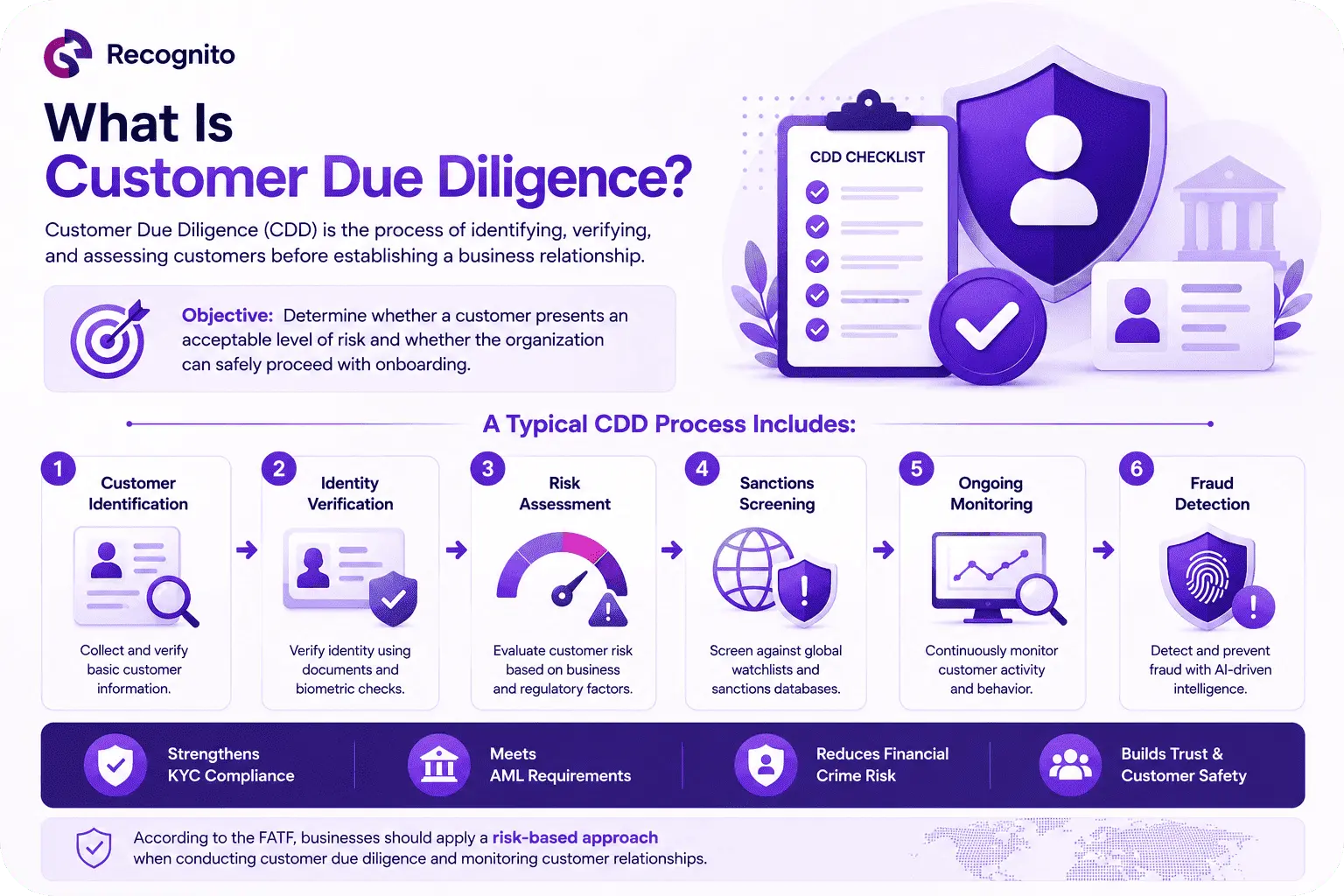
Customer Due Diligence is the process of identifying, verifying, and assessing customers before establishing a business relationship.
The objective is to determine whether a customer presents an acceptable level of risk and whether the organization can safely proceed with onboarding.
A typical CDD process includes:
- Customer identification
- Identity verification
- Risk assessment
- Sanctions screening
- Ongoing monitoring
- Fraud detection
CDD forms the foundation of effective KYC compliance and helps organizations meet broader AML compliance requirements.
According to the Financial Action Task Force (FATF), businesses should apply a risk-based approach when conducting customer due diligence and monitoring customer relationships.
Why Customer Due Diligence Matters
Financial crime has become increasingly sophisticated.
Fraudsters now use synthetic identities, stolen credentials, forged documents, deepfake attacks, and organized fraud networks to bypass traditional onboarding controls.
Many of these threats begin during customer onboarding.
For example, synthetic identity fraud has become one of the fastest-growing financial crime threats globally. Criminals combine genuine and fabricated information to create entirely new identities capable of bypassing weak onboarding controls. Organizations looking to address this challenge should review our guide on How Financial Institutions Detect Synthetic Identity Fraud, which explains how biometric verification and AI-powered fraud detection work together to identify high-risk applicants.
Strong customer due diligence programs help organizations:
- Strengthen onboarding compliance
- Support AML compliance obligations
- Improve identity verification accuracy
- Reduce fraud losses
- Enhance regulatory readiness
- Build customer trust
Core Components of Customer Due Diligence
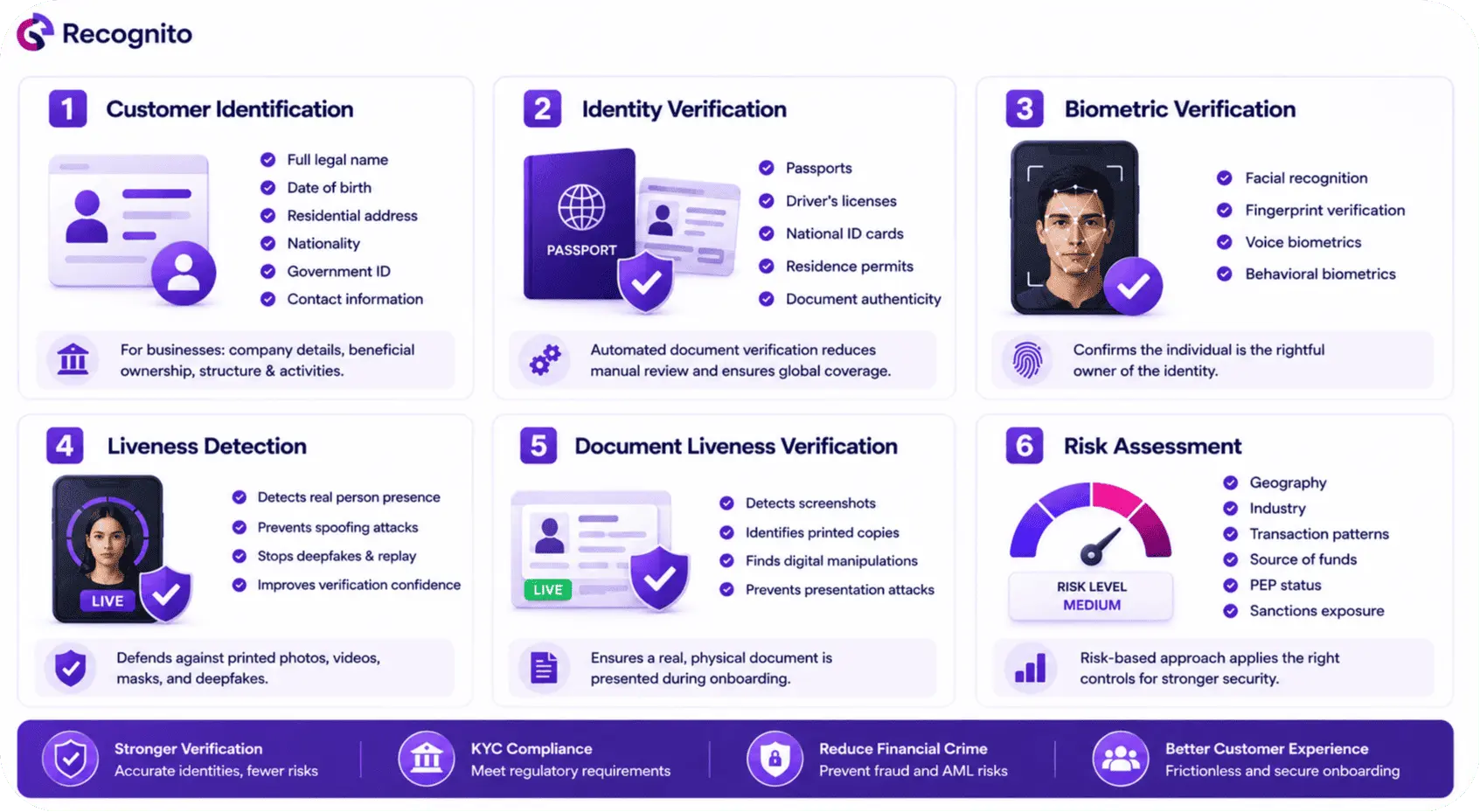
1. Customer Identification
Every customer due diligence process begins with collecting identifying information from the applicant.
Organizations typically gather:
- Full legal name
- Date of birth
- Residential address
- Nationality
- Government-issued identification
- Contact information
For business customers, additional information may include:
- Company registration details
- Beneficial ownership records
- Corporate structure
- Business activities
This information forms the foundation for identity verification and risk assessment.
However, collecting information alone is not enough. Organizations must verify that the information provided is genuine.
2. Identity Verification
Identity verification is one of the most critical components of customer due diligence.
The goal is to confirm that the customer is who they claim to be and that supporting documents are authentic.
Modern verification systems commonly analyze:
- Passports
- Driver’s licenses
- National ID cards
- Residence permits
Organizations increasingly automate this process using solutions such as Recognito’s ID Document Recognition SDK, which validates identity documents from numerous jurisdictions while reducing manual review workloads.
Many onboarding teams also struggle to understand the difference between validating an identity and confirming ownership of that identity. Our article on Identity Proofing vs Identity Verification Explained explores how these two processes work together to create stronger onboarding compliance programs.
3. Biometric Verification
A valid document does not necessarily prove that the person presenting it is the rightful owner.
This is where biometric verification becomes essential.
Biometric verification compares a live biometric sample against a trusted identity source.
Common biometric verification methods include:
- Facial recognition
- Fingerprint verification
- Voice biometrics
- Behavioral biometrics
Facial recognition has become one of the most widely adopted technologies for digital onboarding. Organizations increasingly use Recognito’s Face Recognition SDK to verify customer identities and strengthen KYC compliance while maintaining a smooth customer experience.
Independent evaluations such as the NIST Face Recognition Vendor Test (FRVT) continue to demonstrate the growing accuracy of modern biometric systems.
4. Liveness Detection
Biometric verification alone is no longer sufficient.
Fraudsters increasingly attempt to bypass onboarding systems using:
- Printed photographs
- Mobile device screens
- Video replay attacks
- Deepfake videos
- 3D masks
Liveness detection helps determine whether a real person is physically present during the verification process.
Recognito’s Face Liveness Detection SDK helps organizations defend against spoofing attacks while improving confidence in onboarding decisions.
For a deeper understanding of modern liveness technologies, read our guide on Active vs Passive Liveness Detection.
Businesses concerned about AI-generated fraud should also review Deepfake Attack Prevention Strategies to understand how emerging threats are affecting identity verification systems.
5. Document Liveness Verification
Fraudsters often submit screenshots, photocopies, or digitally manipulated identity documents during onboarding.
Traditional document verification systems may fail to identify these attacks.
Document liveness verification determines whether an actual physical document is being presented.
This technology helps detect:
- Screenshots
- Printed reproductions
- Digital manipulations
- Presentation attacks
Organizations increasingly deploy Recognito’s ID Document Liveness Detection SDK to strengthen onboarding compliance and reduce document fraud.
For additional insights, see our article on Why Document Liveness Detection Is Essential for KYC Verification.
6. Risk Assessment
Not every customer presents the same level of risk.
Effective customer due diligence programs classify customers based on factors such as:
- Geography
- Industry
- Transaction patterns
- Source of funds
- Politically exposed person (PEP) status
- Sanctions exposure
Risk-based onboarding enables organizations to apply additional controls only when necessary, improving both security and customer experience.
Standard Due Diligence vs Enhanced Due Diligence
Customer due diligence generally falls into two categories.
Standard Due Diligence
Standard Due Diligence is applied to customers with relatively low-risk profiles.
This typically includes:
- Identity verification
- Document authentication
- Customer screening
- Basic risk assessment
Enhanced Due Diligence
Enhanced Due Diligence (EDD) applies to higher-risk customers.
EDD may include:
- Source of wealth verification
- Source of funds validation
- Additional identity checks
- Continuous monitoring
- Manual compliance reviews
Enhanced Due Diligence is commonly used for:
- Politically exposed persons
- International customers
- High-risk industries
- Cryptocurrency businesses
- High-value accounts
Common Customer Due Diligence Challenges
1. Synthetic Identity Fraud
Synthetic identities combine genuine and fabricated information to create fraudulent customer profiles.
Organizations can reduce exposure through robust identity verification, biometric verification, and fraud analytics.
2. Deepfake Attacks
AI-generated deepfakes continue to become more realistic.
Modern fraud prevention programs increasingly rely on liveness detection and behavioral analysis to identify these attacks.
3. Regulatory Complexity
Businesses operating across multiple regions face complex compliance requirements.
Organizations must align their due diligence procedures with regulations such as the General Data Protection Regulation (GDPR) and local AML compliance requirements.
4. Customer Experience Expectations
Consumers increasingly expect onboarding processes to be completed within minutes.
Organizations must balance compliance obligations with usability to avoid unnecessary abandonment rates.
Best Practices for Modern Customer Due Diligence Programs
Organizations looking to strengthen customer due diligence should focus on several key areas.
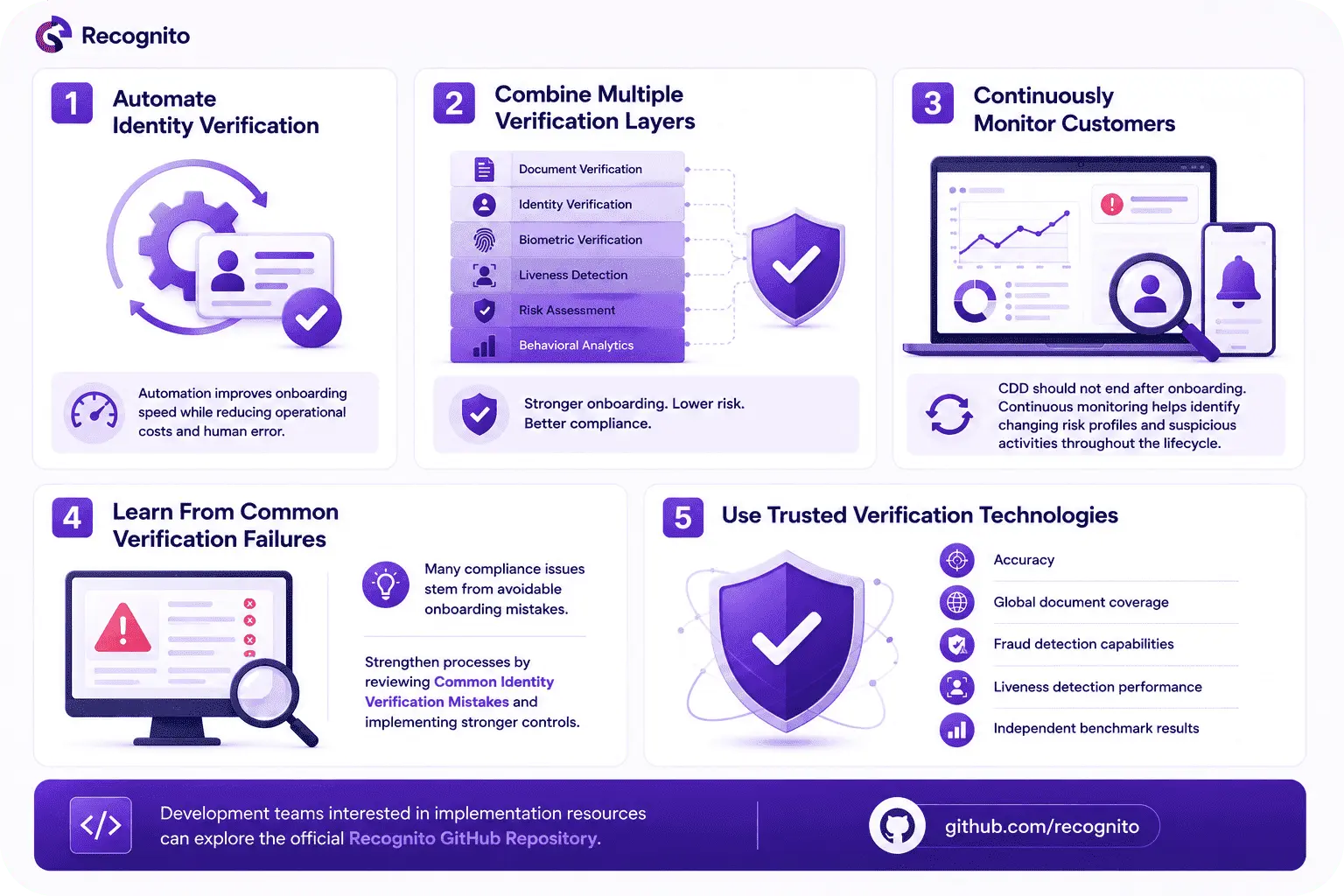
1. Automate Identity Verification
Automation improves onboarding speed while reducing operational costs and human error.
2. Combine Multiple Verification Layers
The strongest onboarding programs combine:
- Document verification
- Identity verification
- Biometric verification
- Liveness detection
- Risk assessment
- Behavioral analytics
3. Continuously Monitor Customers
CDD should not end after onboarding.
Continuous monitoring helps identify changing risk profiles and suspicious activities throughout the customer lifecycle.
4. Learn From Common Verification Failures
Many compliance issues stem from avoidable onboarding mistakes. Organizations can strengthen processes by reviewing Common Identity Verification Mistakes and implementing stronger controls.
5. Use Trusted Verification Technologies
Organizations should evaluate providers based on:
- Accuracy
- Global document coverage
- Fraud detection capabilities
- Liveness detection performance
- Independent benchmark results
Development teams interested in implementation resources can explore the official Recognito GitHub Repository.
The Future of Customer Due Diligence
Customer due diligence continues to evolve alongside fraud techniques and regulatory expectations.
Emerging trends include:
- Continuous identity verification
- Passive liveness detection
- Behavioral biometrics
- AI-powered fraud scoring
- Real-time risk intelligence
- Automated AML monitoring
Organizations investing in these technologies today will be better positioned to address future fraud and compliance challenges.
Conclusion
Customer due diligence is one of the most important components of modern KYC compliance and AML compliance programs. Effective CDD enables organizations to verify customer identities, assess risk levels, prevent fraud, and maintain regulatory compliance without creating unnecessary onboarding friction.
By combining identity verification, biometric verification, document authentication, liveness detection, and ongoing monitoring, organizations can build stronger onboarding compliance frameworks while improving customer trust and operational efficiency.
As digital onboarding continues to expand across industries, technologies such as Recognito identity verification and biometric solutions provide the foundation for secure, scalable, and compliant customer due diligence programs.
Frequently Asked Questions
What is customer due diligence?
Customer due diligence is the process of identifying, verifying, and assessing customers before establishing a business relationship to reduce fraud and meet regulatory requirements.
How does customer due diligence support KYC compliance?
CDD helps organizations verify customer identities, assess risk levels, and maintain accurate records required for KYC compliance programs.
What is the difference between CDD and AML?
CDD is a process used within broader AML compliance programs. AML includes monitoring, sanctions screening, suspicious activity reporting, and other controls designed to prevent financial crime.
Why is identity verification important for customer due diligence?
Identity verification helps confirm that customers are genuine and reduces the risk of fraud, impersonation, and regulatory violations.
When is Enhanced Due Diligence required?
Enhanced Due Diligence is typically required for high-risk customers, politically exposed persons, high-risk industries, and customers operating in higher-risk jurisdictions.
How does biometric verification strengthen customer due diligence?
Biometric verification confirms that the person presenting an identity document is its legitimate owner, helping organizations prevent fraud and improve onboarding security.