
Face recognition has become a practical identity tool for digital onboarding, authentication, access control, and fraud prevention. But a face match alone does not answer one of the most important security questions: Is the person actually present, or is the system looking at a presentation of their face?
That distinction is at the center of face recognition liveness detection.
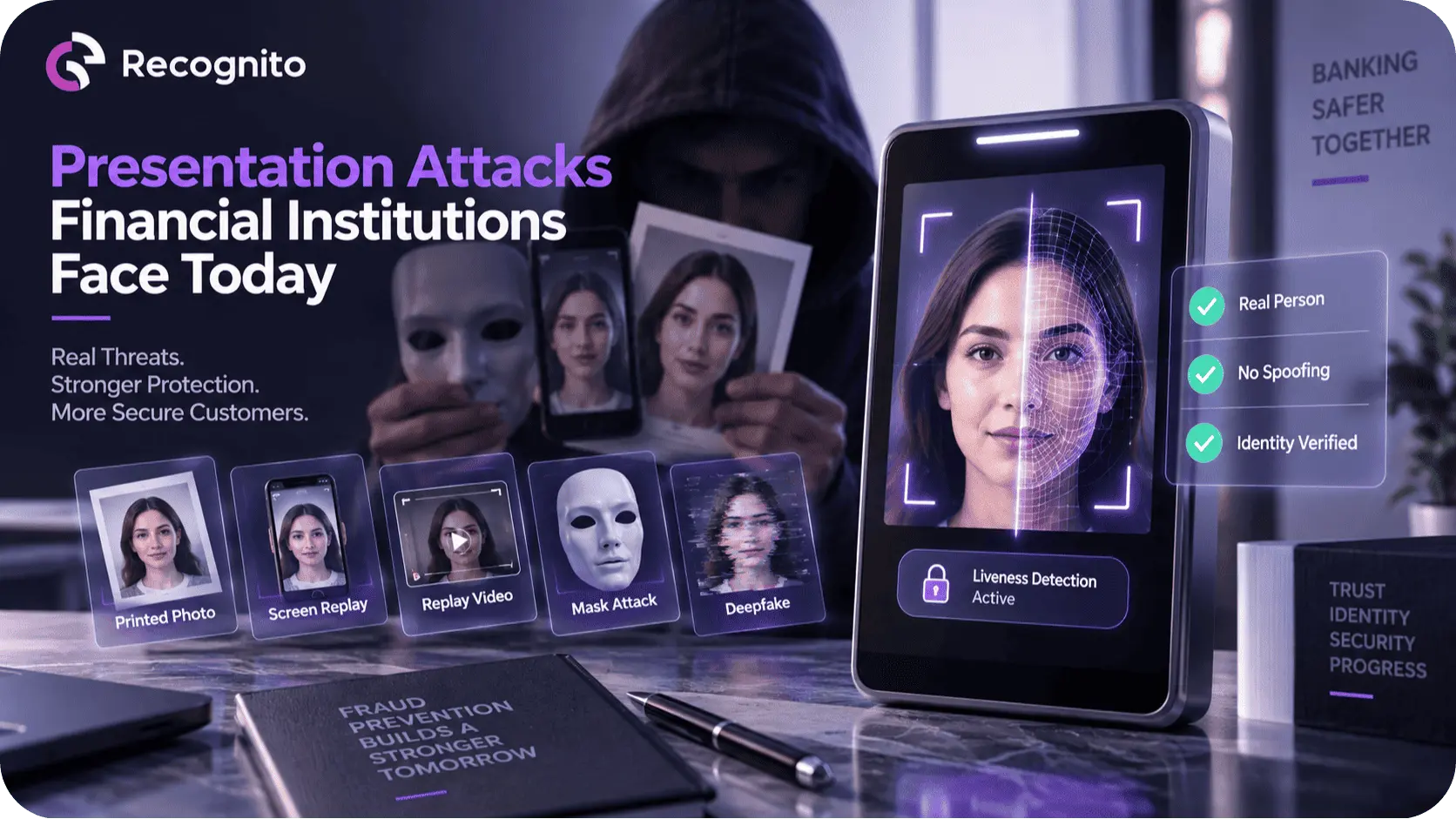
A photograph, replayed video, realistic mask, 3D model, manipulated media, or injected camera stream can potentially make a biometric system analyze something that looks like a genuine face without representing a live interaction. Liveness detection, more broadly described within the biometric security field as presentation attack detection, is designed to identify such attempts at the point of biometric capture.
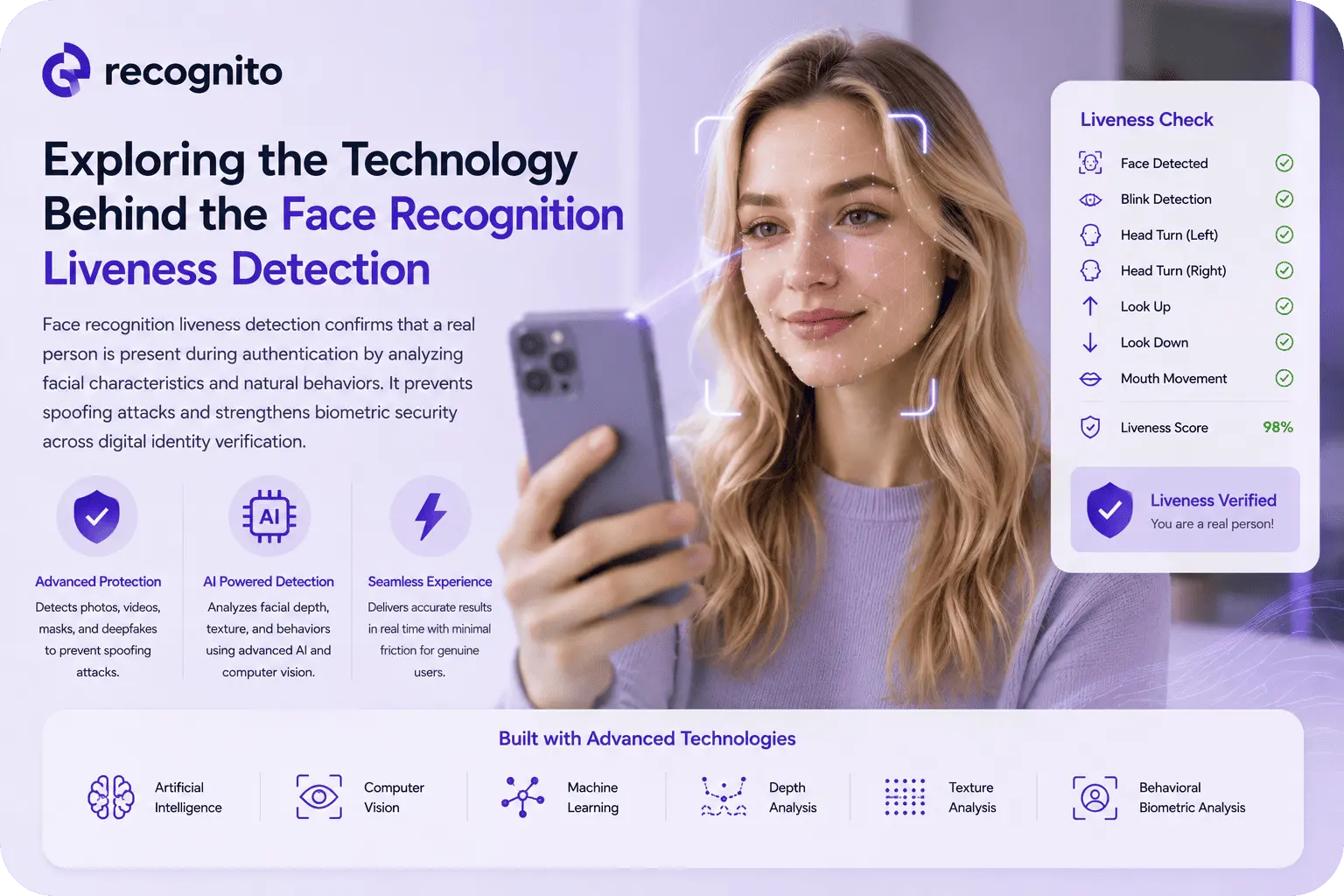
The technology behind it combines computer vision, image analysis, machine learning, temporal information, capture-quality assessment, and increasingly sophisticated attack detection. Understanding how these pieces work is essential when evaluating a facial biometric system for a real production environment.
The Security Problem Behind Face Liveness Detection
Traditional facial recognition is primarily concerned with similarity.
A camera captures a face, an algorithm extracts representative features, and the system compares those features against a reference. When the similarity score exceeds a selected threshold, the system may regard the faces as belonging to the same person.
An attacker does not necessarily have to defeat that matching algorithm directly.
Instead, the attacker can attempt to manipulate what the camera captures in the first place.
For example, a fraudster could hold a photograph in front of the camera. A more sophisticated attempt could use a replayed video showing the genuine person’s face. More advanced presentation attacks may involve masks, printed artifacts, deepfake content, or sophisticated digital injection techniques.
NIST defines Presentation Attack Detection as an automated determination of a presentation attack. Its terminology also recognizes liveness detection as a subset of presentation attack determination methods that can analyze anatomical characteristics or voluntary and involuntary reactions to determine whether biometric characteristics are being captured from a living subject present at the point of capture.
That gives liveness detection a different job from face matching.
Face recognition asks: Does this face correspond to the reference?
Liveness detection asks: Is the biometric input being presented by a live subject?
A secure identity workflow often needs both answers.
How Face Liveness Detection Fits Into the Biometric Pipeline
Liveness detection typically sits close to the capture stage.
A simplified facial verification pipeline looks like this:
Camera capture → image quality assessment → face detection → liveness analysis → face representation → face matching → decision
The exact sequence can vary between implementations. Some systems perform quality and liveness analysis together, while others run multiple checks in parallel.
The purpose of placing liveness close to capture is important. If an attacker can manipulate the biometric input before the security system analyzes it, a highly accurate face matcher may still produce the wrong security outcome.
A useful way to understand the architecture is to separate four functions.
Face detection
The system first determines where a face is located within the camera image. This establishes the region that subsequent biometric processing should analyze.
Image and capture quality
The system needs enough information to make a meaningful assessment. Blur, extreme lighting, motion, poor framing, occlusion, and other conditions can reduce the reliability of both recognition and liveness decisions.
Liveness or presentation-attack analysis
The system examines the captured biometric input for characteristics that distinguish a genuine live interaction from known forms of presentation attack.
Face matching
Only after sufficient biometric evidence is available does the system determine whether the face corresponds to the claimed or enrolled identity.
Keeping these functions conceptually separate helps security teams understand where a failure occurred instead of treating the entire workflow as one unexplained “verification score.”
Passive vs Active Liveness Detection
One of the most important design choices is whether the liveness system uses active challenges, passive analysis, or a combination.
Active liveness detection
Active methods ask the user to perform a specific action.
The application might instruct someone to turn their head, blink, move closer to the camera, or follow another prompted sequence.
The underlying assumption is that a live person can respond to an unpredictable or guided interaction more naturally than a static artifact.
Active techniques can provide useful additional evidence, but they introduce friction. A poorly designed challenge can confuse legitimate users, slow onboarding, and create accessibility problems.
A deeper comparison of the two approaches is covered in active vs passive liveness detection.
Passive liveness detection
Passive methods attempt to analyze the captured biometric input without requiring the customer to perform a deliberate action.
This can make the experience significantly smoother. Instead of asking the user to complete a challenge, the system analyzes visual and other available signals during normal capture.
Modern passive systems use machine-learning models trained to distinguish genuine facial presentations from attack artifacts. The challenge is that attackers also improve their techniques, which means the models must be evaluated against relevant attack types rather than only normal user images.
NIST has specifically evaluated passive software-based face presentation attack detection, including attacks presented through conventional 2D imagery.
The Role of Machine Learning
Modern liveness detection is heavily dependent on machine learning because many useful signals are difficult to capture with simple deterministic rules.
A photograph and a live face may contain similar high-level facial features. The security difference can instead appear in subtle characteristics such as texture, reflectance, edge behavior, spatial inconsistencies, motion patterns, or other properties that a trained model can learn.
A liveness model can therefore be trained using examples of both genuine presentations and attack presentations.
During inference, the model receives the captured input and generates a score or classification representing how consistent that input is with a live presentation.
The challenge is generalization.
Training against photographs does not automatically make a system resilient to every new attack. A model that performs well against printed photographs may behave differently against replayed video, realistic masks, digitally injected content, or previously unseen attack instruments.
That is why the quality and diversity of attack data matter as much as model architecture.
The broader technology behind anti-spoofing is explored in deep learning for face anti-spoofing, particularly around the role of deep-learning techniques in recognizing presentation attacks.
What Visual Signals Can Reveal
A liveness system may analyze several classes of information rather than relying on one visual feature.
Texture and surface characteristics
A printed photograph, screen display, or artificial facial surface can produce different visual characteristics from real human skin.
The differences may be subtle and dependent on the capture hardware, viewing angle, lighting, and attack instrument.
Motion
A real face changes naturally as the person moves, speaks, blinks, or adjusts their position.
Motion information can provide additional evidence that the system is observing a live subject rather than a static artifact. However, replayed video also contains motion, so motion alone is not sufficient protection.
Depth and three-dimensional structure
Some systems can use information related to the three-dimensional structure of a face.
A flat photograph and a real face do not have identical geometric properties, while more sophisticated attacks can attempt to reproduce those properties using masks or three-dimensional representations.
Temporal behavior
A sequence of frames can reveal information that a single image cannot.
Instead of examining only one captured frame, the system can analyze how visual characteristics change over time. This helps distinguish genuine interactions from certain static or replay-based attacks.
Capture-source characteristics
In some architectures, the system can also consider characteristics associated with the capture pipeline itself.
This becomes increasingly important as attackers move from physical presentation attacks toward digital injection, where manipulated content may be introduced into the processing pipeline before the biometric model receives it.
Why a Single Liveness Technique Is Not Enough
A common misconception is that liveness detection is one algorithm performing one test.
In reality, effective systems typically combine multiple signals or models.
A photograph attack is different from a replay attack. A realistic mask is different from synthetic media. A digital injection attack can bypass assumptions that apply to a physical object placed in front of a camera.
ISO/IEC 30107 addresses biometric presentation attack detection as a structured field rather than prescribing one universal anti-spoofing algorithm. ISO/IEC 30107-1:2023 establishes the framework, terminology, and concepts used to specify and evaluate PAD methods.
Its companion ISO/IEC 30107-3:2023 provides principles and methods for assessing PAD mechanisms, reporting test results, and classifying known attack types.
The important implication is that organizations should evaluate attack coverage, not simply ask whether a vendor “has liveness.”
Liveness Detection and Deepfake Attacks
Deepfake technology makes the problem more complicated because sophisticated attacks can manipulate facial imagery without relying on a physical photograph or mask.
A remote attacker could attempt to replay or inject generated video designed to resemble a genuine person. That changes the question from “Can the system detect a printed image?” to “Can it distinguish authentic biometric capture from increasingly realistic synthetic input?”
Deepfake defense therefore needs to be considered alongside presentation-attack detection rather than as an unrelated security feature.
For a broader look at the threat landscape, deepfake attack prevention strategies examines how organizations can build layered defenses against manipulated facial media.
The architecture matters because a liveness model can only make decisions based on the evidence it receives. If synthetic content enters through a compromised capture or injection path, the system needs controls that address that attack surface as well.
Liveness Score vs Final Verification Decision
Another important concept is the distinction between a liveness score and a final identity decision.
A system may produce:
- a face-quality assessment
- a liveness score
- a face-matching score
- a document-verification result
- additional fraud or risk signals
These outputs should not automatically be treated as equivalent.
A high liveness score may indicate that the input appears genuine, but it does not prove that the person is the correct account holder.
Likewise, a strong face match does not prove that a live human produced the input.
A secure decision engine needs to combine these signals according to the application’s risk requirements.
For example, a digital onboarding flow might require:
Live person + acceptable image quality + genuine identity document + sufficient face match + acceptable fraud risk
That is fundamentally stronger than relying on facial similarity alone.
How Thresholds Affect Security
Liveness detection typically involves a decision threshold.
A lower threshold may allow more genuine users to pass but potentially increase acceptance of attacks. A stricter threshold can improve resistance to certain presentation attacks while also increasing false rejections.
The right threshold therefore depends on:
- the application’s risk level
- the expected attack environment
- customer experience requirements
- device and camera characteristics
- supported population
- fallback verification mechanisms
NIST’s current digital identity guidance requires presentation attack detection for facial recognition in the contexts covered by its authentication requirements and specifies performance considerations for biometric systems.
That illustrates a broader principle: biometric security has to be calibrated to its deployment context rather than judged using a single universal score.
Testing Liveness Detection in the Real World
A vendor demonstration can show that a system successfully rejects a basic printed photograph. That tells you very little about how it will behave against the complete threat model.
Testing should include representative attack types and realistic capture conditions.
A serious evaluation should examine:
- printed photographs
- screen-based replay
- video replay
- realistic masks where relevant
- manipulated or synthetic facial media
- camera and device variation
- low-light conditions
- motion and blur
- different user populations
- network and application failures
- potential injection paths
The testing methodology should also distinguish between attack detection performance and ordinary biometric accuracy.
FIDO’s biometric certification requirements include requirements and test procedures covering biometric performance and presentation attack detection. Independent assessment can therefore provide more meaningful assurance than a vendor’s unsupported claim that its liveness system is “AI-powered.”
Integrating Liveness Into a Production Application
The technology is only effective when implementation preserves its security assumptions.
For example, a mobile application may capture camera frames locally before sending them to a server for analysis. Developers need to understand how those frames are obtained, transferred, protected, and processed.
Real-time feedback is also important. If the user’s face is poorly positioned or image quality is insufficient, immediate guidance can prevent repeated failures.
For teams building biometric workflows, a face liveness SDK can provide liveness capabilities designed for integration into applications across supported server and mobile environments.
The engineering process should test more than the successful path. Teams should deliberately test:
- camera permission failures
- weak network conditions
- interrupted sessions
- repeated retries
- unsupported devices
- poor lighting
- attack attempts
- timeout behavior
- fallback verification
Security teams should also verify that a liveness result cannot simply be replaced or manipulated by a client-side application before the final verification decision is made.
On-Device, Server-Side, and Hybrid Architectures
Where liveness analysis runs affects the system’s security and operational characteristics.
On-device processing
Running analysis locally can reduce network dependency and potentially reduce the amount of raw biometric data transmitted elsewhere.
However, mobile environments require careful consideration of device integrity and application security.
Server-side processing
A server-side system can centralize model deployment and updates, making it easier to manage algorithms and infrastructure.
The trade-off is greater dependence on connectivity and the transmission of sensitive biometric information.
Hybrid processing
A hybrid architecture can distribute tasks between the device and backend services. For example, initial capture-quality and processing steps may happen locally while higher-level verification occurs on a protected backend.
There is no universally correct architecture. The right choice depends on privacy requirements, threat model, latency, device capabilities, and regulatory constraints.
Privacy Is Part of the Technical Design
Facial liveness detection operates on biometric information, so security cannot be separated from data governance.
Organizations should determine what data is captured, whether raw images or video are retained, where processing occurs, how biometric templates are protected, who can access them, and when information is deleted.
Data minimization is particularly important. A system should not retain more biometric information than the business actually needs.
Privacy also affects architecture. An organization with strict requirements around data residency or processing location may prefer an on-premise or on-device deployment rather than sending all biometric media to a third-party cloud environment.
These decisions should be established during solution design instead of being treated as post-deployment policy questions.
How to Evaluate a Face Liveness Solution
A practical evaluation should consider the complete biometric workflow, not just the liveness model.
| Evaluation area | Questions to ask | Why it matters |
| Attack coverage | Which presentation attacks have been tested? | Shows the scope of protection |
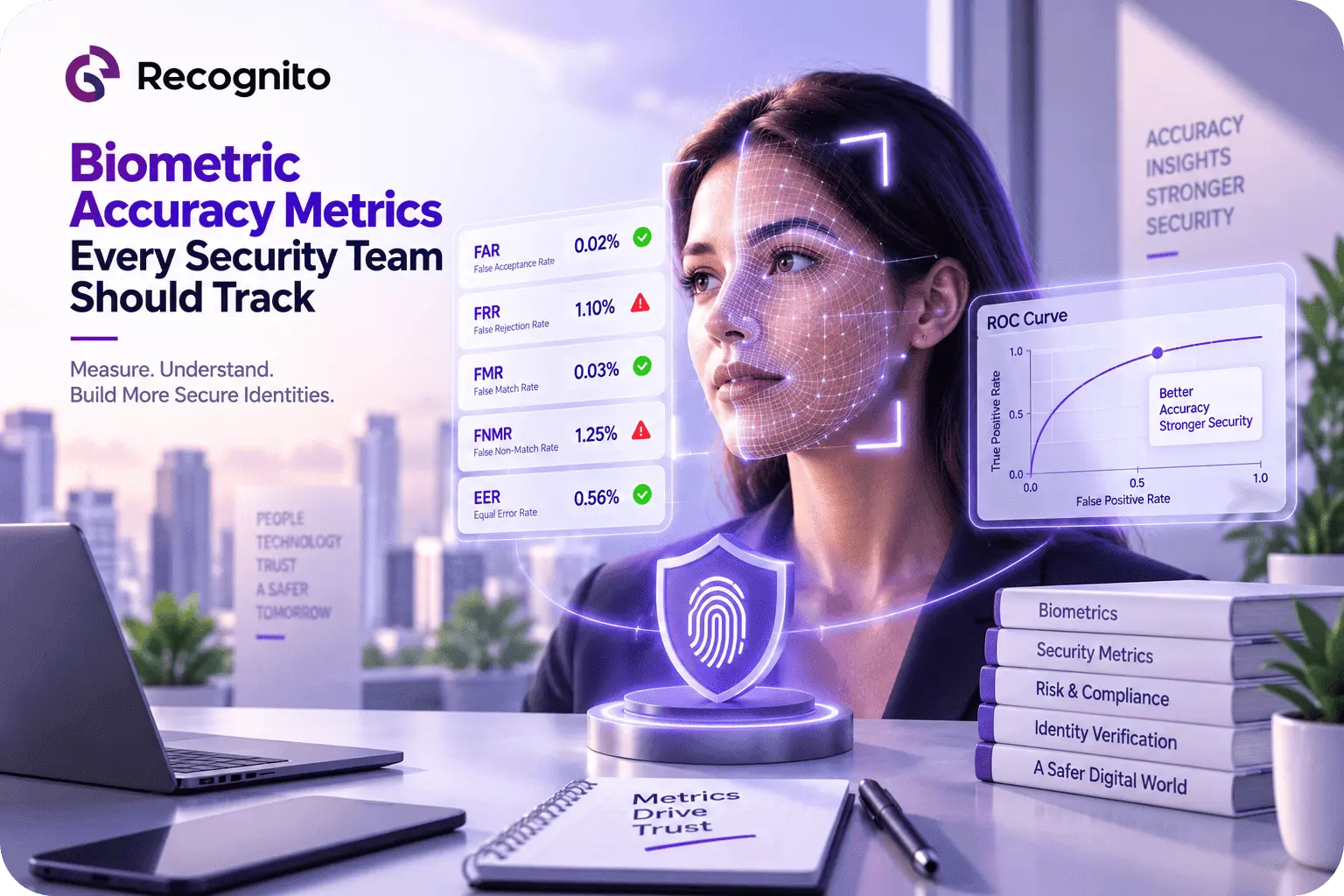
| Model performance | What are the measured error rates? | Provides objective performance evidence |
| Capture environment | Which cameras, devices, and conditions were tested? | Indicates real-world reliability |
| Deepfake resilience | Has synthetic or manipulated media been evaluated? | Addresses modern remote attack techniques |
| Integration | How are liveness results exposed to the application? | Affects implementation security |
| Deployment | Can it run on-device, server-side, or both? | Influences architecture and privacy |
| User experience | How are poor captures and failures handled? | Balances security and conversion |
| Testing standards | Which independent methodologies are used? | Improves confidence in vendor claims |
A strong supplier should be able to explain not only its success rate but also how the results were measured, what attack data was used, what conditions were tested, and what limitations remain.
The Future of Face Liveness Detection
The technology is moving toward increasingly layered analysis.
Physical presentation attacks, replay attacks, deepfakes, and injection attacks overlap but are not identical. Defending against them requires multiple security assumptions rather than one universal detector.
That will place greater emphasis on the complete capture pipeline. Camera integrity, application security, media provenance, model robustness, behavioral signals, and backend decision controls may all contribute to the final result.
At the same time, usability will remain critical. A liveness system that blocks genuine users too frequently can undermine the very identity workflow it is supposed to protect.
The strongest implementations will therefore optimize two variables simultaneously: attack resistance and legitimate-user success.
Conclusion
Face recognition liveness detection is not simply a feature added after facial matching. It is a security layer designed to address a different problem: determining whether biometric input represents a live presentation rather than an attack artifact.
Modern systems use machine learning, image analysis, temporal information, quality assessment, and presentation-attack testing to make that determination. Their effectiveness depends heavily on the diversity of attacks they have been evaluated against and the conditions in which they are deployed.
For businesses, the right approach is layered. Combine liveness with face matching, document verification where required, fraud controls, protected capture, appropriate thresholds, and secure decision logic.
Teams exploring biometric capabilities can also use a face biometric playground to examine how facial technologies behave before making integration decisions.
For organizations building production-grade biometric verification workflows, Recognito provides technologies designed to support facial recognition and liveness as part of a broader identity-security architecture.
Frequently Asked Questions
Is face recognition the same as face liveness detection?
No. Face recognition determines whether two facial representations are sufficiently similar. Liveness detection focuses on whether the captured biometric input appears to originate from a live subject rather than a presentation attack.
Can liveness detection stop deepfakes?
It can help detect certain presentation attacks, but no single liveness technology should be treated as a complete defense against every deepfake or injection technique. Layered controls are important.
Is passive liveness better than active liveness?
Neither is universally better. Passive approaches generally reduce user interaction, while active methods can introduce additional challenge-response information. The right choice depends on risk, user experience, and the application’s capture environment.
Does liveness detection guarantee secure facial authentication?
No. Secure authentication also requires reliable face matching, protected capture and communication, appropriate thresholds, secure application design, and controls against relevant attack paths.
What standards are relevant to face liveness detection?
ISO/IEC 30107 provides the main international framework for biometric presentation attack detection, including terminology, evaluation principles, and reporting approaches. NIST and FIDO also provide relevant evaluation and assurance guidance.