
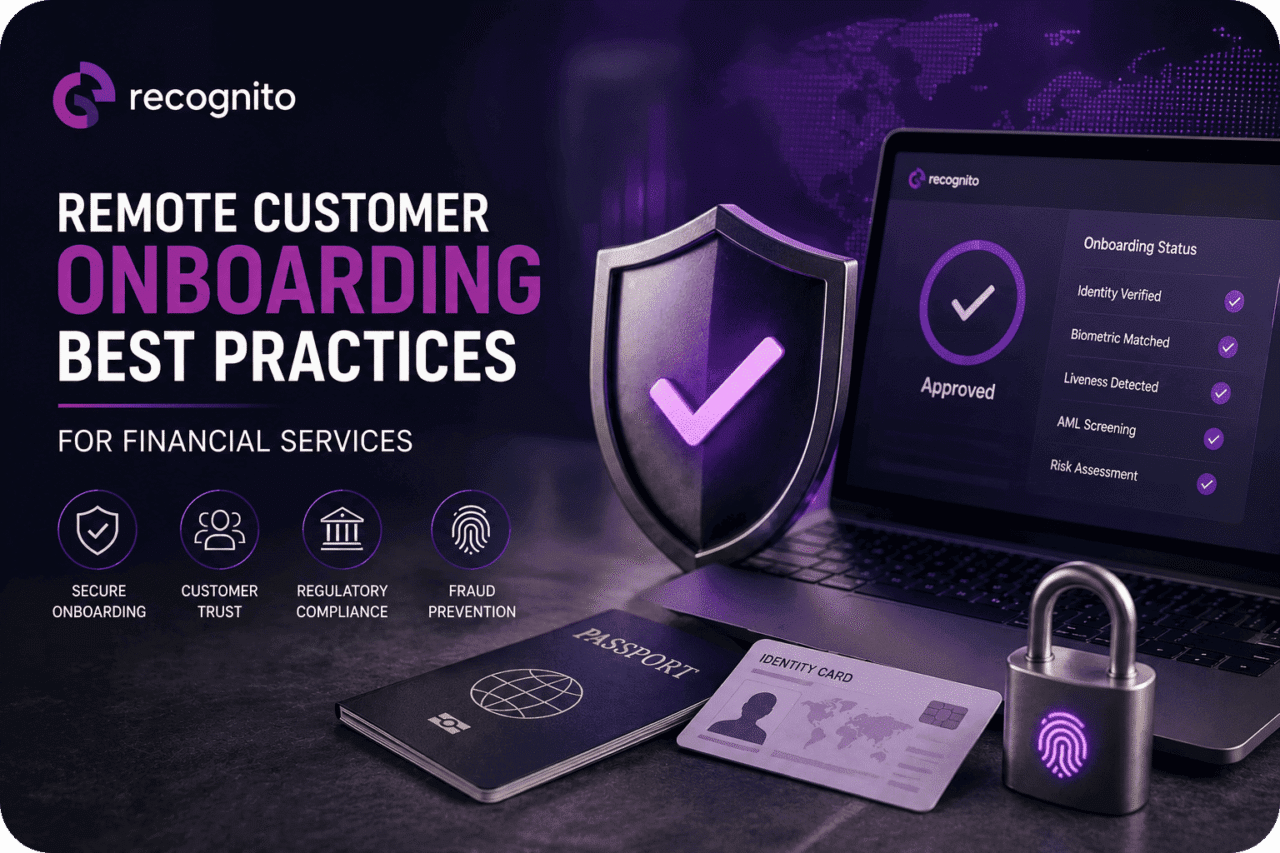
Digital transformation has fundamentally changed how financial institutions interact with customers. Today, people expect to open a bank account, apply for a loan, register for investment services, or access digital wallets without ever visiting a physical branch. This shift has made remote customer onboarding an essential capability for banks, fintech companies, payment providers, insurance companies, cryptocurrency exchanges, and other regulated businesses.
While remote onboarding delivers speed and convenience, it also introduces new security challenges. Fraudsters increasingly exploit digital channels using synthetic identities, stolen credentials, forged documents, account takeover attacks, and AI-generated deepfakes to bypass weak verification systems. At the same time, financial institutions must comply with strict Know Your Customer (KYC) and Anti-Money Laundering (AML) regulations while ensuring legitimate customers can complete onboarding quickly.
Achieving both security and convenience requires a well-designed onboarding process built on identity verification, biometric authentication, document verification, liveness detection, and continuous risk assessment.
This guide explores the best practices financial institutions should follow to build secure, compliant, and customer-friendly remote onboarding experiences.
What Is Remote Customer Onboarding?
Remote customer onboarding is the process of verifying a customer’s identity and establishing a business relationship entirely through digital channels without requiring an in-person visit.
Instead of submitting physical documents or visiting a branch, customers complete the onboarding process using a smartphone, tablet, or computer. Modern onboarding platforms combine multiple verification technologies to establish trust while maintaining a seamless user experience.
A typical remote onboarding workflow includes:
- Identity document verification
- Biometric verification
- Face liveness detection
- Customer Due Diligence (CDD)
- AML and sanctions screening
- Risk assessment
- Account approval
By automating these steps, organizations can onboard customers within minutes while reducing operational costs and strengthening compliance.
Many organizations also adopt electronic Know Your Customer (eKYC) procedures as part of remote onboarding. If you’re interested in how modern eKYC frameworks support digital financial services, our guide on eKYC requirements for fintech platforms explains the technologies and regulatory expectations shaping digital onboarding.
Why Remote Customer Onboarding Matters
Consumer expectations have changed dramatically over the past decade.
Customers increasingly expect financial services to be available anytime and anywhere, with minimal paperwork and instant account approval. Organizations that continue relying on traditional onboarding processes often struggle with high abandonment rates and increased operational costs.
Remote customer onboarding helps organizations deliver a faster and more accessible customer experience while maintaining security and regulatory compliance.
Some of the biggest benefits include:
- Faster customer acquisition
- Improved customer experience
- Reduced operational costs
- Increased onboarding scalability
- Stronger fraud prevention
- Better regulatory compliance
For financial institutions expanding into new markets, remote onboarding also removes geographical barriers by allowing customers to complete identity verification from virtually anywhere.
However, speed should never come at the expense of security. Without effective verification controls, remote onboarding can become one of the easiest entry points for financial crime.
Remote Customer Onboarding vs Traditional Onboarding
Although both approaches aim to establish customer trust, the way they achieve it is very different.
Traditional onboarding relies heavily on face-to-face interactions, manual document reviews, and physical paperwork. While this process can provide a high level of confidence, it is often time-consuming, expensive, and inconvenient for customers.
Remote onboarding replaces these manual processes with digital verification technologies that automate identity validation while maintaining compliance.
Instead of relying on a compliance officer to inspect identity documents manually, organizations increasingly use AI-powered document verification to validate passports, driver’s licences, national identity cards, and other government-issued documents within seconds.
Biometric verification then compares a live facial image with the identity document, allowing organizations to confirm that the person completing the onboarding process is the legitimate owner of the submitted identity.
For organizations building secure onboarding workflows, understanding the distinction between establishing an identity and confirming ownership is equally important. Our guide on identity proofing and identity verification explains how these two processes work together to strengthen digital onboarding.
Core Components of a Secure Remote Customer Onboarding Process
Successful remote onboarding is built on multiple verification layers rather than relying on a single security control.
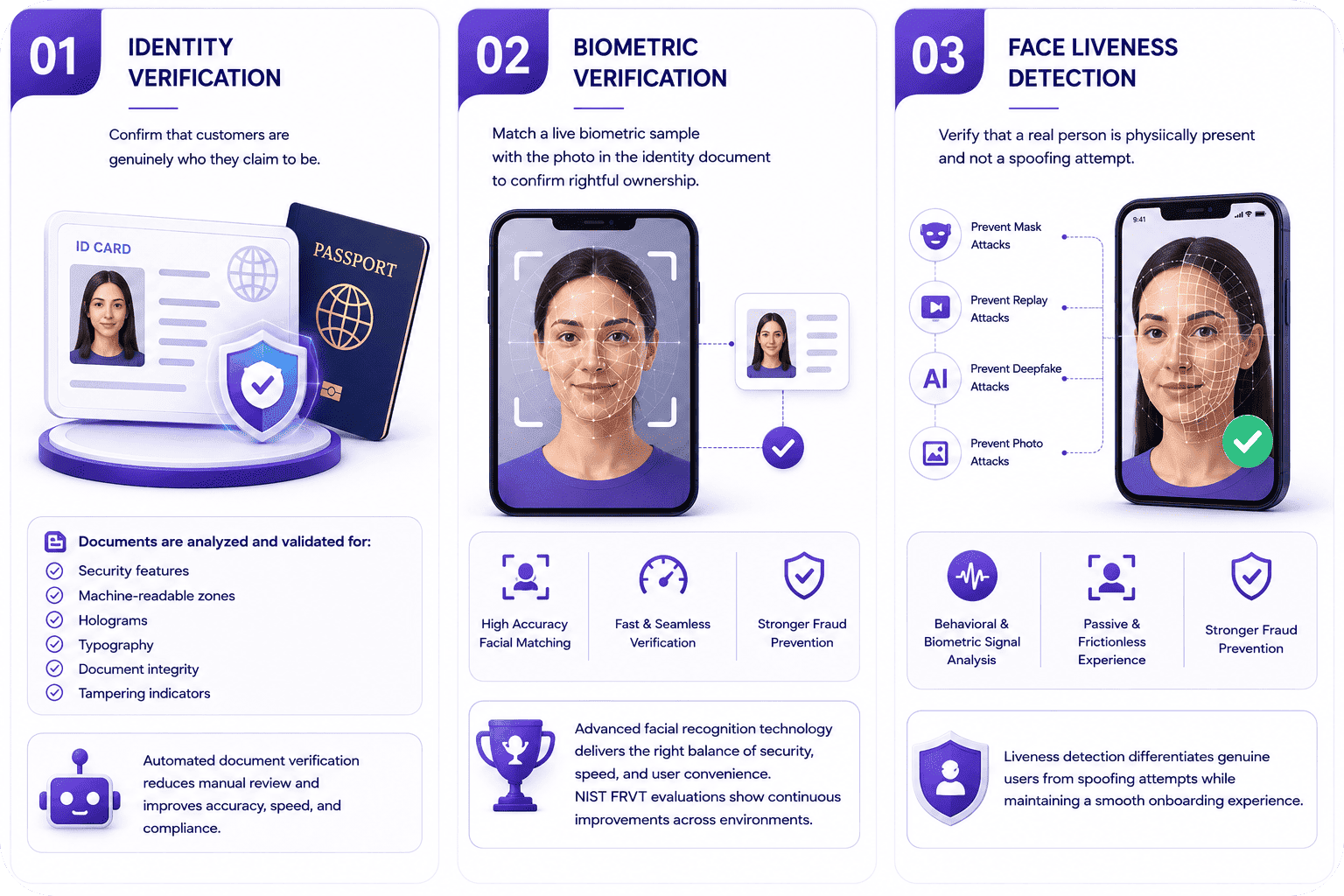
1. Identity Verification
Identity verification remains the foundation of every remote onboarding process.
Before providing access to financial services, organizations must confirm that customers are genuinely who they claim to be.
Modern verification systems analyse government-issued identity documents by validating:
- Security features
- Machine-readable zones
- Holograms
- Typography
- Document integrity
- Tampering indicators
Financial institutions increasingly automate these checks using Recognito’s document verification platform, reducing manual review while improving verification accuracy and onboarding speed.
2. Biometric Verification
A valid identity document alone cannot confirm that the person presenting it is its rightful owner.
Biometric verification addresses this challenge by comparing a live biometric sample against the photograph stored within the identity document.
Facial recognition has become one of the most widely adopted biometric technologies because it offers a balance between security, speed, and user convenience.
Organizations increasingly rely on advanced facial recognition technology to strengthen customer verification while reducing impersonation attempts during remote onboarding.
Independent evaluations conducted through the NIST Face Recognition Vendor Test (FRVT) continue to demonstrate the significant improvements achieved by modern facial recognition algorithms across diverse operating environments.
3. Face Liveness Detection
As biometric verification has improved, fraudsters have adopted more sophisticated presentation attacks.
Printed photographs, replayed videos, mobile screens, silicone masks, and AI-generated deepfakes are now regularly used to bypass weak verification systems.
Face liveness detection verifies that a real person is physically present during the onboarding process rather than a spoofing attempt.
Modern passive liveness solutions analyse multiple behavioural and biometric signals to distinguish genuine users from fraudulent presentations without creating unnecessary friction.
Organizations implementing biometric liveness verification significantly improve fraud prevention while maintaining a smooth onboarding experience.
To better understand the differences between modern liveness technologies, explore our comparison of active and passive liveness detection.
Best Practices for Remote Customer Onboarding
Building an effective remote customer onboarding process requires more than simply digitizing paper forms. Financial institutions must create workflows that verify customer identities accurately, comply with regulatory requirements, and provide an experience that customers trust.
The following best practices help organizations achieve that balance while reducing fraud and improving operational efficiency.
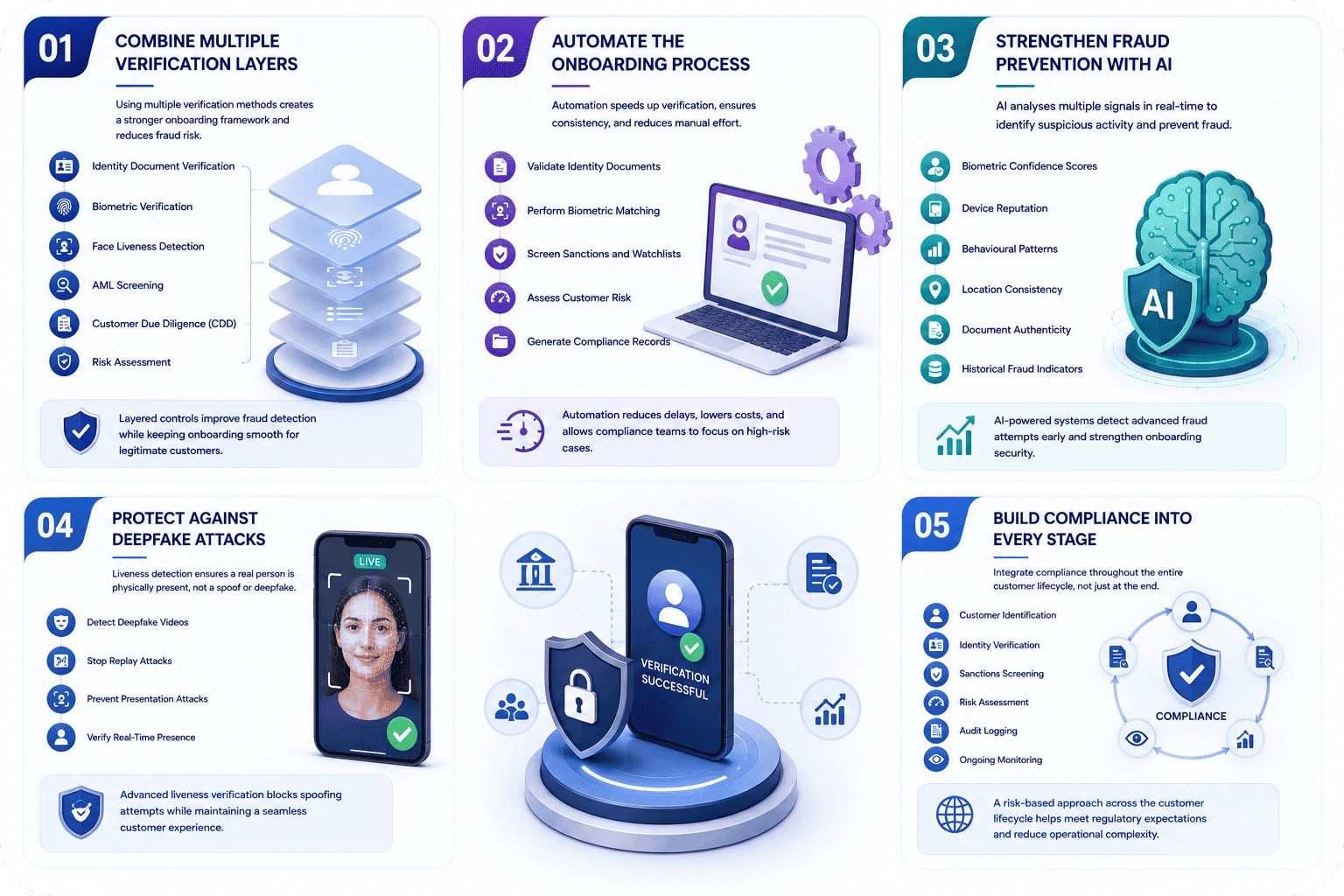
1. Combine Multiple Verification Layers
One of the biggest mistakes organizations make is relying on a single verification method.
For example, document verification alone cannot confirm that the individual presenting the document is its legitimate owner. Likewise, biometric verification without validating the identity document leaves organizations vulnerable to forged or stolen credentials.
The strongest onboarding frameworks combine multiple verification technologies, including:
- Identity document verification
- Biometric verification
- Face liveness detection
- AML screening
- Customer Due Diligence (CDD)
- Risk assessment
By layering these controls, financial institutions can significantly improve fraud detection without creating unnecessary friction for legitimate customers.
2. Automate the Onboarding Process
Manual onboarding introduces delays, increases operational costs, and creates opportunities for human error.
Automation enables organizations to verify customer identities within minutes while maintaining consistent compliance procedures across every application.
Modern onboarding platforms can automatically:
- Validate identity documents
- Perform biometric matching
- Screen sanctions and watchlists
- Assess customer risk
- Generate compliance records
Automation also allows compliance teams to focus on higher-risk cases instead of manually reviewing every application.
3. Strengthen Fraud Prevention With AI
Financial fraud continues to evolve rapidly.
Criminals increasingly use synthetic identities, AI-generated deepfakes, document manipulation, and account takeover techniques to bypass traditional verification systems.
Artificial intelligence helps organizations identify these threats by analysing hundreds of verification signals simultaneously.
Rather than relying on predefined rules alone, AI-powered systems evaluate:
- Biometric confidence scores
- Device reputation
- Behavioural patterns
- Location consistency
- Document authenticity
- Historical fraud indicators
Organizations implementing AI-driven verification platforms are often better equipped to identify suspicious applications before accounts are approved.
Businesses looking to strengthen fraud prevention can also explore our guide on detecting synthetic identity fraud, which explains how modern verification technologies identify fabricated identities during onboarding.
4. Protect Against Deepfake Attacks
The rapid advancement of generative AI has introduced entirely new challenges for remote onboarding.
Deepfake videos, AI-generated facial imagery, replay attacks, and presentation attacks can deceive verification systems that rely solely on facial similarity.
To counter these threats, organizations increasingly combine facial recognition with liveness detection.
Instead of simply comparing two facial images, liveness detection analyses movement, texture, lighting, depth, and behavioural signals to confirm that a genuine person is physically present.
Financial institutions deploying advanced liveness verification significantly improve resistance against spoofing attacks while maintaining a smooth customer experience.
For a deeper understanding of emerging AI threats, read our article on deepfake attack prevention strategies.
5. Build Compliance Into Every Stage
Compliance should never be treated as a final approval step.
Instead, regulatory requirements should be integrated throughout the entire onboarding journey.
This includes customer identification, identity verification, sanctions screening, risk assessment, audit logging, and ongoing monitoring.
Organizations adopting this approach are better positioned to satisfy evolving regulatory expectations while reducing operational complexity.
International standards published by the Financial Action Task Force (FATF) continue to emphasize the importance of applying a risk-based approach throughout the customer lifecycle rather than limiting compliance to account creation.
Common Challenges in Remote Customer Onboarding
Although digital onboarding offers significant advantages, organizations continue to face several operational and security challenges.
Balancing Security With Customer Experience
Customers expect onboarding to be completed quickly, often within just a few minutes.
Long verification processes, repeated document uploads, or unnecessary manual reviews frequently lead to application abandonment.
At the same time, reducing verification requirements too aggressively can expose organizations to fraud and regulatory risk.
Successful financial institutions strike the right balance by automating verification while applying additional checks only when risk indicators justify them.
Identity Fraud and Synthetic Identities
Fraudsters continue developing increasingly sophisticated methods for creating fraudulent accounts.
Synthetic identities, forged documents, and stolen credentials remain some of the most significant threats facing digital onboarding programs.
Organizations can reduce these risks by combining document verification, biometric authentication, liveness detection, and behavioural analysis into a unified verification workflow.
Our article on identity proofing and identity verification explains why validating both the identity itself and the person presenting it is essential for secure onboarding.
Meeting Global Regulatory Requirements
Financial institutions operating internationally often need to comply with multiple regulatory frameworks across different jurisdictions.
These requirements may include:
- KYC compliance
- AML compliance
- Customer Due Diligence
- Data protection regulations
- Sanctions screening
- Record-keeping obligations
Organizations should also ensure their verification programs align with internationally recognised privacy frameworks such as the General Data Protection Regulation (GDPR), particularly when processing biometric and identity data.
Emerging Trends in Remote Customer Onboarding
Customer onboarding continues to evolve alongside fraud techniques and customer expectations.
Several innovations are expected to shape the future of digital onboarding.
Continuous Identity Verification
Rather than verifying customers only once, organizations increasingly monitor identity throughout the customer relationship.
Additional verification may occur during high-value transactions, password resets, device changes, or unusual account activity.
This continuous approach strengthens security while reducing the likelihood of account compromise.
Behavioural Biometrics
Behavioural biometrics analyse how users interact with applications instead of relying solely on physical characteristics.
Typing speed, touch behaviour, navigation patterns, and device interactions can provide valuable fraud indicators without disrupting the customer experience.
As these technologies mature, behavioural analysis is expected to become an increasingly important component of remote customer onboarding.
Choosing the Right Remote Customer Onboarding Solution
Not every remote onboarding platform offers the same level of security, compliance, or scalability. As financial institutions continue expanding their digital services, selecting the right technology partner has become a strategic business decision rather than simply a compliance requirement.
An effective onboarding solution should be capable of adapting to evolving fraud techniques while providing a frictionless experience for legitimate customers.
When evaluating providers, organizations should consider:
- Accuracy of identity verification
- Global identity document coverage
- Facial recognition performance
- Liveness detection capabilities
- AML and KYC compliance support
- Integration flexibility
- Scalability for future growth
- Developer documentation and SDK availability
Solutions that combine document verification, biometric authentication, liveness detection, and compliance tools within a single platform typically reduce integration complexity while improving overall onboarding efficiency.
Development teams looking to implement enterprise-grade biometric verification can also explore the Recognito GitHub repository, which provides technical resources and SDK documentation.
The Future of Remote Customer Onboarding
The future of customer onboarding will be shaped by automation, artificial intelligence, and increasingly intelligent identity verification systems.
Financial institutions are already moving beyond traditional onboarding models toward continuous identity assurance that protects customer accounts throughout the entire relationship.
Several trends are expected to influence the next generation of remote onboarding.
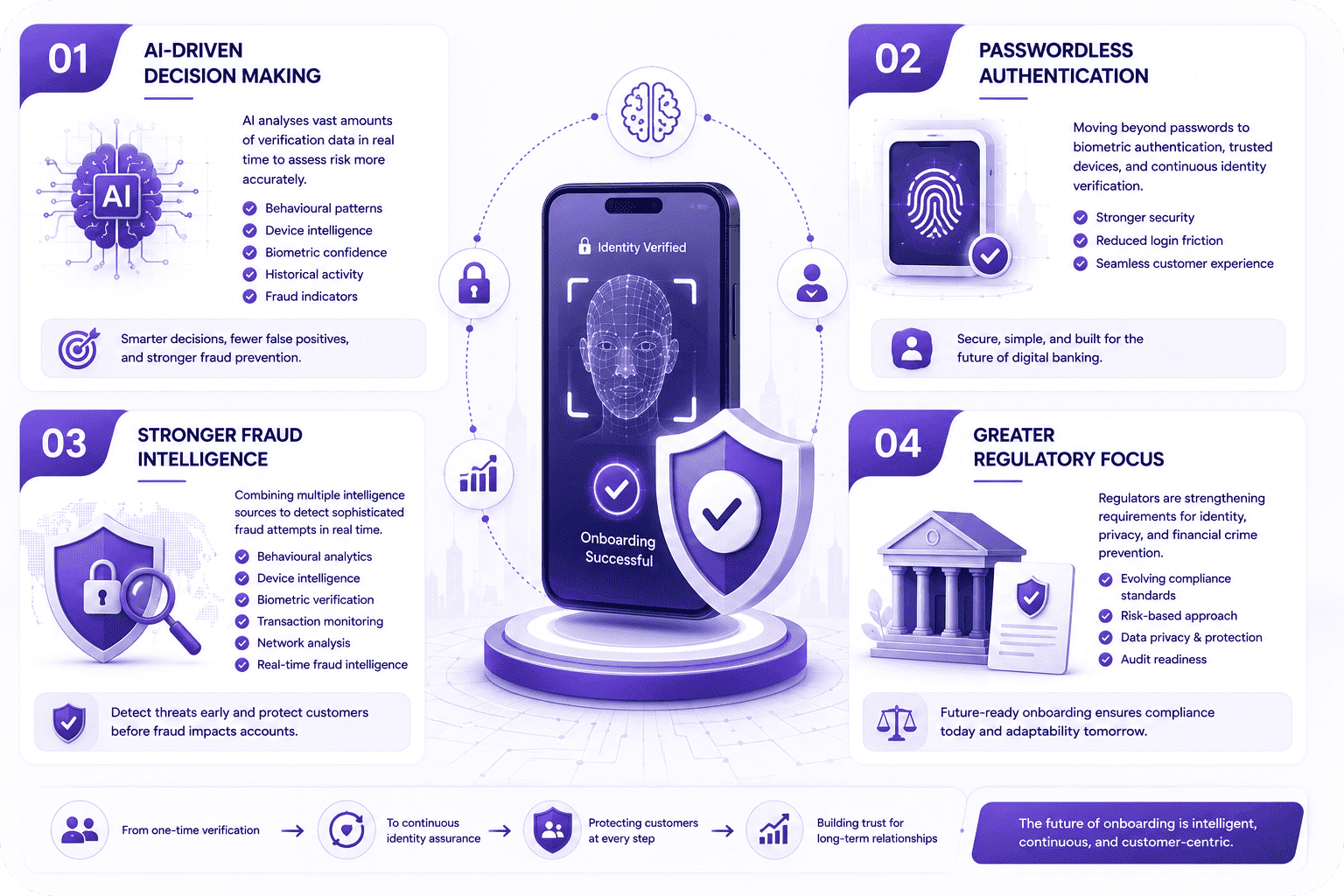
AI-Driven Decision Making
Artificial intelligence will continue improving onboarding by analysing large volumes of verification data in real time.
Instead of relying on fixed rules, machine learning systems evaluate behavioural patterns, device intelligence, biometric confidence, historical activity, and fraud indicators to make more informed risk decisions.
This enables organizations to identify suspicious applications more accurately while reducing false positives for legitimate customers.
Passwordless Authentication
Passwords remain one of the weakest links in digital security.
Financial institutions are increasingly replacing traditional passwords with biometric authentication, trusted devices, and continuous identity verification.
This approach not only improves security but also delivers a more convenient customer experience by reducing login friction.
Stronger Fraud Intelligence
Financial crime continues to evolve alongside advances in artificial intelligence.
Modern verification platforms are expected to combine multiple intelligence sources, including:
- Behavioural analytics
- Device intelligence
- Biometric verification
- Transaction monitoring
- Network analysis
- Real-time fraud intelligence
By evaluating these signals together, organizations can detect increasingly sophisticated fraud attempts before they impact customers.
Greater Regulatory Focus
Governments and regulators continue strengthening requirements around customer identification, privacy, and financial crime prevention.
Organizations investing in flexible onboarding frameworks today will be better prepared to adapt to future regulatory changes without redesigning their verification processes.
Conclusion
Remote customer onboarding has become a critical capability for financial institutions operating in an increasingly digital economy. Customers expect fast, convenient account creation, while regulators expect organizations to maintain rigorous identity verification, KYC compliance, and AML controls.
Meeting both expectations requires more than digitizing traditional onboarding. Financial institutions must adopt a layered verification strategy that combines identity document verification, biometric authentication, liveness detection, Customer Due Diligence, sanctions screening, and continuous risk assessment.
By implementing these best practices, organizations can reduce fraud, strengthen regulatory compliance, improve operational efficiency, and build greater customer trust.
Advanced solutions such as Recognito identity verification, facial recognition, document authentication, and liveness detection technologies provide financial institutions with the tools needed to create secure, scalable, and future-ready remote customer onboarding experiences.
Frequently Asked Questions
What is remote customer onboarding?
Remote customer onboarding is the process of verifying a customer’s identity and establishing a business relationship entirely through digital channels without requiring an in-person visit.
Why is remote customer onboarding important for financial services?
It enables financial institutions to onboard customers faster, improve accessibility, reduce operational costs, strengthen fraud prevention, and maintain compliance with KYC and AML regulations.
How does remote identity verification work?
Remote identity verification combines identity document verification, biometric authentication, facial recognition, and liveness detection to confirm that a customer is genuinely who they claim to be.
What is the role of eKYC in remote onboarding?
eKYC enables organizations to verify customer identities digitally using automated verification technologies, helping improve onboarding speed while supporting regulatory compliance.
How can financial institutions prevent fraud during remote onboarding?
Organizations can reduce fraud by combining document verification, biometric verification, liveness detection, AML screening, Customer Due Diligence, behavioural analytics, and AI-powered risk assessment.
What technologies are used in modern remote customer onboarding?
Modern onboarding platforms typically use identity verification, facial recognition, document authentication, liveness detection, sanctions screening, behavioural analytics, artificial intelligence, and continuous monitoring to create secure digital onboarding experiences.
