

As financial services continue shifting toward digital experiences, customer onboarding has become one of the most important stages in preventing financial crime. Banks, fintech companies, payment providers, cryptocurrency exchanges, insurance companies, and other regulated businesses must verify customer identities quickly while complying with increasingly complex Anti-Money Laundering (AML) regulations.
The challenge is that modern fraud has evolved far beyond stolen passwords and fake IDs. Criminals now use synthetic identities, forged documents, AI-generated deepfakes, account takeover techniques, and organized fraud networks to exploit weaknesses in digital onboarding systems. At the same time, legitimate customers expect to open an account and access services within minutes without unnecessary delays or manual reviews.
This balance between security and user experience has made AML verification and identity verification fundamental components of every modern onboarding process. While identity verification confirms that a customer is genuinely who they claim to be, AML verification determines whether that customer poses a financial crime risk before a business relationship begins.
When these processes work together, organizations can significantly reduce fraud, strengthen KYC compliance, improve regulatory readiness, and create a faster onboarding experience for genuine customers.
What Is AML Verification?
AML verification is the process of identifying, verifying, and assessing customers before establishing a business relationship to reduce the risk of money laundering, terrorist financing, sanctions violations, and other financial crimes.
Rather than relying on a single verification step, AML verification combines multiple compliance checks into one risk-based framework that helps organizations make informed onboarding decisions.
A modern AML verification program generally includes:
- Customer identification
- Identity verification
- Customer Due Diligence (CDD)
- Sanctions and watchlist screening
- Politically Exposed Person (PEP) screening
- Risk assessment
- Ongoing monitoring
These checks help organizations identify suspicious applicants before they gain access to financial products or services.
International guidance published by the Financial Action Task Force (FATF) recommends a risk-based approach, allowing businesses to apply additional due diligence where higher financial crime risks exist while maintaining a smooth experience for lower-risk customers.
Why AML Verification Matters During Customer Onboarding
Customer onboarding is the first opportunity to prevent financial crime before it reaches an organization’s systems.
If a fraudulent applicant successfully creates an account, detecting suspicious activity later often becomes significantly more expensive and far more difficult. Criminals frequently exploit weak onboarding controls to establish trusted customer relationships before carrying out fraudulent transactions.
Common objectives include opening fraudulent bank accounts, creating cryptocurrency wallets, laundering illicit funds, applying for credit using stolen identities, or using mule accounts to move money across multiple financial institutions.
An effective AML verification framework helps organizations:
- Identify high-risk applicants before approval.
- Support KYC verification and AML compliance.
- Reduce financial fraud losses.
- Improve customer trust.
- Minimize costly manual investigations.
Rather than slowing down onboarding, modern verification technologies enable businesses to automate many of these compliance processes while maintaining a seamless customer experience.
AML Verification vs Identity Verification
Although AML verification and identity verification are closely connected, they solve two different problems.
Understanding the distinction helps organizations build stronger customer onboarding programs that address both fraud prevention and regulatory compliance.
1. Identity Verification Confirms Identity Ownership
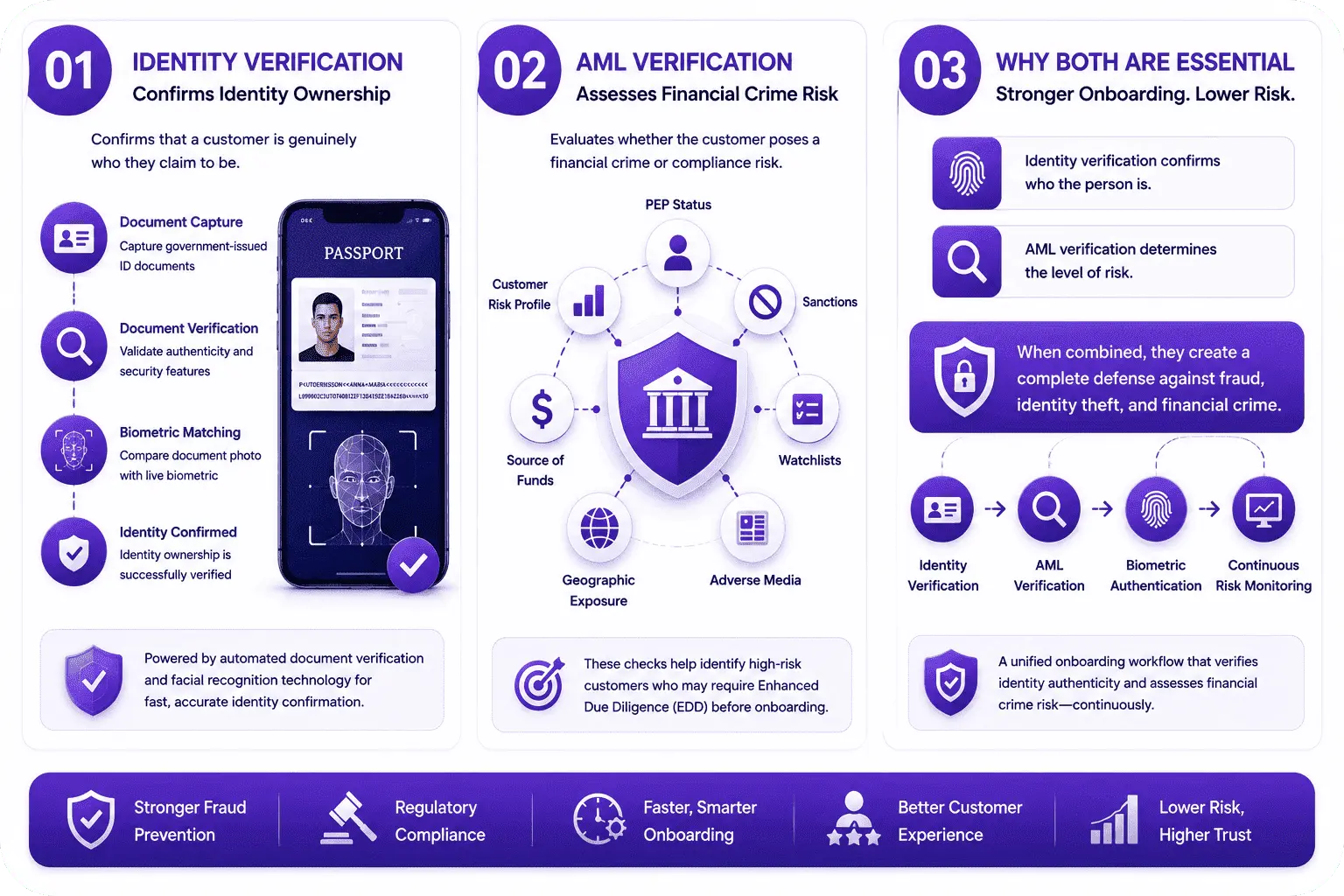
Identity verification focuses on confirming that a customer is genuinely who they claim to be.
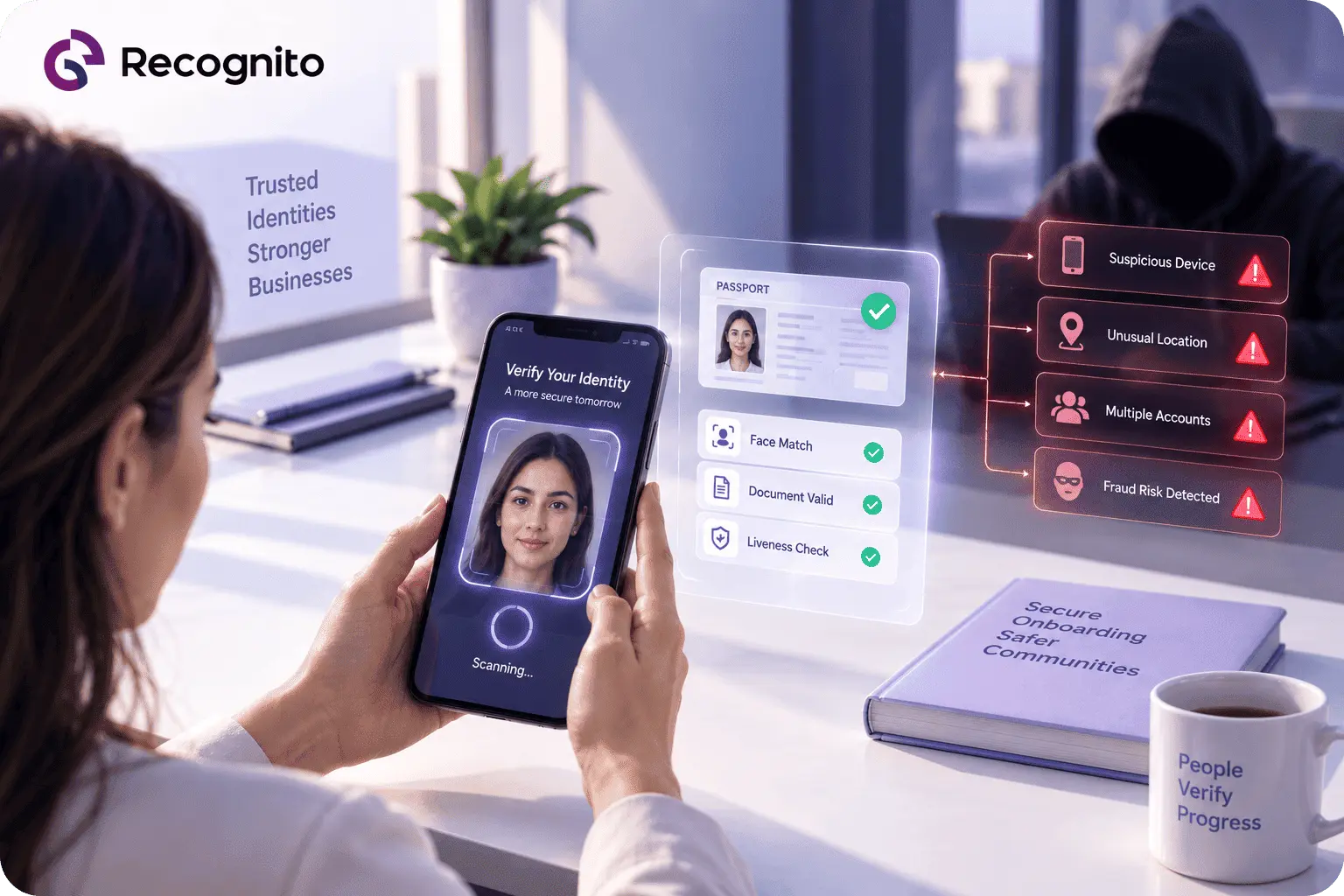
Modern verification systems typically validate government-issued documents such as passports, driver’s licences, national identity cards, and residence permits before comparing the document photograph with a live biometric sample.
Many organizations streamline this process using automated identity document verification, followed by biometric matching through Recognito’s facial recognition technology to improve accuracy while reducing manual review.
Businesses looking to understand how identity validation differs from confirming ownership can also explore our guide to identity proofing and identity verification, which explains how these two processes complement one another during digital onboarding.
2. AML Verification Assesses Financial Crime Risk
While identity verification answers the question, “Is this person who they claim to be?”, AML verification asks a different question:
“Should this customer be allowed to establish a business relationship?”
To answer that question, organizations evaluate a range of financial crime indicators, including:
- Politically Exposed Person (PEP) status
- International sanctions
- Watchlists
- Adverse media
- Geographic exposure
- Source of funds
- Customer risk profile
These additional checks allow compliance teams to identify customers who require Enhanced Due Diligence (EDD) before onboarding continues.
3. Strong Customer Onboarding Requires Both
Neither process can replace the other.
Identity verification alone may successfully confirm that a document belongs to the person presenting it, yet still fail to identify sanctions exposure or money laundering risks.
Likewise, AML screening without confirming identity could allow fraudsters using stolen or synthetic identities to bypass onboarding controls.
For this reason, modern financial institutions combine identity verification, AML verification, biometric authentication, and continuous risk monitoring into a single onboarding workflow that evaluates both identity authenticity and financial crime risk.
Core Components of AML Verification
An effective AML verification program combines several technologies and compliance controls that work together throughout the onboarding journey.
1. Customer Identification
Every verification process begins by collecting information that establishes a customer’s identity.
For individual customers, this generally includes full legal name, date of birth, residential address, nationality, government-issued identification, and contact details.
Business customers often require additional information, including company registration details, beneficial ownership information, corporate structure, and business activities.
Collecting this information establishes the foundation for Customer Due Diligence, but information alone is not enough. Organizations must also verify that the information provided is genuine before onboarding proceeds.
2. Identity Verification
Identity verification remains one of the most important stages of AML verification because it establishes confidence in the customer’s claimed identity.
Modern verification platforms analyse identity documents by examining:
- Security features
- Machine-readable zones
- Holograms
- Typography
- Tampering indicators
- Data consistency
Many organizations automate these checks using AI-powered document verification, reducing manual review while improving both speed and accuracy.
To strengthen onboarding security even further, businesses increasingly deploy document liveness detection to identify screenshots, photocopies, digitally manipulated documents, and presentation attacks before verification is approved.
For a deeper understanding of how this technology strengthens KYC programs, read our guide on document liveness detection for identity verification.
3. Biometric Verification
Verifying an identity document does not automatically prove that the individual presenting it is the legitimate owner.
Biometric verification addresses this challenge by comparing a live biometric sample against a trusted identity document.
Today’s onboarding platforms commonly use facial recognition because it offers an effective balance between security, convenience, and scalability.
Organizations increasingly rely on enterprise facial recognition software to reduce impersonation attempts while delivering a frictionless customer experience.
Independent testing through the NIST Face Recognition Vendor Test (FRVT) continues to demonstrate the significant improvements achieved by modern facial recognition algorithms across diverse real-world conditions.
4. Face Liveness Detection
Even highly accurate facial recognition systems can be vulnerable if they cannot distinguish between a real person and a spoofing attempt.
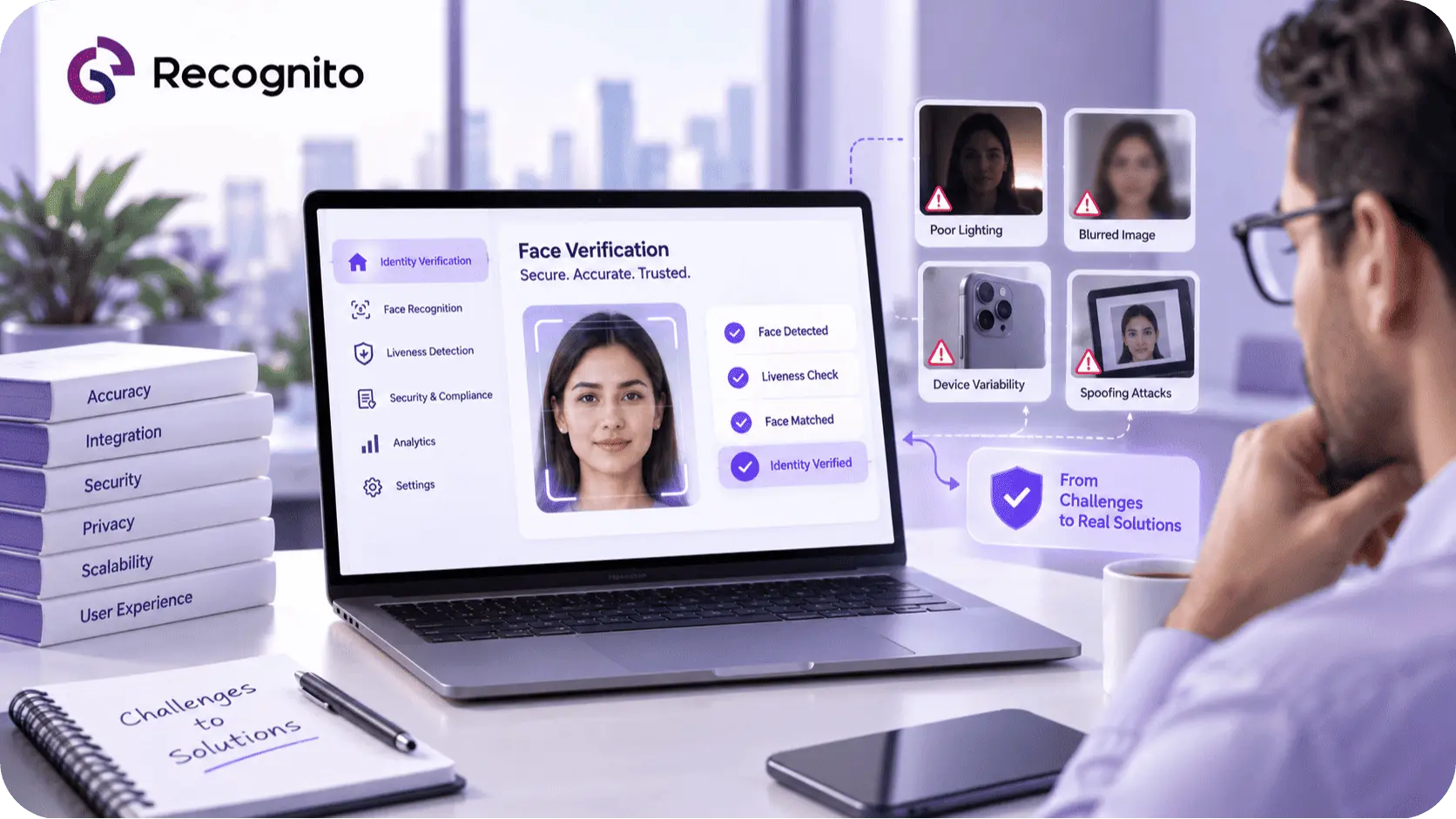
Criminals increasingly attempt to bypass onboarding systems using printed photographs, replayed videos, deepfake content, mobile screens, and realistic masks.
Face liveness detection verifies that a genuine person is physically present during the verification process by analysing multiple behavioural and biometric signals rather than relying solely on facial similarity.
Organizations implementing advanced liveness detection can significantly reduce presentation attacks while maintaining a seamless onboarding experience.
If you’re evaluating different implementation approaches, our comparison of active and passive liveness detection explains how each method contributes to stronger fraud prevention.
How AML Verification Strengthens Customer Onboarding
A successful onboarding process does more than satisfy regulatory requirements. It creates the foundation for a secure and trustworthy customer relationship.
Modern financial institutions are expected to verify identities quickly, detect financial crime risks, and provide a seamless customer experience all within a matter of minutes. Achieving these goals requires multiple verification layers working together rather than relying on a single compliance check.
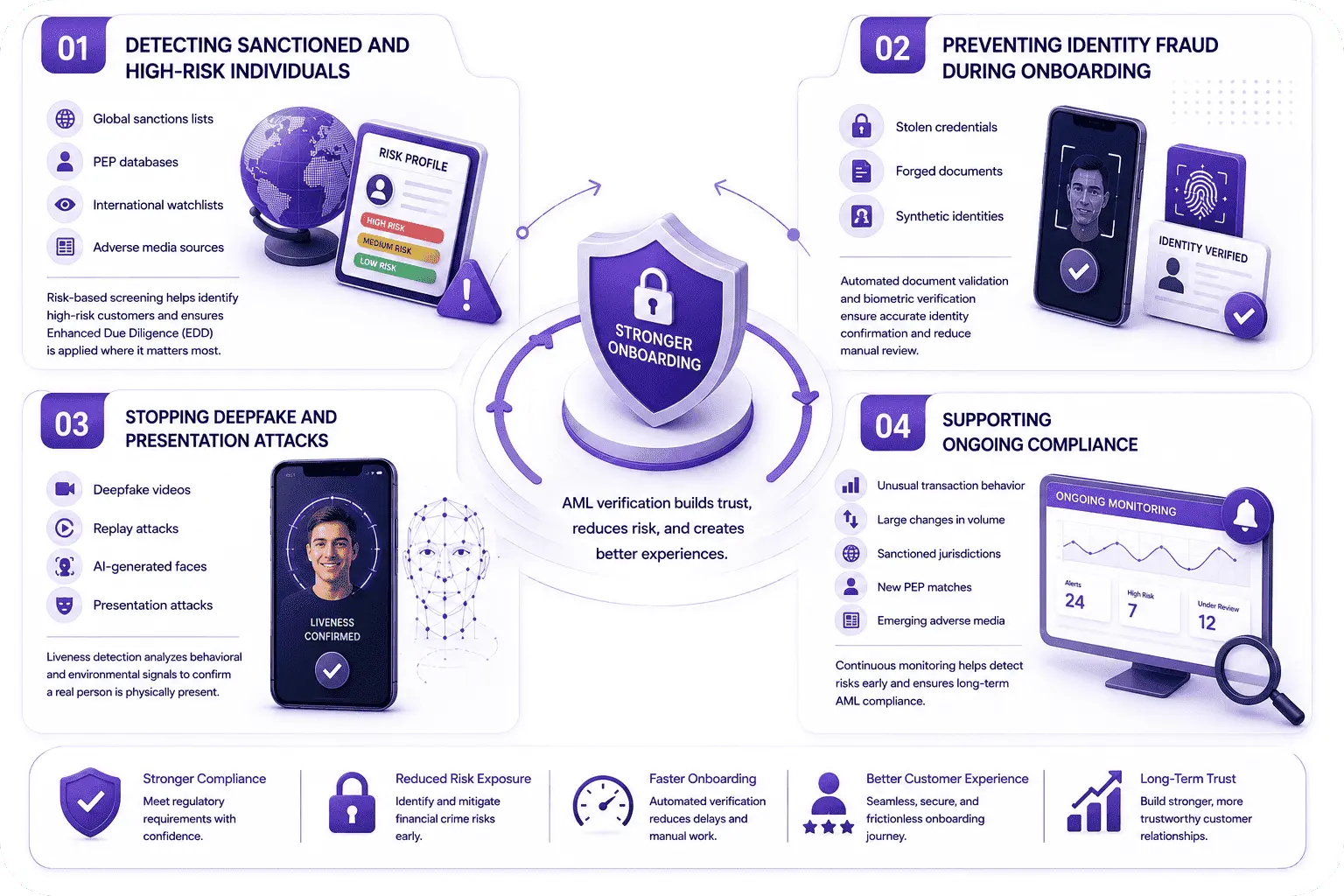
1. Detecting Sanctioned and High-Risk Individuals
One of the primary objectives of AML verification is identifying customers who may present an elevated financial crime risk.
Organizations routinely screen applicants against:
- Global sanctions lists
- Politically Exposed Person (PEP) databases
- International watchlists
- Adverse media sources
These checks help compliance teams identify individuals who require additional review before onboarding is approved.
Rather than treating every customer the same, organizations can apply a risk-based approach that reserves Enhanced Due Diligence (EDD) for applicants who genuinely require it. This improves compliance while reducing unnecessary delays for legitimate customers.
2. Preventing Identity Fraud During Onboarding
Identity fraud remains one of the biggest challenges facing financial institutions.
Fraudsters frequently attempt to create accounts using stolen credentials, forged documents, or entirely fabricated identities. Traditional manual reviews often struggle to detect these increasingly sophisticated attacks.
Modern onboarding platforms combine automated document validation with biometric verification to establish much higher confidence in customer identities.
Organizations implementing digital identity verification solutions can automatically verify identity documents while reducing manual review times and improving onboarding accuracy.
Businesses concerned about emerging fraud trends should also explore our guide on how financial institutions detect synthetic identity fraud, which explains how AI and biometrics help identify fabricated identities before they enter financial systems.
3. Stopping Deepfake and Presentation Attacks
Artificial intelligence has made identity fraud significantly more convincing.
Deepfake videos, replay attacks, AI-generated faces, and realistic presentation attacks are now capable of deceiving verification systems that rely solely on facial matching.
This is why leading financial institutions increasingly combine biometric verification with liveness detection.
Instead of simply checking whether two faces look alike, liveness technology analyses behavioural and environmental signals to confirm that a genuine person is physically present during verification.
Businesses deploying facial anti-spoofing technology can significantly reduce the risk of deepfake attacks while maintaining a frictionless onboarding experience.
To understand how AI-generated fraud continues to evolve, read our article on deepfake attack prevention strategies.
4. Supporting Ongoing Compliance
AML verification should not end once an account has been created.
Customer risk profiles evolve over time as transaction patterns, geographic exposure, ownership structures, and regulatory requirements change.
Continuous monitoring enables organizations to identify suspicious activity long after onboarding has been completed.
Examples include:
- Unusual transaction behaviour
- Large changes in transaction volume
- Activity involving sanctioned jurisdictions
- Newly identified politically exposed persons
- Emerging adverse media
By continuously evaluating customer risk, organizations can respond more quickly to changing circumstances while maintaining ongoing AML compliance.
Common Challenges in AML Verification
Although technology has transformed customer onboarding, organizations continue to face several operational and compliance challenges.
1. Balancing Security and User Experience
Customers expect digital onboarding to be completed within minutes.
Excessive verification requirements often increase abandonment rates, while insufficient verification increases fraud exposure.
Finding the right balance between convenience and security remains one of the biggest challenges facing compliance teams.
Modern automation allows organizations to perform sophisticated identity verification behind the scenes without creating unnecessary friction for legitimate applicants.
2. Increasing Regulatory Complexity
AML regulations continue to evolve across different jurisdictions.
Organizations operating internationally often need to comply with multiple regulatory frameworks, making onboarding significantly more complex.
Beyond local regulations, businesses frequently align their compliance programs with internationally recognised standards such as the General Data Protection Regulation (GDPR) and recommendations published by the Financial Action Task Force (FATF).
Building flexible verification workflows enables organizations to adapt more easily as regulatory expectations continue to change.
3. Sophisticated Fraud Techniques
Financial criminals are constantly developing new methods for bypassing onboarding controls.
Common threats now include:
- Synthetic identities
- Deepfake impersonation
- Forged identity documents
- Account takeover attacks
- AI-generated biometric spoofing
Organizations relying solely on manual document reviews or passwords are increasingly vulnerable to these attacks.
This is why modern customer onboarding combines document verification, biometric authentication, liveness detection, behavioural analytics, and AI-powered fraud detection into a single verification workflow.
Best Practices for Modern AML Verification
Organizations looking to strengthen customer onboarding should focus on several practical strategies.
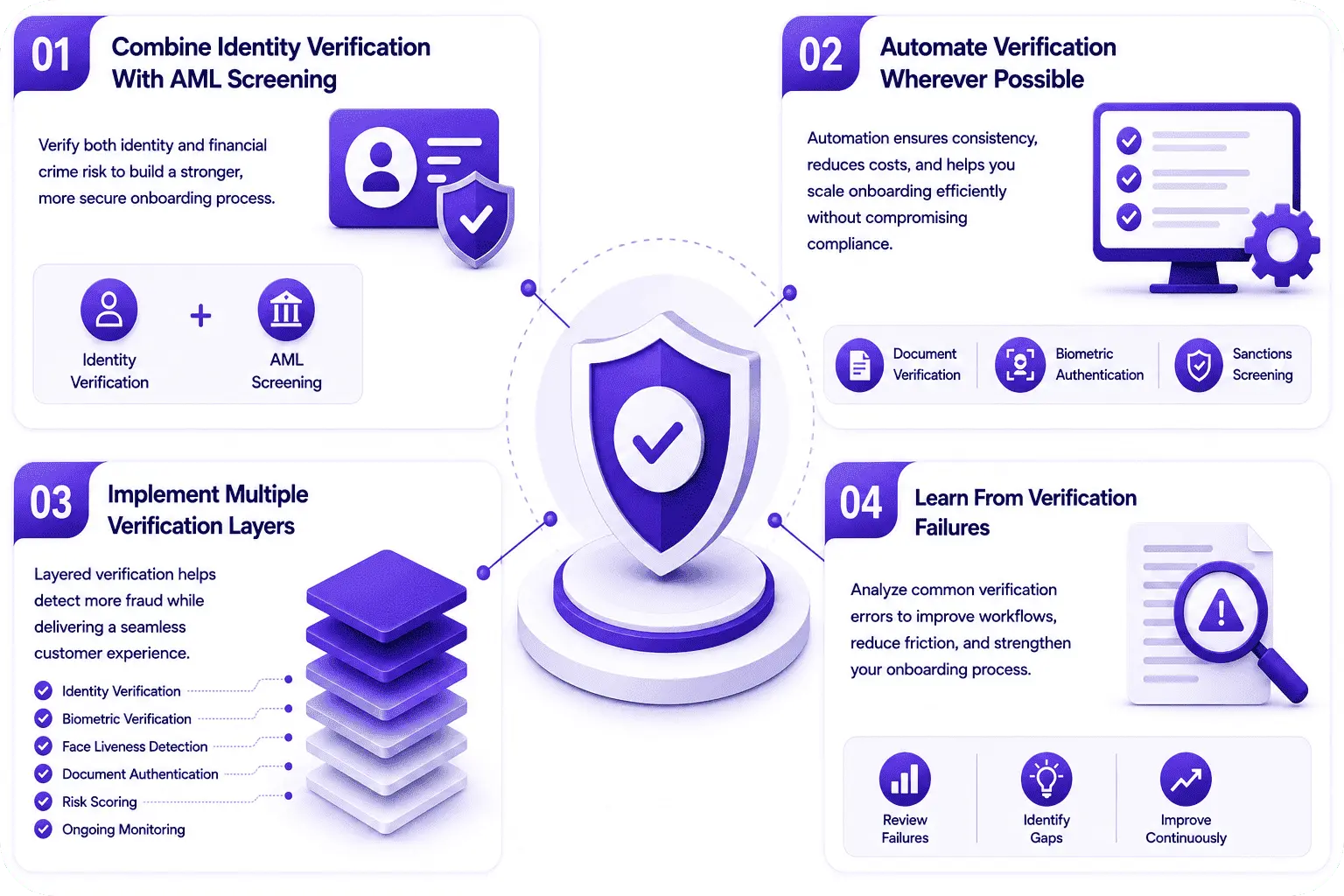
1. Combine Identity Verification With AML Screening
Identity verification and AML verification should work together rather than operating as separate compliance processes.
Verifying both the customer’s identity and their financial crime risk creates a much stronger onboarding framework.
2. Automate Verification Wherever Possible
Automation improves consistency while reducing operational costs.
Organizations that automate document verification, biometric authentication, and sanctions screening are better positioned to scale customer onboarding without compromising compliance.
3. Implement Multiple Verification Layers
No single technology can prevent every type of fraud.
The strongest onboarding programs combine:
- Identity verification
- Biometric verification
- Face liveness detection
- Document authentication
- Risk scoring
- Ongoing monitoring
Layered verification significantly improves fraud detection while maintaining a positive customer experience.
4. Learn From Verification Failures
Many onboarding failures result from avoidable mistakes rather than sophisticated attacks.
Reviewing common verification errors helps organizations strengthen onboarding workflows and reduce manual intervention.
Our guide to common identity verification mistakes highlights several issues businesses should avoid when designing digital onboarding programs.
The Future of AML Verification
As financial crime becomes more sophisticated, AML verification is evolving from a compliance requirement into a strategic advantage. Financial institutions are increasingly adopting intelligent verification technologies that not only satisfy regulatory obligations but also improve operational efficiency and customer experience.
Several emerging trends are shaping the future of customer onboarding.
1. AI-Powered Risk Assessment
Artificial intelligence is transforming how compliance teams evaluate customer risk.
Instead of reviewing only a handful of data points, AI-driven systems analyse hundreds of signals simultaneously, including identity verification results, behavioural patterns, device intelligence, transaction history, geolocation consistency, and biometric confidence scores.
This allows organizations to identify high-risk applicants more accurately while reducing false positives and unnecessary manual reviews.
2. Continuous Identity Verification
Traditional onboarding verifies a customer once before an account is approved.
However, customer risk does not remain static.
Modern compliance programs increasingly perform continuous identity verification throughout the customer lifecycle. Additional verification may be triggered when:
- Large or unusual transactions occur.
- Customers log in from unfamiliar devices.
- Sensitive account information changes.
- High-risk behaviour is detected.
- Account recovery is requested.
This continuous approach enables organizations to detect suspicious activity much earlier while maintaining a secure customer experience.
3. Passive Biometric Authentication
Biometric verification is becoming less intrusive.
Rather than asking customers to complete multiple verification actions, modern onboarding platforms increasingly rely on passive authentication that operates in the background.
Advanced facial recognition and liveness detection technologies can verify users with minimal interaction, reducing friction while maintaining a high level of security.
Organizations evaluating biometric technologies should also explore our guide to AI-powered identity verification for fintech onboarding, which explains how artificial intelligence is improving verification accuracy and onboarding efficiency.
4. Smarter Fraud Detection
Fraud prevention is no longer based solely on predefined rules.
Machine learning models continuously learn from new attack patterns, allowing organizations to identify emerging fraud techniques before they become widespread.
Modern fraud detection platforms increasingly combine:
- Behavioural analytics
- Device intelligence
- Biometric verification
- Transaction monitoring
- Risk scoring
- Threat intelligence
Working together, these technologies enable organizations to detect sophisticated fraud attempts while minimizing disruption for legitimate customers.
Choosing the Right AML Verification Solution
Selecting an AML verification platform involves more than simply comparing compliance features.
Organizations should evaluate whether a solution can support long-term growth while adapting to changing regulations and evolving fraud techniques.
When comparing providers, consider factors such as:
- Verification accuracy
- Global identity document coverage
- Biometric performance
- Liveness detection capabilities
- Integration flexibility
- Scalability
- Compliance support
- Developer resources
Solutions that combine document verification, biometric authentication, AML screening, and fraud detection within a single platform typically provide the most efficient customer onboarding experience.
Development teams looking to explore implementation options can also browse the Recognito GitHub repository for SDK resources and integration examples.
Conclusion
AML verification and identity verification are no longer independent compliance processes. Together, they form the foundation of secure customer onboarding, enabling organizations to verify customer identities, assess financial crime risk, and meet increasingly complex regulatory requirements without sacrificing user experience.
As fraudsters continue adopting synthetic identities, deepfake technology, and AI-driven attacks, businesses need a layered verification strategy that combines document authentication, biometric verification, liveness detection, sanctions screening, and continuous monitoring.
Organizations investing in advanced verification technologies today will be better positioned to reduce fraud, strengthen KYC and AML compliance, and build lasting customer trust.
Modern solutions such as Recognito identity verification, biometric authentication, and liveness detection technologies provide businesses with the tools required to create secure, scalable, and compliant digital onboarding experiences for the future.
Frequently Asked Questions
What is AML verification?
AML verification is the process of identifying, verifying, and assessing customers to reduce the risk of money laundering, terrorist financing, sanctions violations, and other financial crimes before establishing a business relationship.
How is AML verification different from identity verification?
Identity verification confirms that a customer is genuinely who they claim to be, while AML verification evaluates whether that customer presents a financial crime risk by performing sanctions screening, PEP checks, Customer Due Diligence, and risk assessments.
Why is AML verification important during customer onboarding?
AML verification helps organizations prevent financial crime, comply with KYC and AML regulations, identify high-risk applicants before accounts are approved, and improve overall onboarding security.
How does biometric verification support AML compliance?
Biometric verification confirms that the individual presenting an identity document is its legitimate owner. When combined with document verification and AML screening, it significantly reduces impersonation and identity fraud.
What role does liveness detection play in AML verification?
Liveness detection verifies that a real person is physically present during identity verification and helps prevent spoofing attacks involving photographs, videos, masks, and AI-generated deepfakes.
Can AML verification be automated?
Yes. Modern AML verification platforms automate identity verification, sanctions screening, biometric authentication, risk assessment, and ongoing monitoring, allowing organizations to improve compliance while delivering faster and more secure customer onboarding.