
When identity verification happens remotely, every second matters. A customer expects to prove who they are without visiting a branch, while the organization needs enough evidence to distinguish a legitimate applicant from an impersonator.
That pressure has made facial biometrics an important part of modern identity workflows. But a face recognition model by itself is not enough. Production systems need image capture, face detection, quality checks, biometric matching, liveness detection, integration APIs, error handling, and a decision layer that can operate quickly.
This is where a facial recognition SDK becomes valuable. Instead of building every biometric capability internally, development teams can integrate a software layer that handles core facial processing and exposes the results to an identity-verification application.
The real advantage is not simply faster face matching. It is the ability to turn biometric analysis into a practical, real-time verification workflow.
Why Real-Time Identity Verification Is Difficult
A remote identity check has to solve several problems at once.
First, the system needs usable biometric evidence. A blurry, poorly framed, or badly illuminated face can lead to an unsuccessful comparison even when the customer is genuine.
Second, the system needs to determine whether the captured face corresponds to the claimed identity.
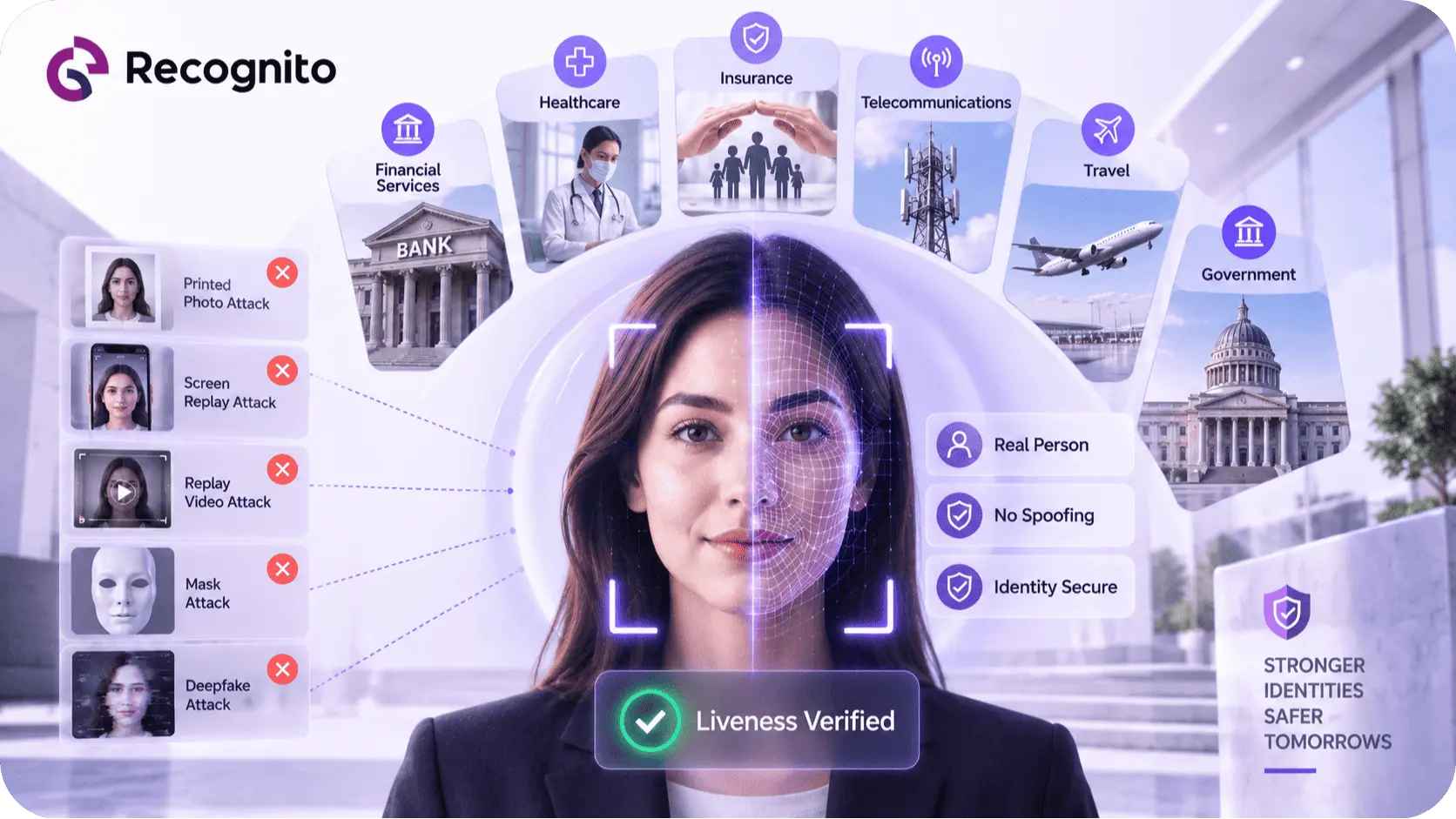
Third, it must consider whether the biometric input represents a real person who is physically present. A photograph or replayed video may contain the correct face while still representing an attack.
Finally, the verification result needs to reach the application quickly enough that the user does not experience unnecessary delays.
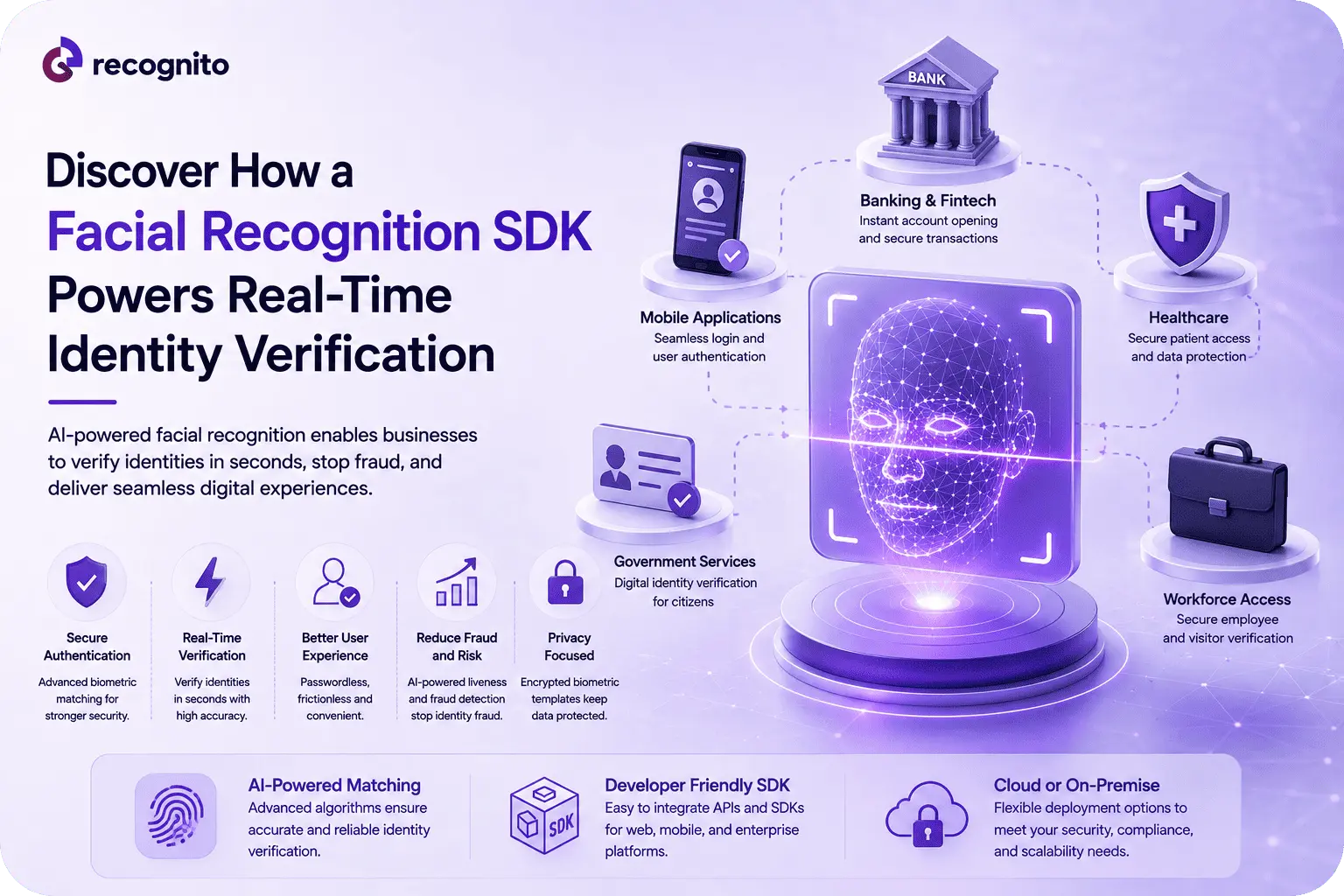
A facial recognition SDK sits inside this chain. It provides developers with reusable biometric components that can be connected to onboarding, authentication, account recovery, fraud prevention, or other identity processes.
NIST’s current face-recognition evaluations distinguish between 1:1 verification and 1:N identification, illustrating why biometric requirements must be matched to the actual business scenario.
What a Facial Recognition SDK Actually Handles
The term “facial recognition SDK” can sound like a single feature, but a production implementation usually involves multiple processing stages.
A typical SDK may support:
- camera or image capture
- face detection
- face alignment and preprocessing
- facial feature extraction
- face-to-face or face-to-document matching
- image-quality assessment
- liveness or presentation-attack checks
- result handling through APIs or application callbacks
The precise capabilities vary between vendors, so developers should evaluate the complete workflow rather than assuming every SDK provides the same functionality.
For organizations comparing vendors, face recognition SDK evaluation criteria offers a useful framework for looking beyond model accuracy at integration, performance, platform support, and operational requirements.
The important architectural point is that the SDK becomes the bridge between biometric intelligence and the business application.
From Camera Input to a Verification Result
A real-time verification flow begins with capture.
The application opens the camera and guides the user to present their face correctly. The SDK may detect whether a face is present, assess image quality, and determine whether the captured image is suitable for further processing.
Once a usable frame is available, facial features can be extracted and transformed into a biometric representation. The application then compares that representation against a trusted reference.
In an onboarding scenario, the reference may come from the portrait on an identity document. In authentication, it may be an enrolled biometric template.
The result is generally not just “face detected.” A production application needs structured output that can feed a larger decision process.
For developers building the integration layer, the identity verification API guide provides relevant context on connecting verification capabilities to a digital onboarding workflow.
Why Liveness Belongs Beside Face Matching
Face matching answers a specific question: Does this face resemble the reference face closely enough to satisfy the matching threshold?
It does not necessarily answer: Is this a genuine person presenting their face right now?
That second question is handled by liveness or presentation-attack detection.
Consider an attacker using a photograph of a legitimate customer. The face may be highly similar to the enrolled person, but the input is not a live subject. A replayed video or manipulated media can create a similar problem.
Modern face-verification systems therefore need to treat biometric matching and attack detection as related but distinct controls.
FIDO’s current Face Verification certification framework explicitly tests areas including biometric matching, liveness, deepfake resistance, injection attacks, usability, and demographic performance for remote identity-verification solutions.
A facial recognition SDK used in identity verification should therefore be evaluated on more than its matching capability.
How Real-Time Processing Improves the User Journey
Real-time identity verification changes what the customer experiences.
A traditional workflow might require a user to upload a selfie, wait for the system to process it, receive an error, repeat the submission, and potentially wait for manual review.
A real-time SDK can perform checks while the customer is still inside the capture experience.
The application can detect that the face is too far away, poorly positioned, partially obscured, or affected by inadequate lighting. It can prompt the customer immediately rather than waiting until the entire process is submitted.
This feedback loop has a practical benefit: the system corrects capture problems at the point where they occur.
The result is fewer avoidable failures and a shorter path between biometric capture and a verification decision.
Accuracy Depends on More Than the Model
A facial recognition model may perform very well under controlled testing and still encounter difficulties in production.
Real-world variables include:
- camera differences
- lighting
- pose
- motion
- image compression
- face angle
- capture distance
- demographic characteristics
- reference-image quality
NIST’s current FRTE 1:1 evaluation reports false non-match rates at specified false-match operating points rather than reducing performance to one universal accuracy figure. It also provides demographic analyses that help illustrate how recognition outcomes can vary across conditions and populations.
That distinction matters to businesses. A vendor should be able to explain not only how accurate its system is, but under what conditions that performance was measured.
A useful related resource is face recognition system explained with real examples, particularly when translating the underlying technology into practical business workflows.
The Role of Thresholds in Real-Time Verification
A face matcher typically produces a similarity score rather than a simple identity label.
The application then uses a threshold to decide whether the score is sufficient for acceptance.
A stricter threshold can reduce the probability of accepting an incorrect match, but it may also increase legitimate-user failures. A more permissive threshold can reduce friction while increasing the risk of false matches.
There is no universally correct threshold.
A banking application protecting account recovery may require a more conservative configuration than a low-risk convenience feature. The organization must determine the acceptable balance based on the consequences of each error.
For that reason, developers should avoid hard-coding biometric decisions without considering the application’s risk policy.
The SDK should supply meaningful outputs, while the surrounding identity platform determines how those outputs influence approval, rejection, step-up verification, or manual review.
Facial Recognition SDK and Identity Documents
Real-time identity verification often becomes more powerful when facial biometrics are paired with document evidence.
A customer may first capture a passport or national ID. The system extracts identity information and obtains the document portrait. The customer then performs a live facial capture.
The application compares the live face with the trusted portrait.
This creates a chain of evidence:
document evidence → facial comparison → liveness → identity decision
Each stage addresses a different risk.
Document verification helps establish whether the identity credential is legitimate. Facial matching connects the applicant to the portrait. Liveness helps determine whether the facial input is genuinely live.
The result is stronger than relying on any one signal independently.
Where an SDK Makes Development Faster
Building facial verification internally requires more than training or purchasing a recognition model.
Engineering teams also have to handle:
- mobile camera integration
- image preprocessing
- device compatibility
- model execution
- performance optimization
- API design
- error handling
- biometric result formatting
- updates and maintenance
- security testing
An SDK packages much of this functionality into an integration layer that developers can work with more directly.
That does not eliminate implementation work. The team still needs to design the application flow, protect credentials, handle failures, configure thresholds, log relevant events, and integrate the result with the identity platform.
The value is that developers can spend more effort on the business workflow instead of recreating every biometric primitive from scratch.
Mobile, Cloud, or Hybrid Processing?
A facial recognition SDK can be deployed in different architectural models.
On-device processing
Some biometric operations can run locally on the user’s device. This can reduce network dependency and may improve responsiveness.
It can also introduce constraints around device performance, model distribution, platform support, and update management.
Cloud processing
A cloud service can centralize computation and simplify model management across supported devices. However, the architecture must account for network latency, service availability, data transmission, and privacy requirements.
Hybrid architecture
A hybrid design can perform some capture and quality operations locally while sending selected data or results to backend services for additional processing.
The right choice depends on security requirements, regulatory considerations, expected traffic, latency targets, and the organization’s control over its application environment.
Security Goes Beyond the SDK
An SDK is one component of the identity architecture, not the entire security system.
A complete deployment should consider:
Capture security: Can an attacker interfere with the camera or media pipeline?
Presentation attacks: Can photographs, videos, masks, or manipulated media bypass the biometric process?
Injection attacks: Can forged biometric data enter the workflow without coming from a genuine capture?
Credential protection: Are API keys, tokens, and service credentials protected properly?
Data protection: How are facial images, templates, and verification results stored and transmitted?
Operational monitoring: Can the organization identify unusual failure or attack patterns?
FIDO’s certification model illustrates this broader perspective by assessing end-to-end face-verification solutions rather than treating the matching algorithm as the only relevant security component.
Testing a Facial Recognition SDK Before Production
A successful demo is not enough.
The SDK should be tested with the devices, users, workflows, and environmental conditions expected in production.
Test scenarios should include:
- different smartphone cameras
- low and uneven lighting
- users wearing glasses
- varied face angles
- movement during capture
- poor network conditions
- repeated failed attempts
- legitimate users with difficult captures
- presentation attacks
- application timeouts
- service interruptions
Measure more than successful matches.
Track capture failure rate, retry rate, verification latency, false rejection patterns, fraud outcomes, and the percentage of cases requiring additional review.
This turns SDK evaluation into an engineering and risk exercise rather than a feature demonstration.
For developers wanting to explore facial biometric capabilities interactively, the face biometric playground can provide a practical evaluation environment before a deeper integration.
Real-Time Verification in Different Business Workflows
The same facial recognition infrastructure can support multiple use cases, but the surrounding workflow changes.
Digital onboarding
The applicant captures an ID and face. The system verifies that the biometric evidence corresponds to the claimed identity.
Account recovery
A returning customer can complete an additional biometric check before a sensitive account action is approved.
High-risk transaction verification
A business may request additional biometric verification when transaction or account behavior triggers elevated risk.
Employee or workforce authentication
A controlled environment can use facial verification to confirm an employee’s identity during access or authentication events.
Remote customer support
Biometric verification can become an additional assurance step when a customer requests a sensitive account change.
The SDK provides the biometric capability, while the application determines when that capability should be invoked.
Compliance and Privacy Considerations
Biometric technology should be introduced alongside governance requirements, not after them.
The organization should determine why biometric information is being collected, what data is necessary, how long it will be retained, who can access it, and where processing takes place.
NIST’s digital identity guidance addresses identity proofing and authentication processes, including requirements around biometric use and remote identity workflows. The broader principle is that identity assurance should be appropriate to the risk being addressed.
Privacy decisions also affect architecture. Some organizations may prefer designs that minimize centralized storage of biometric material, while others may require controlled backend processing.
The SDK should therefore be evaluated as part of the organization’s complete privacy and security model.
What to Look for When Choosing a Facial Recognition SDK
A strong evaluation should cover six areas.
Recognition performance: How does the system perform under realistic conditions?
Liveness and attack resistance: What threats does it address beyond ordinary face matching?
Integration: Does the SDK support the required platforms, APIs, and development environments?
Performance: How quickly can it process capture and return results?
Reliability: How does it behave when capture fails, the device changes, or services become unavailable?
Governance: What controls exist for data handling, logging, updates, and security?
For technical teams, the Recognito GitHub repository can complement SDK evaluation with developer-oriented resources.
Conclusion
A facial recognition SDK is more than a face-matching component. In a real-time identity-verification system, it can form the biometric layer connecting camera capture, quality analysis, facial comparison, liveness, and application-level decisioning.
The strongest implementations do not treat recognition accuracy as the entire solution. They account for real-world image conditions, attack scenarios, thresholds, privacy, integration, monitoring, and fallback procedures.
That broader approach allows organizations to make biometric verification both faster and more practical without reducing security to a single model score.
For companies building secure identity-verification workflows, Recognito provides biometric technologies designed to support real-world facial verification and identity applications.
Frequently Asked Questions
What is the main purpose of a facial recognition SDK?
It provides reusable software components for capturing and processing facial biometric data so developers can integrate recognition capabilities into an application without building the entire biometric stack internally.
Can a facial recognition SDK perform liveness detection?
Some SDKs include liveness or presentation-attack detection, while others focus primarily on face matching. These capabilities should be evaluated separately during vendor selection.
Is real-time face verification secure by itself?
No. Security depends on the complete architecture, including liveness, capture protection, injection defenses, data security, thresholds, monitoring, and appropriate business rules.
How fast should real-time identity verification be?
There is no universal latency target. The acceptable response time depends on the application, device environment, network architecture, and customer experience requirements.
Should businesses test an SDK before deployment?
Yes. Production validation should use representative devices, users, environments, workflows, and relevant attack scenarios rather than relying only on vendor demonstrations.