
Digital fraud is becoming increasingly difficult to prevent with traditional identity checks alone.
Criminals can use stolen personal information, genuine identity documents, synthetic identities, deepfakes, replay attacks, and other forms of impersonation to bypass weak onboarding and authentication processes. For financial institutions, fintech platforms, payment providers, marketplaces, and other digital businesses, preventing these attacks requires more than checking whether a name, address, or identity document appears legitimate.
A strong fraud prevention strategy needs multiple layers that work together.
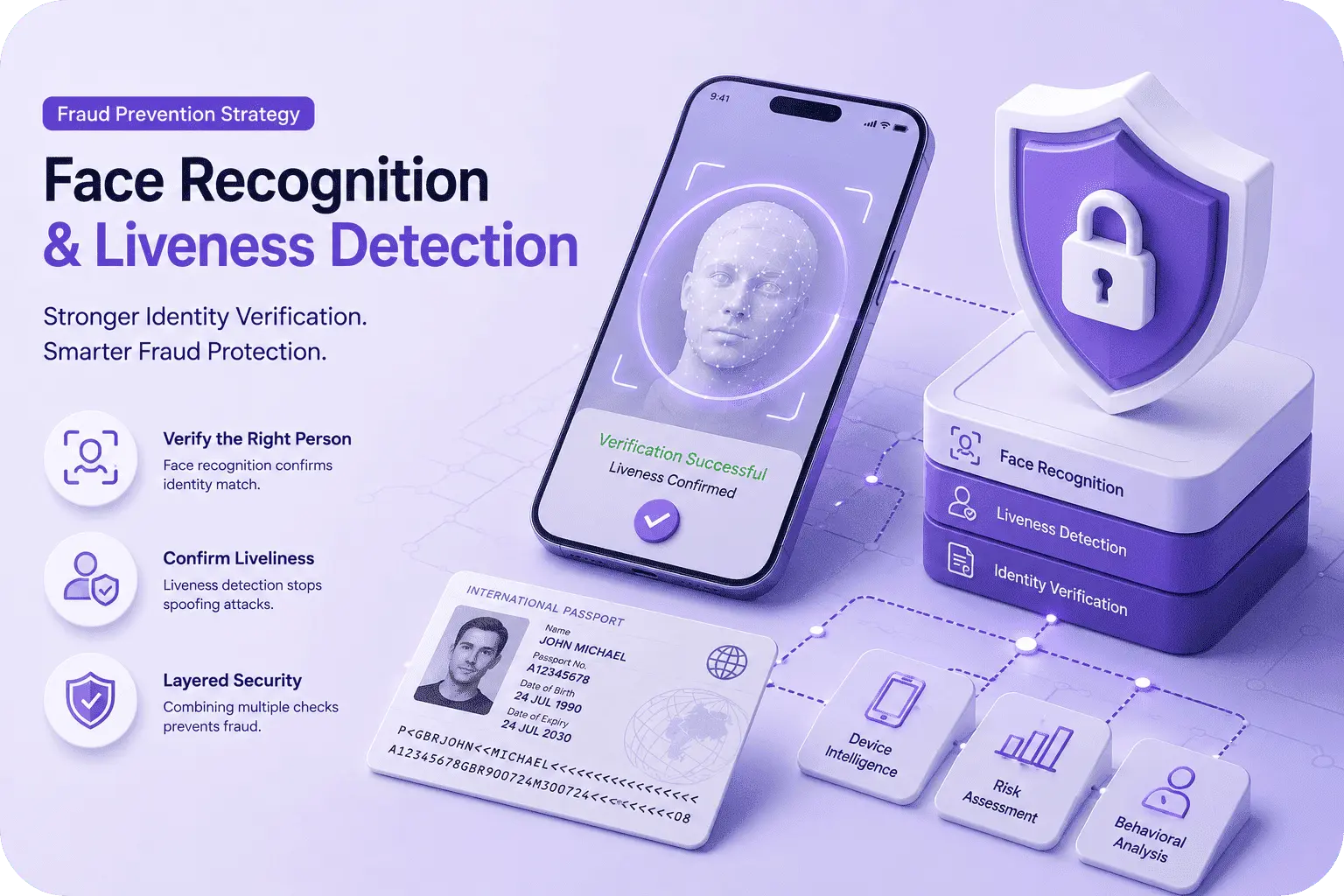
Face recognition can help establish whether a person’s face corresponds with a trusted identity. Liveness detection can help determine whether the biometric presentation comes from a genuine live person rather than a photograph, replay, or other presentation attack.
Together, these technologies can strengthen face recognition fraud prevention and provide an additional layer of biometric security.
The important point, however, is that neither technology should be treated as a complete fraud solution by itself. The strongest approach combines biometrics with identity verification, document checks, device intelligence, risk analysis, behavioral signals, and ongoing monitoring.
This guide explains how to build that layered strategy and how face recognition and liveness detection fit into the wider identity fraud prevention process.
Why Modern Fraud Prevention Requires Multiple Layers
Fraud rarely depends on one weakness.
An attacker may first obtain legitimate identity information, use it to create or acquire a genuine document, and then attempt to bypass biometric controls with manipulated media. If an onboarding system relies on only one verification signal, several parts of that attack can remain undetected.
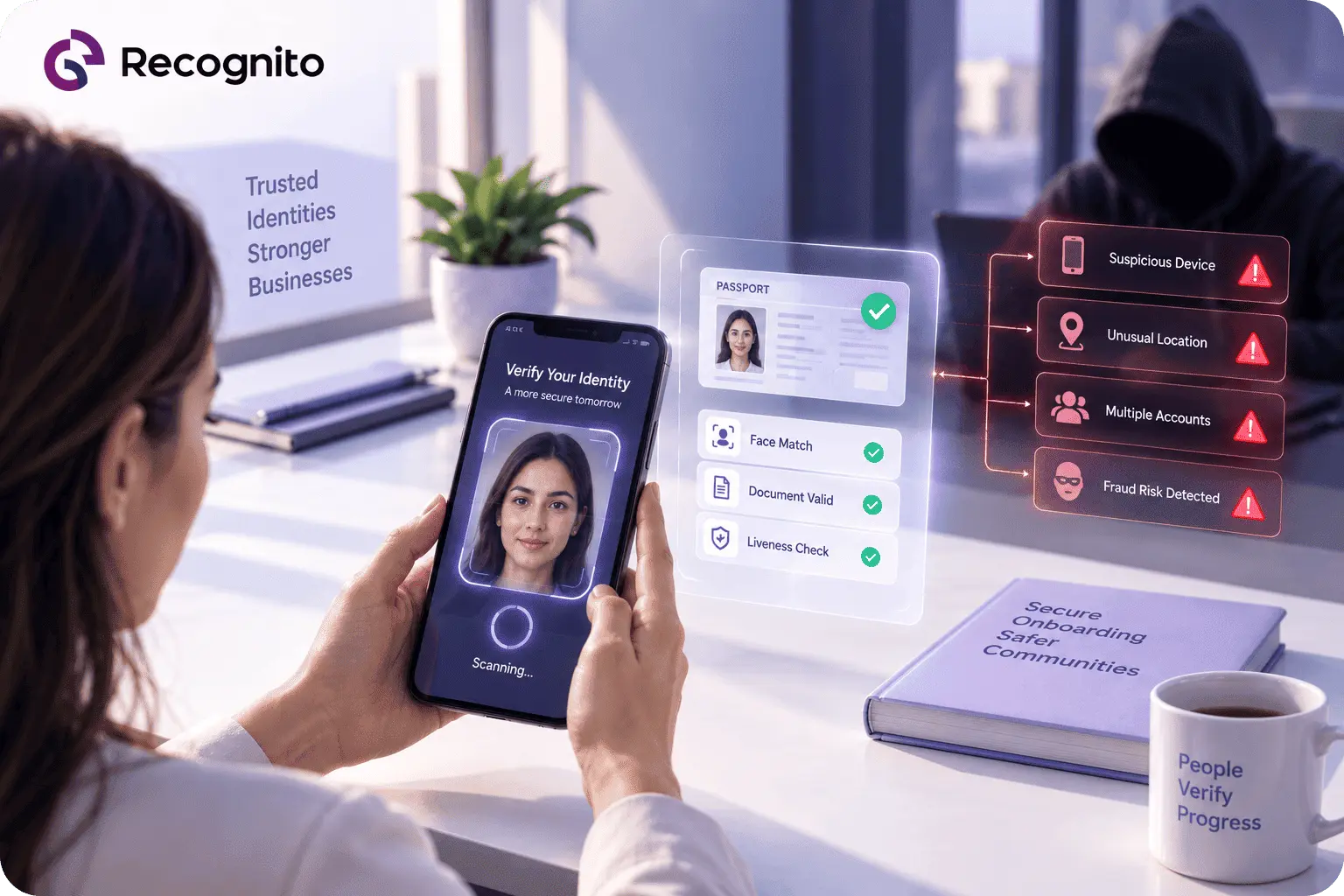
Consider a genuine passport being used by the wrong person. Document verification may determine that the passport appears authentic, but it does not necessarily establish that the person holding it is the rightful owner.
Facial verification can address that gap by comparing the applicant’s face with the trusted facial image associated with the identity.
But facial matching creates another question: is the captured face actually coming from a live person?
This is where liveness detection becomes important.
A layered fraud architecture therefore separates several questions:
- Is the identity information credible?
- Is the document authentic?
- Does the person’s face match the trusted identity?
- Is the biometric presentation genuine?
- Does the overall activity appear risky?
Each layer addresses a different part of the identity fraud problem.
What Role Does Face Recognition Play in Fraud Prevention?
Face recognition compares facial characteristics from a captured image with another facial representation.
During customer onboarding, the reference may come from an identity document or another trusted identity record. During authentication, it may come from a previously enrolled biometric template.
The purpose is to determine whether the face presented during the current interaction is sufficiently consistent with the identity associated with the account.
This can help address several common fraud scenarios.
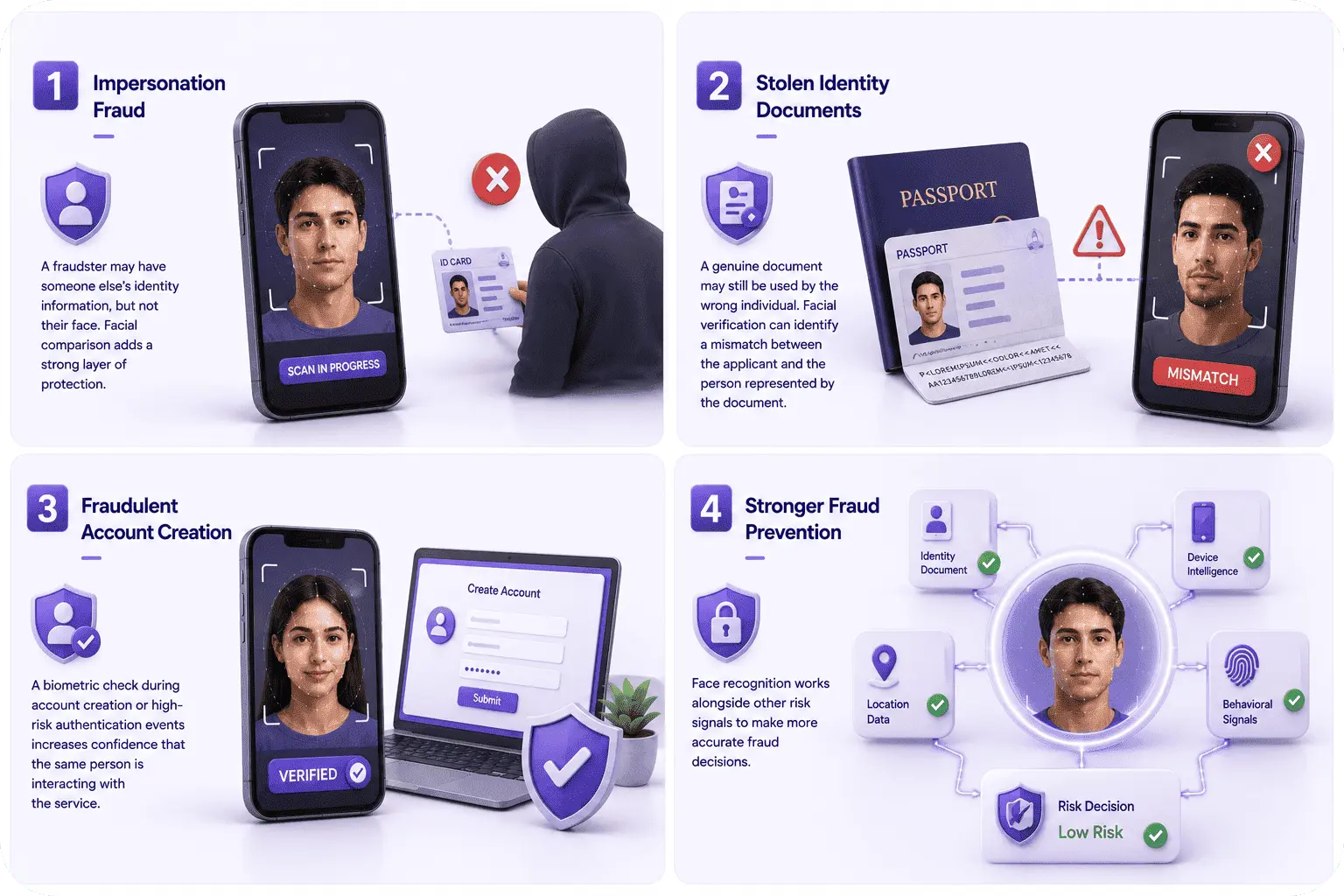
Impersonation Fraud
A fraudster may possess another person’s identity information but not their face. Facial comparison provides an additional barrier against this type of impersonation.
Stolen Identity Documents
A genuine document may still be used by the wrong individual. Facial verification can identify a mismatch between the applicant and the person represented by the document.
Fraudulent Account Creation
A biometric check can be included during account creation or higher-risk authentication events to increase confidence that the same person is interacting with the service.
For organizations building this capability into an application, a facial biometric SDK can provide the underlying biometric matching component.
The broader value comes from how that component is connected to the rest of the fraud decision.
Why Face Recognition Alone Is Not Enough
Face recognition can provide strong identity evidence, but it does not automatically establish that a real person is physically present.
An attacker may attempt to present:
- A printed photograph
- An image on a smartphone screen
- A replayed video
- A manipulated video stream
- A physical mask
- Synthetic or deepfake facial media
If the biometric system treats one of these presentations as a genuine sample, the facial matching control can be bypassed.
This is why organizations should distinguish between face matching and biometric presentation security.
The first asks whether the facial characteristics correspond.
The second asks whether the biometric capture itself can be trusted.
What Does Liveness Detection Add?
Liveness detection is designed to assess whether a biometric presentation appears to originate from a genuine live subject.
In a remote facial verification workflow, it can analyze the capture and associated signals to identify signs that the user may be presenting an artificial representation instead of their actual face.
A liveness detection SDK can therefore complement facial matching in a broader identity and fraud workflow.
The technologies answer different questions:
Face recognition: Does the presented face correspond with the trusted reference?
Liveness detection: Does the biometric presentation appear to come from a genuine live person?
Used together, they provide a stronger control than either capability can provide independently.
Organizations evaluating different interaction models can also review active and passive liveness detection to understand how user interaction, security, and friction can vary.
Common Fraud Attacks a Layered Biometric Strategy Can Address
A useful fraud prevention strategy should begin with the actual threats an organization faces.
Stolen Identity Information
Attackers can obtain personal information from data breaches, phishing, or other sources and use it to create fraudulent accounts.
Identity verification establishes whether the submitted information is credible, while biometrics can provide an additional connection between the identity and the individual.
Synthetic Identity Fraud
Synthetic identity fraud combines real and fabricated information to create apparently legitimate identities.
These profiles can be difficult to detect when onboarding relies heavily on static information.
A combination of document verification, biometric verification, liveness, and risk analysis creates additional signals that can make synthetic identities harder to use successfully.
Recognito’s guide to detecting synthetic identity fraud provides a deeper look at this attack pattern.
Deepfake Attacks
Generative AI can produce increasingly convincing synthetic facial imagery and manipulated video.
This makes anti-spoofing controls increasingly important for organizations using remote biometrics.
The deepfake attack prevention guide explores how organizations can respond to this changing threat.
Presentation Attacks
Presentation attacks attempt to interfere directly with biometric capture.
Security teams should therefore examine what attack classes their liveness implementation is designed to address and how those capabilities have been tested.
The ISO/IEC 30107-3:2023 standard provides principles and methods for assessing presentation attack detection mechanisms and reporting results.
Designing the Fraud Prevention Workflow
The technology becomes much more useful when it is placed in the correct sequence.
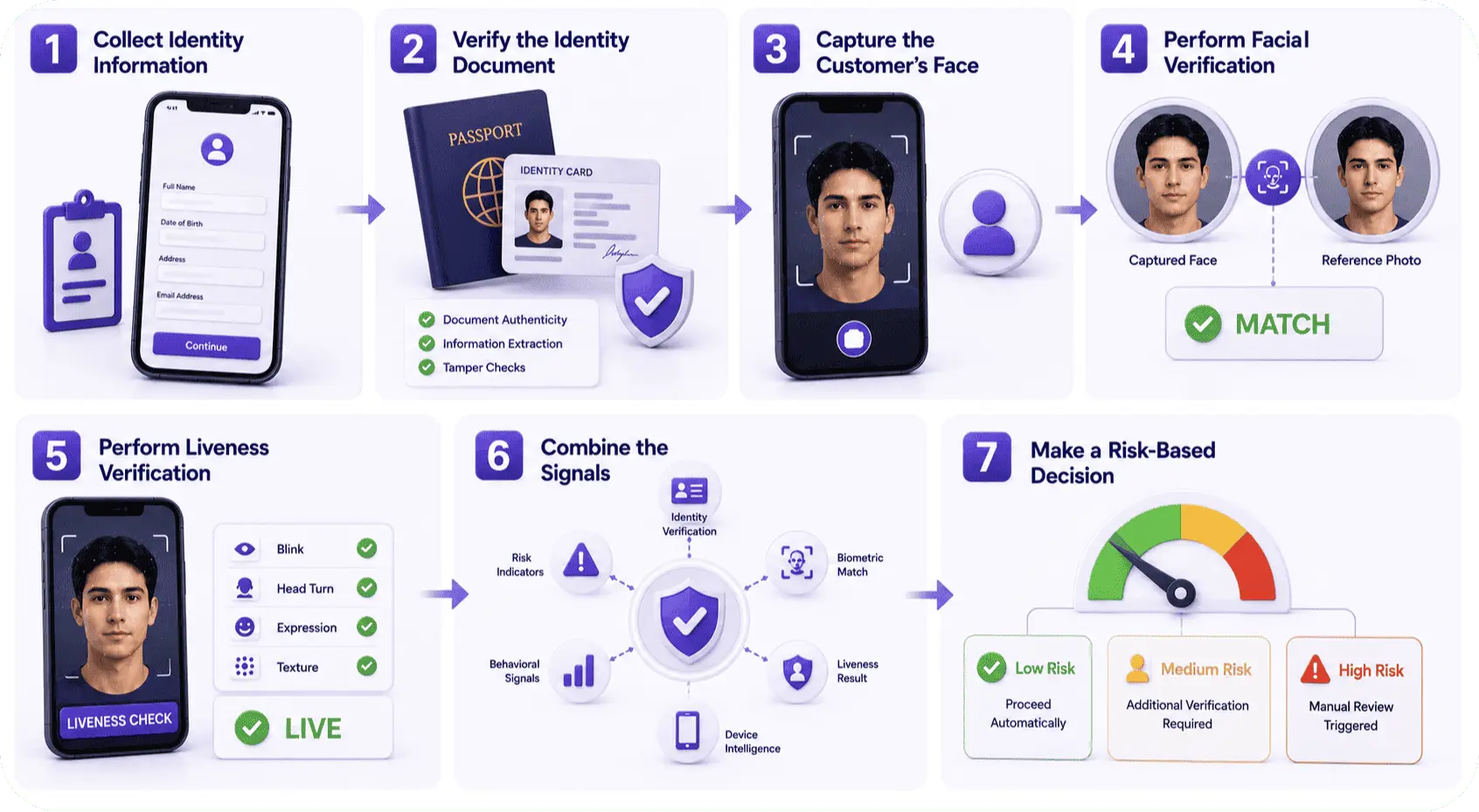
A typical remote identity workflow can include several stages.
1. Collect Identity Information
The customer provides the information needed to begin onboarding.
2. Verify the Identity Document
The system evaluates the submitted document and extracts the required information.
3. Capture the Customer’s Face
The customer provides a facial sample through the device camera.
4. Perform Facial Verification
The captured face is compared with the trusted reference identity.
5. Perform Liveness Verification
The system evaluates whether the biometric presentation appears genuine.
6. Combine the Signals
The identity, biometric, liveness, device, behavioral, and risk results are evaluated together.
7. Make a Risk-Based Decision
Low-risk applications may proceed automatically, while suspicious cases can receive additional verification or manual review.
This structure prevents one biometric feature from having to make the entire fraud decision on its own.
Adding Document Verification to the Strategy
Document verification remains important even when an organization has advanced facial biometrics.
A face recognition system needs a trusted reference against which the facial sample can be compared. In remote onboarding, that reference frequently originates from an identity document.
An ID document recognition SDK can support automated analysis of passports, national identity cards, driver’s licenses, and other supported documents before facial verification occurs.
This creates a clear relationship between the layers.
Document verification helps establish the identity evidence.
Facial verification connects the person to that identity evidence.
Liveness verification helps determine whether the biometric presentation is genuine.
The value comes from combining the results rather than treating the technologies as separate checks.
Building a Risk-Based Fraud Decision
Not every customer interaction requires the same level of scrutiny.
A standard account opening may require ordinary identity and biometric checks. A high-risk transaction or suspicious account event may require stronger controls.
This is where risk-based decisioning becomes important.
A fraud engine might evaluate:
- Identity verification results
- Facial similarity
- Liveness outcome
- Device characteristics
- Geographic consistency
- Previous account activity
- Transaction behavior
- Previous fraud indicators
The result does not necessarily need to be a simple “fraud” or “not fraud” classification.
Instead, the system can determine whether the interaction should be:
Approved
Challenged
Reviewed manually
Rejected
This allows organizations to apply stronger verification where it adds value without making every legitimate customer complete an unnecessarily difficult process.
Choosing the Right Biometric Security Controls
Not every organization needs the same fraud architecture.
A banking platform, cryptocurrency exchange, internal enterprise application, and low-risk consumer service may have very different threat models.
The technology evaluation should therefore consider recognition performance, liveness capabilities, presentation attack protection, platform compatibility, integration effort, processing speed, scalability, privacy, technical support, and total cost of ownership.
Independent testing can provide useful evidence when comparing technologies. The NIST Face Technology Evaluations provide independent information about facial recognition performance under defined testing conditions.
However, benchmark results should complement rather than replace testing with the organization’s own users, devices, workflows, and threat scenarios.
How Should Fraud Prevention Performance Be Measured?
Deploying biometric technology is not the end of fraud prevention.
Organizations should continuously monitor how the strategy performs after launch.
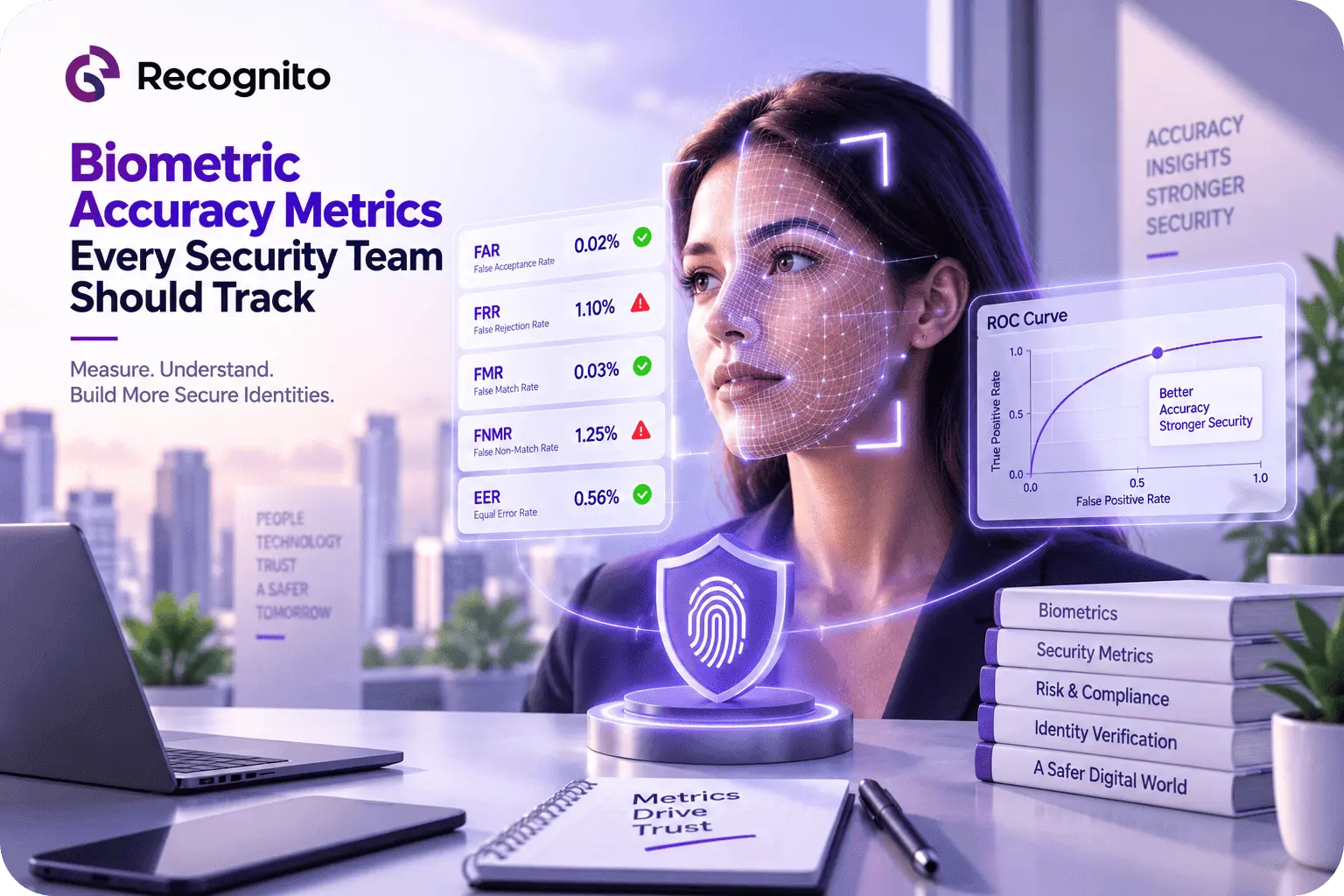
Useful metrics include:
- Fraud detection rate
- False acceptance rate
- False rejection rate
- Verification completion rate
- Manual review rate
- Customer abandonment
- Average verification time
- Liveness failure rate
- Fraud losses prevented
These metrics need to be viewed together.
For example, increasing security sensitivity may reduce fraudulent approvals but also increase legitimate customer rejection.
The objective is not to maximize rejection.
It is to find an appropriate balance between fraud prevention, customer experience, and operational efficiency.
Common Mistakes When Building a Biometric Fraud Strategy
Even sophisticated biometric technology can underperform when the surrounding implementation is weak.
Treating Facial Recognition as a Complete Fraud Solution
Facial matching is one useful identity signal, but it should generally operate alongside other verification and risk controls.
Ignoring Liveness
A highly accurate recognition algorithm can still be exposed to presentation attacks if biometric capture is not adequately protected.
Applying the Same Verification Level to Everyone
Customer and transaction risk varies. A one-size-fits-all model can either create unnecessary friction or leave high-risk situations underprotected.
Focusing Only on Accuracy
Accuracy matters, but privacy, scalability, integration, security, and usability also determine whether the system works effectively in production.
Failing to Monitor After Deployment
Fraud techniques evolve. A strategy that performs well today should be continuously reviewed against emerging attack patterns and changing customer behavior.
How Biometric Security Fits Into Digital Onboarding
For digital onboarding, the objective is to establish sufficient confidence in the applicant without making the customer journey unnecessarily complicated.
A well-designed workflow can combine document verification, facial verification, liveness, and risk signals while keeping most of the complexity behind the scenes.
This is particularly important in financial services, where customers expect fast onboarding while the institution must maintain strong fraud and compliance controls.
The result should be a balanced system that supports:
- Security
- Fraud prevention
- Regulatory compliance
- Customer experience
- Operational efficiency
These goals should reinforce each other rather than compete unnecessarily.
How Different Biometric Technologies Work Together
The strongest fraud architectures do not treat identity verification, face matching, and liveness as isolated products. They connect the results so each control addresses a different part of the fraud problem.
| Fraud Control | What It Helps Establish | Example Risk Addressed |
| Identity document verification | Whether the submitted identity credential appears authentic | Forged or manipulated documents |
| Face recognition | Whether the applicant corresponds to the trusted facial reference | Impersonation and stolen identities |
| Liveness detection | Whether the biometric presentation appears genuine | Photos, replay attacks, and presentation attacks |
| Device and behavioral signals | Whether the interaction is consistent with normal customer activity | Coordinated or automated fraud |
| Risk-based decisioning | Whether the combined signals justify approval or additional checks | High-risk onboarding or transactions |
For example, a genuine document combined with a strong facial match and successful liveness should generally produce a different risk profile from a genuine document combined with a weak facial match and suspicious device behavior.
This is where fraud orchestration becomes increasingly important.
Instead of asking whether a single control says “pass,” the system can ask:
Do the available signals collectively support the identity and risk assessment?
That creates a stronger basis for automated fraud prevention while allowing organizations to apply additional verification when the signals do not align.
Building a Sustainable Fraud Prevention Program
A strong initial implementation is valuable, but fraud prevention requires continuous management.
Establish Clear Ownership
Security, fraud, compliance, product, and engineering teams should understand who owns biometric performance and fraud outcomes.
Review Threats Regularly
Attack techniques, particularly deepfakes and synthetic media, can evolve quickly.
Test Under Real Conditions
The production environment should be tested using realistic devices, users, documents, and workflows.
Tune Risk Thresholds
Verification thresholds should be based on observed performance and business risk rather than arbitrary settings.
Maintain the Technology
SDK versions, operating systems, security controls, and biometric models should be reviewed and updated as the environment changes.
Where SDK-Based Biometrics Fit Into the Strategy
Organizations often do not need to build every biometric capability themselves.
An SDK can provide the biometric component while internal teams focus on the fraud strategy, customer experience, application architecture, and compliance model.
For organizations evaluating biometric face matching, a facial biometric SDK can form the recognition layer of the workflow.
Liveness can provide an additional biometric anti-spoofing capability, while document analysis can establish the identity evidence required before matching takes place.
Technical teams can also explore the Face Biometric Playground when evaluating the practical user experience and integration approach.
For developers, the Recognito GitHub repository provides additional technical resources that can support implementation research.
The right combination should still be determined by the organization’s risk model rather than by the number of features a provider offers.
A Practical Framework for Implementation
Before taking a biometric fraud prevention strategy into production, organizations should work through a structured process.
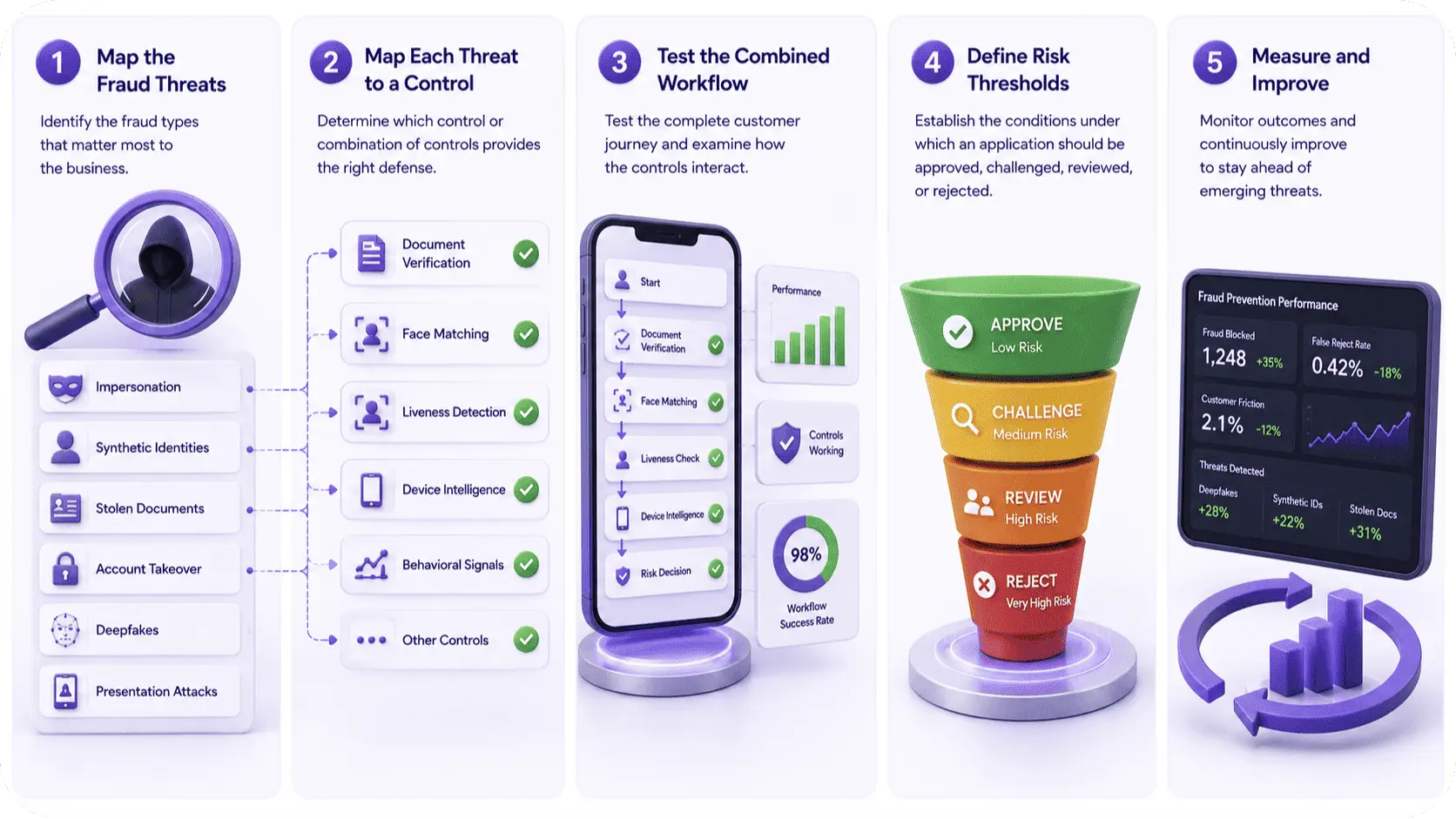
1. Map the Fraud Threats
Identify the fraud types that matter most to the business, including impersonation, synthetic identities, stolen documents, account takeover, deepfakes, and presentation attacks.
2. Map Each Threat to a Control
Determine whether document verification, face matching, liveness, device intelligence, behavioral signals, or another control provides the appropriate defense.
3. Test the Combined Workflow
Do not evaluate each component only in isolation. Test the complete customer journey and examine how the controls interact.
4. Define Risk Thresholds
Establish the conditions under which an application should be approved, challenged, reviewed, or rejected.
5. Measure and Improve
Monitor fraud outcomes, customer friction, false decisions, and emerging threats after launch.
This creates a fraud prevention system that can evolve instead of remaining fixed around the assumptions made during initial implementation.
Conclusion
A strong fraud prevention strategy using face recognition and liveness detection should be built around layers rather than a single biometric control.
Facial recognition can help establish the relationship between a person and a trusted identity. Liveness can help protect the biometric capture process from presentation attacks. Document verification can provide identity evidence, while device, behavioral, and risk signals can add further context.
The most effective approach is therefore not to ask which individual technology is best in isolation.
It is to determine how the technologies can work together to address the organization’s actual fraud risks while preserving an acceptable customer experience.
Organizations should continuously monitor fraud outcomes, false rejection rates, operational performance, and emerging attack methods rather than treating biometric deployment as a one-time project.
Businesses evaluating biometric technologies for fraud prevention can explore the broader capabilities available from Recognito as part of their identity and security architecture.
Frequently Asked Questions
How does face recognition help prevent fraud?
Face recognition can help establish whether the person presenting an identity corresponds to a trusted facial reference. This can reduce impersonation and certain identity fraud attempts during onboarding and authentication.
Why is liveness detection important for face recognition?
Liveness detection helps determine whether a biometric presentation appears to come from a genuine live person rather than a photograph, replay, mask, or another presentation attack.
Is face recognition alone enough for fraud prevention?
No. Strong fraud prevention generally combines facial verification with document verification, liveness detection, device intelligence, behavioral analysis, and risk-based decisioning.
How should businesses measure a biometric fraud prevention strategy?
Organizations should monitor fraud detection outcomes, false acceptance and rejection rates, verification completion, manual review rates, customer abandonment, verification time, liveness failures, and fraud losses.
What should organizations consider before implementing biometric fraud prevention?
They should evaluate biometric performance, liveness protection, privacy, integration, scalability, user experience, security, regulatory requirements, monitoring, and the total cost of operating the solution.