
University admissions are built around a basic assumption: the person applying is the person represented by the submitted academic records and identity documents.
When that assumption fails, the consequences can extend far beyond one fraudulent application. An impostor may gain admission using another student’s identity, submit altered credentials, create multiple identities across institutions, or obtain access to services and benefits intended for a legitimate student.
Digital applications make this harder to detect because admissions teams may never meet the applicant in person. Documents arrive electronically, photographs can be manipulated, and personal information can be collected from many sources. At the same time, universities must process large numbers of applications quickly and provide a convenient experience for genuine students.
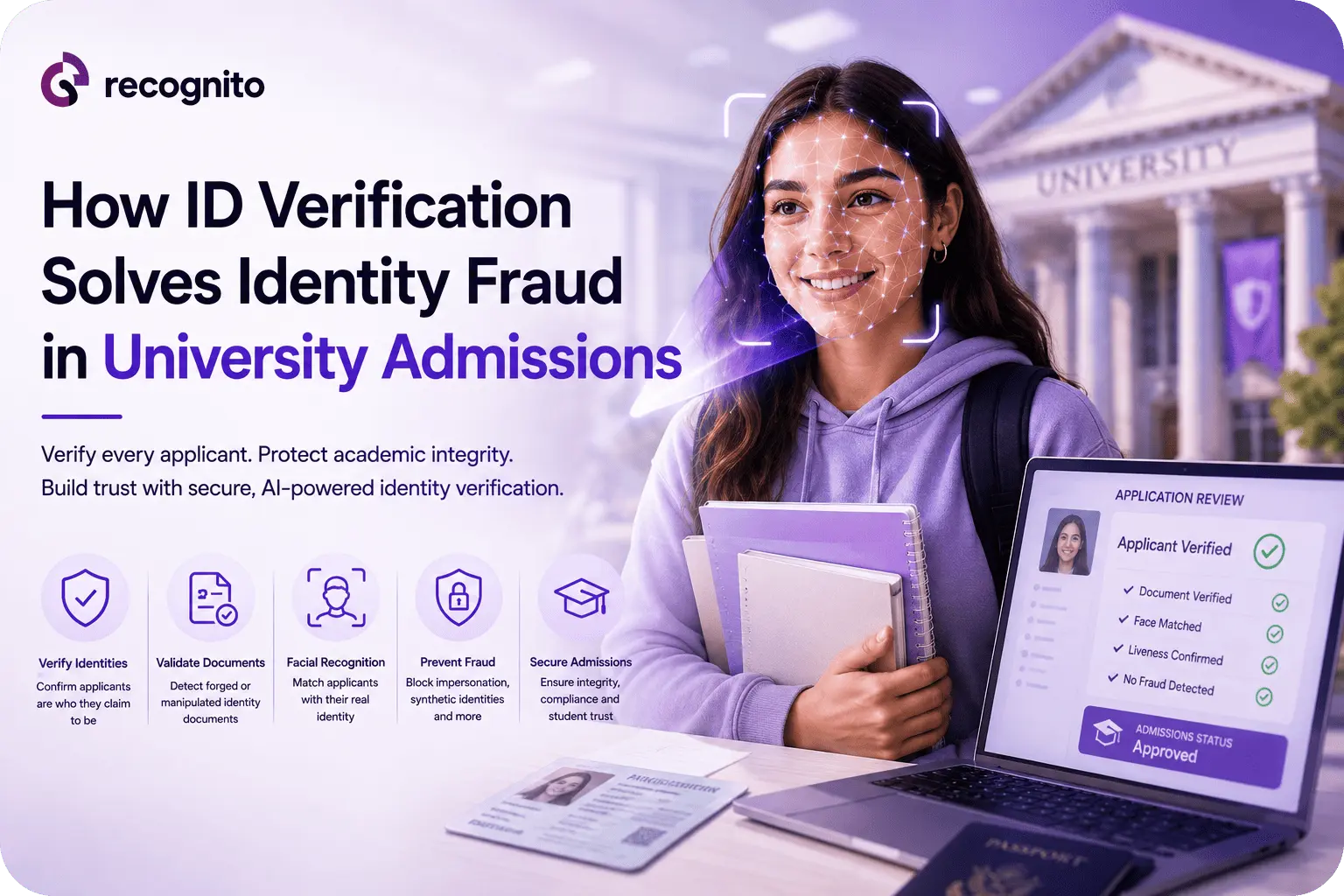
ID verification addresses this gap by connecting an applicant to trustworthy identity evidence before admission decisions are finalized. When document checks, biometric verification, liveness detection, and risk-based review work together, universities gain much stronger assurance that an application belongs to a real person.
Why Identity Fraud Is a Growing Admissions Problem
University admissions already rely on information that can be attractive to fraudsters: names, dates of birth, government-issued identifiers, academic records, addresses, and other personal data.
A stolen identity can therefore become more valuable when it is paired with forged academic information or access to a legitimate student’s records.
The risk is not limited to completely fabricated applications. Fraud can also involve:
- submitting someone else’s identity document
- altering personal details on application materials
- creating multiple identities
- using genuine documents obtained through theft or deception
- misrepresenting information to gain an unfair admissions advantage
- attempting to pass a verification step on behalf of another applicant
UCAS, for example, operates a dedicated Verification Team to prevent and detect fraud in applications and to screen for false, missing, or misleading information. Its process illustrates an important point: admissions integrity depends on verifying more than whether an application form is complete. It depends on establishing that the information and identity behind the application are credible.
As admissions move further online, universities need technology that can perform part of the identity-assurance process without recreating a fully manual admissions office.
Identity Verification Changes the Question Universities Ask
A traditional admissions workflow may ask:
“Does this application contain the required information?”
A stronger digital workflow asks:
“Can we establish that this applicant is the person represented by the submitted identity evidence?”
That distinction is the foundation of identity verification.
NIST’s current identity proofing and enrollment guidance describes identity proofing as the process of establishing sufficient confidence that an applicant is associated with the claimed identity. Although NIST’s requirements are designed for government digital identity systems, the underlying concepts provide a useful reference for universities designing remote identity workflows.
For admissions teams, identity verification becomes a bridge between the application and the individual behind it.
How ID Verification Works in University Admissions
A modern admissions verification process can combine several stages.
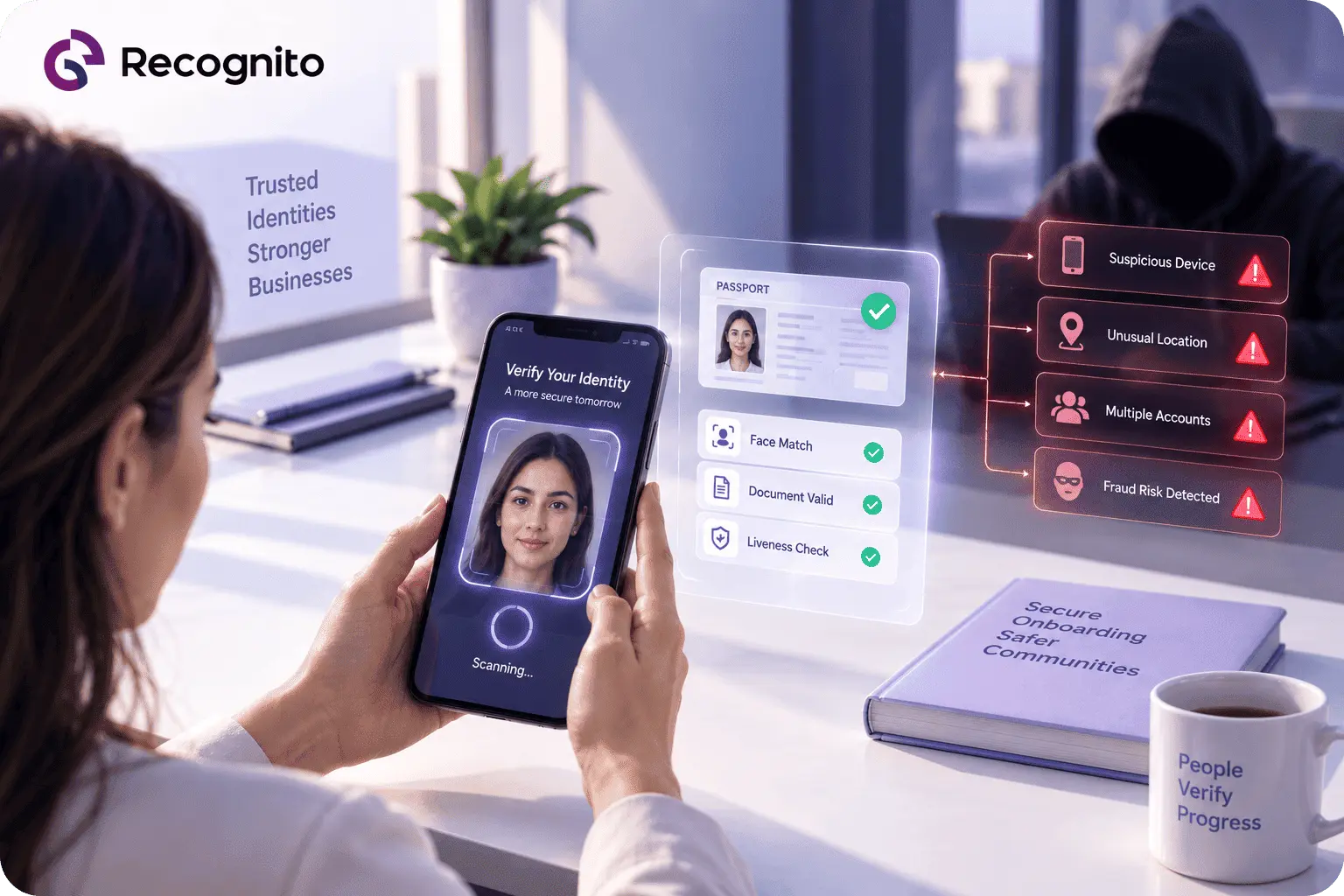
1. Capture identity evidence
The applicant photographs a passport, national identity card, driving licence, or another accepted credential using a phone or computer.
The capture process should guide the student toward a clear image rather than accepting any arbitrary upload.
2. Analyze the document
Document recognition and OCR can identify the document type, extract fields, and detect inconsistencies.
The system may also evaluate characteristics associated with document authenticity and image manipulation.
3. Verify the applicant
The extracted identity information can be checked against other available evidence and, when appropriate, authoritative data sources.
4. Compare the student with the document
A selfie or live facial capture can be compared with the portrait associated with the identity document.
This is particularly useful for remote admissions because it connects the person holding the device to the identity evidence submitted earlier.
5. Check liveness
A facial match is not enough on its own. Someone attempting impersonation could present a photograph, replayed video, or other manipulated media.
Liveness detection adds a separate control designed to determine whether the facial input comes from a live person.
6. Make a risk-based decision
Applications with consistent evidence can continue automatically. Conflicting or suspicious cases can be routed for further verification or manual review.
That approach allows admissions teams to spend their time on difficult cases rather than manually checking every application.
For a deeper explanation of how identity proofing differs from later verification, see identity proofing vs identity verification.
Why Document Verification Alone Is Not Enough
A genuine-looking identity document does not necessarily prove that the person submitting it is the rightful holder.
Consider a student who obtains a genuine passport belonging to someone else. The document may pass basic authenticity checks. The problem is not necessarily the document itself; it is the connection between the document and the applicant.
This is where biometric verification becomes useful.
A facial comparison can determine whether the person completing the application resembles the portrait on the identity document. The result does not prove every fact about the student, but it adds an identity-binding layer that a document image alone cannot provide.
The broader relationship between these technologies is explained in document verification vs biometric verification.
The strongest admissions workflows therefore do not choose between document and biometric verification. They use each for a different purpose.
Liveness Detection Closes Another Security Gap
Biometric verification creates another possible attack surface.
If the system simply accepts a photograph uploaded by the applicant, an attacker may attempt to submit an image of the legitimate student. A stronger workflow uses live capture and presentation-attack defenses to increase confidence that the person participating in the session is physically present.
This matters particularly when admission verification takes place remotely.
A student might be thousands of miles away from campus, using a personal smartphone and an unfamiliar internet connection. The university needs evidence that is trustworthy despite the physical distance.
Liveness is therefore not a replacement for face matching. It is a complementary layer that helps answer a different question.
Face matching asks: Does the applicant resemble the identity reference?
Liveness asks: Is the biometric input coming from a live subject rather than a presentation attack?
For universities incorporating face verification into their digital identity workflows, a facial biometric SDK can provide the matching component needed for application integration.
Where ID Verification Creates the Biggest Value
The strongest business case is not simply fraud prevention. Identity verification can improve several parts of the admissions operation at once.
Protecting legitimate applicants
An impostor using someone else’s identity can interfere with the legitimate student’s educational opportunities and create difficult record-reconciliation problems.
Early identity verification reduces the chance that a fraudulent applicant reaches later stages unnoticed.
Reducing manual verification
Admissions offices often have limited staff relative to application volume. Automated document and biometric checks can handle straightforward applications while sending exceptions to trained reviewers.
That turns manual work into an escalation mechanism rather than the default processing method.
Improving downstream record integrity
A verified identity established during admissions becomes useful beyond the admission decision itself.
Universities may later need to connect the student to campus accounts, enrollment records, examination systems, certificates, housing, financial services, and other institutional processes.
Weak identity assurance at admission can therefore create problems that surface years later.
Detecting inconsistent applications earlier
Identity verification can also expose conflicts between submitted information and identity evidence.
A mismatch does not automatically mean fraud. It may be caused by a name change, transliteration difference, outdated document, or capture problem. But it gives the institution a reason to investigate before relying on questionable information.
Identity Verification Is Not the Same as Checking Academic Credentials
Universities should separate identity assurance from academic verification.
A student can have a legitimate identity and still submit fraudulent academic records.
Conversely, an authentic transcript does not prove that the person submitting it is the person named on it.
These are different controls addressing different risks.
A mature admissions architecture can therefore use identity verification alongside:
- academic credential verification
- application consistency checks
- institution-to-institution record validation
- fraud screening
- payment and enrollment controls
- manual review
The advantage comes from linking these controls rather than expecting one technology to solve every form of admissions fraud.
The Role of AI in the Verification Process
AI and computer vision are increasingly useful because they can process visual evidence at a scale that would be difficult to achieve manually.
AI-assisted systems may classify identity documents, extract text, detect visual inconsistencies, identify faces, compare biometric representations, and evaluate live captures.
The important consideration is not whether a vendor labels a product “AI-powered.” Admissions teams should understand what the technology actually evaluates and what happens when the system is uncertain.
A system should be able to distinguish between situations such as:
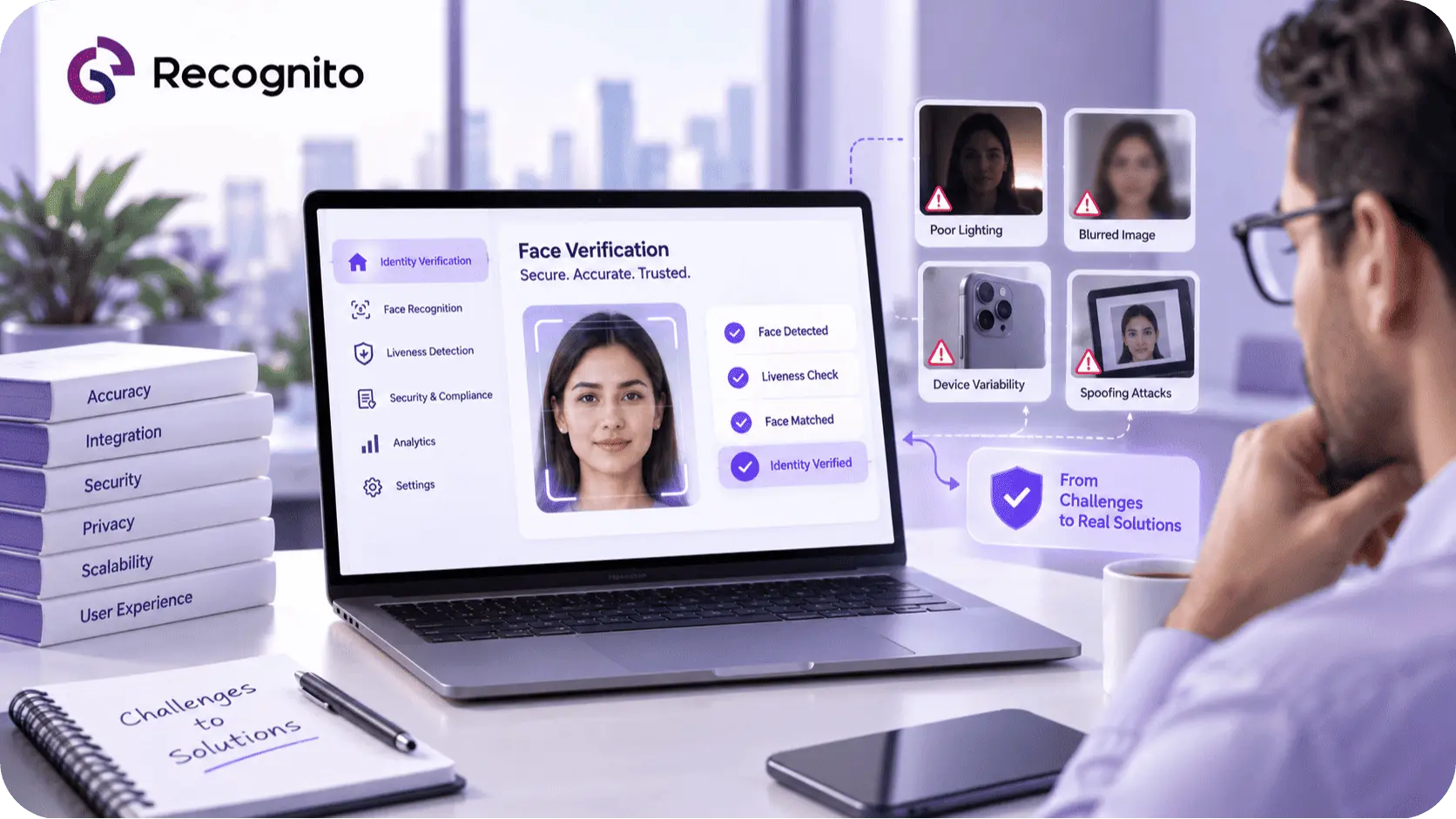
- poor image quality
- unsupported document
- unreadable fields
- possible document manipulation
- biometric mismatch
- failed liveness
- ambiguous result
That distinction matters operationally. A poor-quality camera image should not automatically be treated as evidence of fraud.
Teams reviewing automated verification should also examine common identity verification mistakes before designing the final admissions workflow.
Security Threats Universities Should Consider
The threat model for admissions is broader than forged documents.
Identity theft
A fraudster may obtain another person’s identity information and use it during application.
Document manipulation
An authentic document can be edited digitally before being uploaded.
Presentation attacks
An attacker may present a photograph, video, or other artificial representation during biometric capture.
Account takeover
An applicant’s existing university account can become a target if credentials are compromised after admission.
Multiple-account abuse
Fraudsters may attempt to create multiple profiles using different identity combinations.
Human error
Admissions staff may incorrectly approve inconsistent evidence, particularly during periods of high application volume.
This is why an effective identity system should combine automated controls with clear escalation procedures.
Designing the Capture Experience Matters
Security controls are only effective when students can complete them successfully.
A complicated verification flow can create unnecessary abandonment. Poor instructions can result in blurry document images, incorrect framing, repeated attempts, and avoidable manual reviews.
The capture interface should therefore guide users through the process.
Useful design elements include:
- clear document-positioning instructions
- automatic image-quality feedback
- guidance for face positioning
- immediate notification when a capture fails
- sensible retry limits
- accessible fallback procedures
- clear explanations of why verification is required
Universities also need to consider accessibility and device diversity. International applicants may use lower-end smartphones, different operating systems, or weaker network connections.
Verification should be secure without assuming that every applicant has identical hardware or connectivity.
Privacy Is a Major Part of Admissions Verification
Identity verification involves highly sensitive personal information, particularly when government documents and biometrics are involved.
Universities should define what information they actually need and establish clear policies for:
- collection
- storage
- transmission
- access
- retention
- deletion
- third-party processing
In the United States, FERPA defines personally identifiable information in education records broadly, including direct identifiers and indirect identifiers such as dates of birth that can distinguish or trace an individual. FERPA regulations also require educational institutions to use reasonable methods to identify and authenticate parties receiving access to covered records.
The Department of Education’s FERPA guidance on personally identifiable information is useful when considering how identity-related information should be handled within educational environments.
Importantly, privacy should influence the verification architecture from the beginning. Collecting more biometric or identity information than necessary can increase institutional risk without necessarily improving admissions assurance.
How Universities Should Evaluate an ID Verification Solution
Technology selection should be based on the actual admissions environment rather than a vendor’s headline accuracy number.
| Evaluation area | Questions to ask | Why it matters |
| Document support | Which passports, IDs, and permits are supported? | Determines international applicant coverage |
| Verification | How is the applicant linked to the submitted identity? | Reduces impersonation risk |
| Liveness | Which presentation attacks are addressed? | Strengthens remote biometric assurance |
| Performance | How does the system behave with poor captures? | Reduces unnecessary rejection |
| Integration | Are APIs and SDKs practical for existing systems? | Controls implementation complexity |
| Privacy | What data is stored and for how long? | Reduces data-governance risk |
| Review workflow | Can ambiguous cases be escalated? | Prevents automation from becoming a blind decision-maker |
| Monitoring | Can institutions measure failure and fraud patterns? | Supports continuous improvement |
Universities should test the system using the applicants and documents they actually expect.
An institution recruiting globally should not evaluate a verification platform only with a handful of domestic identity documents. Test passports, national IDs, residence documents, different cameras, different lighting conditions, and different levels of network quality.
A Practical Admissions Verification Workflow
A university implementing remote identity verification can structure the process around a few clear stages:
Application: The student submits the admissions application and identity information.
Document capture: The applicant captures an accepted government-issued document.
Document analysis: The system extracts identity attributes and evaluates the submitted evidence.
Biometric verification: The applicant completes a live facial capture where required.
Liveness assessment: The system checks whether the facial input appears to originate from a live subject.
Risk evaluation: Verification outcomes and other application signals are assessed together.
Escalation: Exceptions are reviewed manually or routed through an additional verification step.
Enrollment: Once identity assurance is sufficient, the verified identity can be linked to downstream student systems.
For organizations wanting to evaluate facial biometric behavior before integration, a face biometric playground can provide a practical environment for exploring capabilities and capture behavior.
What Good Implementation Looks Like
A reliable identity program is not simply a verification API connected to an application form.
It requires decisions about thresholds, exception handling, manual review, logging, privacy, system availability, and integration with existing student information systems.
The engineering team should also test failure conditions deliberately.
What happens if the document is unreadable? What happens if the face does not match? What happens if liveness fails? What happens if the applicant loses connectivity halfway through the process?
These scenarios should have defined outcomes rather than being left to ad hoc support processes.
For teams building integrations, the Recognito GitHub repository can complement technical evaluation and development work.
The Business Case for Early Identity Assurance
The cost of admissions fraud is not limited to the time required to investigate one suspicious application.
Once an identity is incorrectly associated with a student record, remediation can affect admissions, enrollment, student services, examination systems, financial records, and institutional reporting.
Early identity verification moves part of the risk decision closer to the point where the applicant first enters the institution’s systems.
That creates a valuable principle:
Verify the identity before building important downstream records around it.
The earlier an institution establishes confidence in the applicant’s identity, the fewer dependent processes have to be untangled when fraud is discovered later.
Conclusion
ID verification gives universities a practical way to strengthen admissions integrity in an environment where applicants, documents, and institutions may never meet physically.
The strongest approach combines document verification with biometric matching, liveness detection, risk-based decisioning, manual escalation, and careful privacy controls. Each layer answers a different question, and together they create much stronger identity assurance than any individual check.
The objective is not to make admissions harder. It is to make the institution more confident that the student receiving an admission offer is the person represented by the application and identity evidence.
For universities building secure digital identity workflows, Recognito provides technologies that can support practical document and biometric verification as part of a broader admissions security architecture.
Frequently Asked Questions
Can ID verification completely eliminate admissions fraud?
No. It reduces specific identity-related risks but does not replace academic credential checks, fraud screening, account security, or human investigation.
Should universities verify every applicant?
The appropriate approach depends on institutional risk, applicant population, regulatory requirements, and the consequences of identity failure. Some institutions may apply stronger checks to higher-risk workflows.
Why combine document and biometric verification?
A document can establish identity evidence, while biometrics can help connect the applicant to that evidence. Using both addresses different parts of the identity-assurance problem.
Does biometric verification create privacy risks?
Yes. Universities should carefully define data collection, storage, access, retention, deletion, and third-party processing requirements before deploying biometric verification.
What should universities test before selecting a provider?
Test real applicant conditions, supported identity documents, image quality, biometric matching, liveness, failure handling, international device diversity, integration, privacy controls, and manual-review workflows.