
When someone applies for a financial service, employment opportunity, or government service, they may be asked to submit the same passport, address, qualification, or identity information repeatedly. Each organization collects another copy, performs its own checks, and stores another version of the person’s identity data.
Decentralized identity offers a different approach. Instead of depending entirely on individual organizations to maintain separate identity records, people can hold digital credentials issued by trusted institutions and present selected information whenever verification is required.
Verifiable credentials make this possible through digitally structured, cryptographically protected claims that another party can independently validate.
The technology has the potential to improve identity portability, privacy, and interoperability. However, it also introduces new requirements around issuer trust, credential security, wallet management, and identity governance.
Understanding how these components work together is essential before adopting decentralized identity.
What Is Decentralized Identity?
Decentralized identity is an approach to digital identity management in which identity information is not controlled exclusively by one central identity provider.
Instead, individuals and organizations can receive, hold, and present identity credentials issued by different trusted authorities.
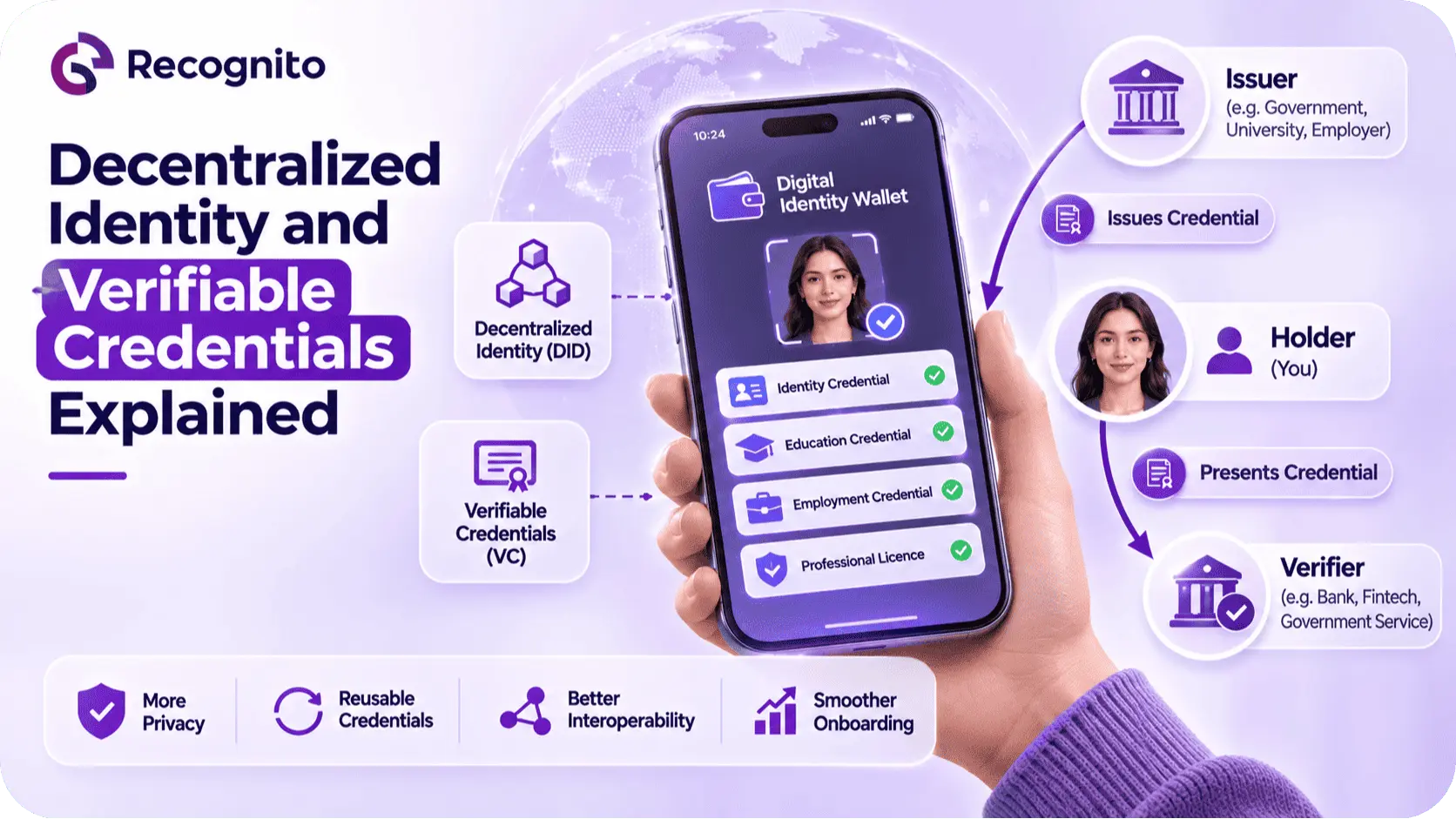
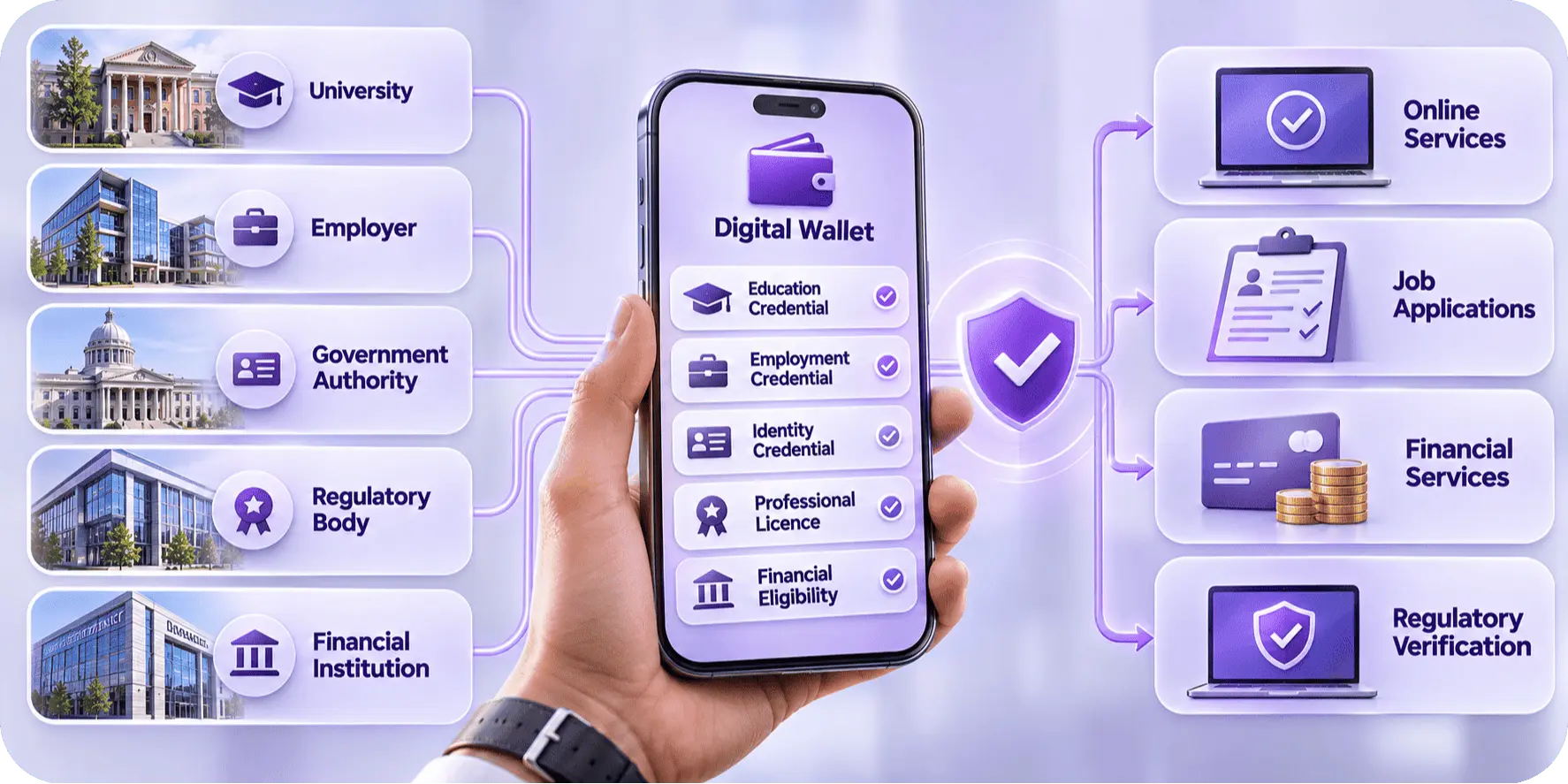
For example, a person might receive:
- An educational qualification from a university.
- An employment credential from an employer.
- An identity credential from a government authority.
- A professional licence from a regulatory body.
- An eligibility credential from a financial institution.
These credentials can be stored in a digital wallet and presented to organizations that need to verify specific information.
This changes the relationship between individuals and identity providers. Rather than repeatedly uploading documents, users can potentially reuse previously issued digital evidence.
Decentralized identity is frequently associated with Self-Sovereign Identity (SSI). Although the concepts overlap, SSI places particular emphasis on individual control, portability, and consent.
Importantly, decentralized identity does not mean that all identity information becomes public or that governments and trusted institutions disappear. Trusted issuers, verification services, registries, and governance authorities may still play essential roles.
What Are Verifiable Credentials?
A verifiable credential is a digitally structured collection of claims made by an issuer about a particular subject.
It is designed so that another party can check its integrity and verify the cryptographic proof associated with it.
Examples include:
- University degrees and professional qualifications.
- Government-issued identity credentials.
- Digital driving licences.
- Employment and organizational credentials.
- Insurance and membership information.
- Eligibility and age-verification credentials.
A conventional digital document may simply be a PDF or image. A verifiable credential contains machine-readable information and cryptographic evidence that helps establish whether the information has been altered and whether it originated from the claimed issuer.
The W3C Verifiable Credentials Data Model 2.0 became a W3C Recommendation on 15 May 2025. It establishes a standardized data model and defines an ecosystem involving issuers, holders, and verifiers.
However, cryptographic verification does not automatically prove that every claim is true or that the issuer is trustworthy. Those decisions require additional verification and trust policies.
The Three Main Participants in Decentralized Identity
1. Issuer
An issuer is an organization that verifies information and creates a digital credential.
Examples include government agencies, universities, employers, banks, and professional licensing authorities.
Before issuing a credential, the organization must establish that the information it contains is sufficiently reliable.
For instance, a university issuing a digital degree credential must have an appropriate process for confirming the graduate and qualification.
2. Holder
The holder is the individual or organization receiving and storing the credential.
Credentials are commonly stored in digital identity wallets, where users can manage their identity information and authorize presentations to other services.
The holder’s wallet also needs to protect associated cryptographic keys, because those keys may be required to demonstrate control over credentials.
3. Verifier
The verifier is the organization requesting and validating a credential.
A bank, employer, government portal, healthcare provider, or online platform may act as a verifier.
It checks the cryptographic proof, issuer identity, credential validity, status, and whether the information satisfies its requirements.
A credential can have a valid cryptographic signature but still originate from an issuer that the verifier should not trust. This distinction is fundamental to decentralized identity security.
How Verifiable Credentials Work
A typical verifiable credential lifecycle contains five stages.
1. Issuance: The issuer verifies the subject and creates a credential containing the relevant claims, protected through an appropriate cryptographic mechanism.
2. Storage: The credential is delivered to the holder’s digital wallet or another suitable repository. The holder must protect the credential and associated keys.
3. Request: A service requests specific information, such as proof of identity, age, qualification, or employment.
4. Presentation: The holder authorizes the requested information to be shared. Depending on the credential format, selective disclosure may allow the wallet to reveal only the required claims.
5. Verification: The receiving organization checks the proof, issuer, holder binding, validity period, and credential status before making a decision.
Issuing and presenting credentials are separate technical interactions.
The OpenID for Verifiable Credential Issuance 1.0 defines an API for credential issuance, while the OpenID for Verifiable Presentations 1.0 defines a protocol for requesting and presenting credentials.
These specifications help establish interoperable communication between different identity systems. However, organizations must still agree on credential formats, trust policies, wallet compatibility, and security requirements.
Decentralized Identifiers and Their Role
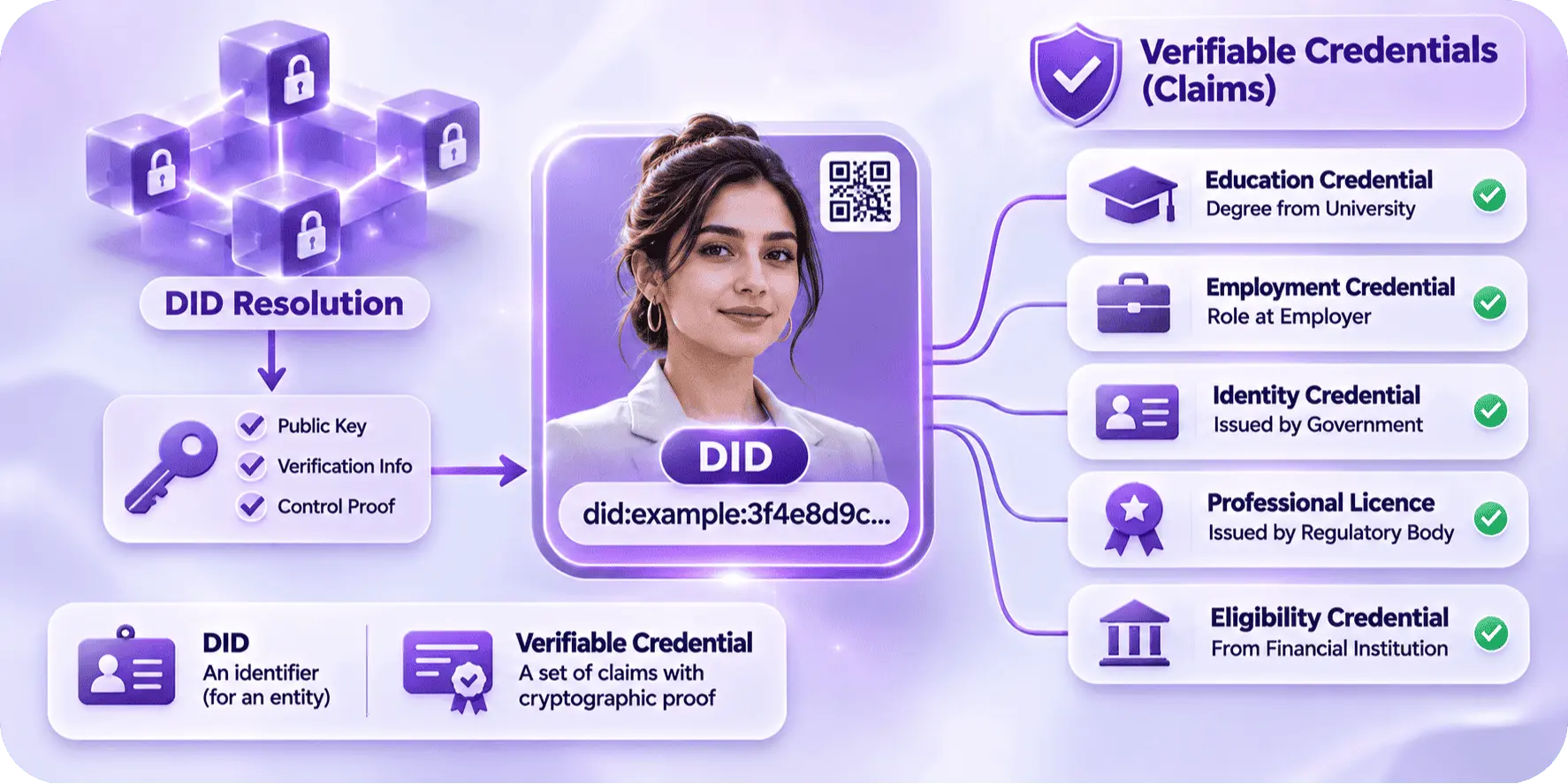
Decentralized Identifiers, commonly known as DIDs, are identifiers designed to be resolved through an associated method rather than depending exclusively on a centralized identifier registry.
A DID can identify an individual, organization, device, or another entity. Depending on the method, associated information may help a verifier discover public keys or other information required to verify control.
DIDs and verifiable credentials are related but are not interchangeable.
A DID represents an identifier, while a verifiable credential represents a set of claims supported by cryptographic proof.
Some decentralized identity ecosystems use DIDs, while others use alternative identifier and key-discovery approaches. There is no requirement for every implementation to adopt one universal DID method.
The identifier method, cryptographic mechanisms, and resolution infrastructure should be selected according to interoperability, security, and governance requirements.
What Makes a Verifiable Credential Trustworthy?
A valid cryptographic signature is only one part of establishing trust.
A verifier must also determine:
- Who issued the credential?
- Is the issuer authorized to make the particular claim?
- Has the credential been modified?
- Is the credential still within its validity period?
- Has it been revoked or suspended?
- Is it associated with the person presenting it?
- Does it provide sufficient assurance for the requested service?
The W3C data model does not establish one universal trust list for all issuers. Verifiers must independently determine which organizations they trust and for which claims or purposes.
This means decentralized identity ecosystems need appropriate governance arrangements, issuer accreditation, trusted registries, key management, credential status services, and procedures for handling disputes.
Without these arrangements, technically valid credentials may still be unsuitable for business decisions.
Privacy and Selective Disclosure
One of the most valuable aspects of verifiable credentials is their potential to reduce unnecessary disclosure.
Consider an online service that needs to confirm whether a customer meets a particular age requirement.
Traditional verification may involve requesting an identity document containing the person’s full name, address, date of birth, identification number, and photograph.
A credential-based process could allow the customer to present only the required age-related claim.
This approach is known as selective disclosure. However, it depends on the credential format and cryptographic mechanism. It is not automatically available in every verifiable credential implementation.
Privacy also depends on how presentations are designed. Excessive information requests, persistent identifiers, and repeated status checks may create opportunities to correlate a user’s activities across different services.
Organizations should therefore request only necessary information, explain why it is required, and avoid unnecessary tracking.
Where Decentralized Identity Can Be Used
| Industry | Example credential | Potential application |
| Financial services | Verified identity attributes | Reusable customer onboarding evidence |
| Employment | Employment and qualification credentials | Recruitment and workforce verification |
| Education | Degrees and training certificates | Digital qualification verification |
| Healthcare | Professional licences and insurance credentials | Provider and patient-related verification |
| Government | Identity and residency credentials | Access to digital public services |
| Business services | Company roles and authorization credentials | Verifying representatives and delegated authority |
Digital identity wallets can become an important part of these applications by allowing individuals to store and present credentials when required.
The future of digital identity wallets explores how this approach may change the way individuals manage and share identity information.
The European Digital Identity Wallet Initiative
The European Union is developing a major digital identity ecosystem through its revised eIDAS framework.
European Digital Identity Wallets are intended to allow citizens, residents, and businesses to identify themselves, store digital documents, and share selected information with public and private services.
The European Commission requires Member States to make wallets available by the end of 2026.
Its European Digital Identity framework overview describes the intended user-controlled approach and its potential applications.
However, implementation involves more than developing wallet applications. Interoperability, technical specifications, security requirements, certification, issuer participation, and governance are equally important.
In April 2026, ENISA reported progress on national wallet certification schemes and development of a European cybersecurity certification scheme. Its European Digital Wallet certification update explains the work supporting secure wallet deployment.
For businesses, this creates an important preparation requirement: verification systems should be capable of requesting, validating, and accepting compatible digital credentials.
Security Risks and Implementation Challenges
Decentralized identity changes how identity information is managed, but it does not eliminate security risks.
Wallet and key compromise
If a digital wallet is compromised or its cryptographic keys are exposed, an attacker may attempt to present credentials as the legitimate holder.
Secure key storage, wallet authentication, recovery procedures, and compromised-key response mechanisms are essential.
Issuer compromise
A compromised issuer could generate fraudulent credentials or expose signing keys.
Issuers need reliable identity proofing, secure key management, authorization controls, monitoring, and incident-response procedures.
Credential revocation and status
Credentials may expire, become invalid, or be revoked.
Verifiers need dependable status-checking mechanisms and clear procedures for situations where status information is unavailable.
Interoperability limitations
Different ecosystems may use different credential formats, cryptographic mechanisms, schemas, and trust frameworks.
Supporting one wallet does not guarantee that an organization can automatically accept credentials from every issuer.
User experience and recovery
Users may lose devices, forget recovery methods, or require accessibility support.
Without secure recovery and alternative verification options, decentralized identity could create barriers for legitimate users.
Governance and liability
Participants need clear rules covering issuer authorization, incorrect claims, disputes, compromised credentials, and security incidents.
These responsibilities should be established before deployment.
Is Decentralized Identity the Same as Blockchain Identity?
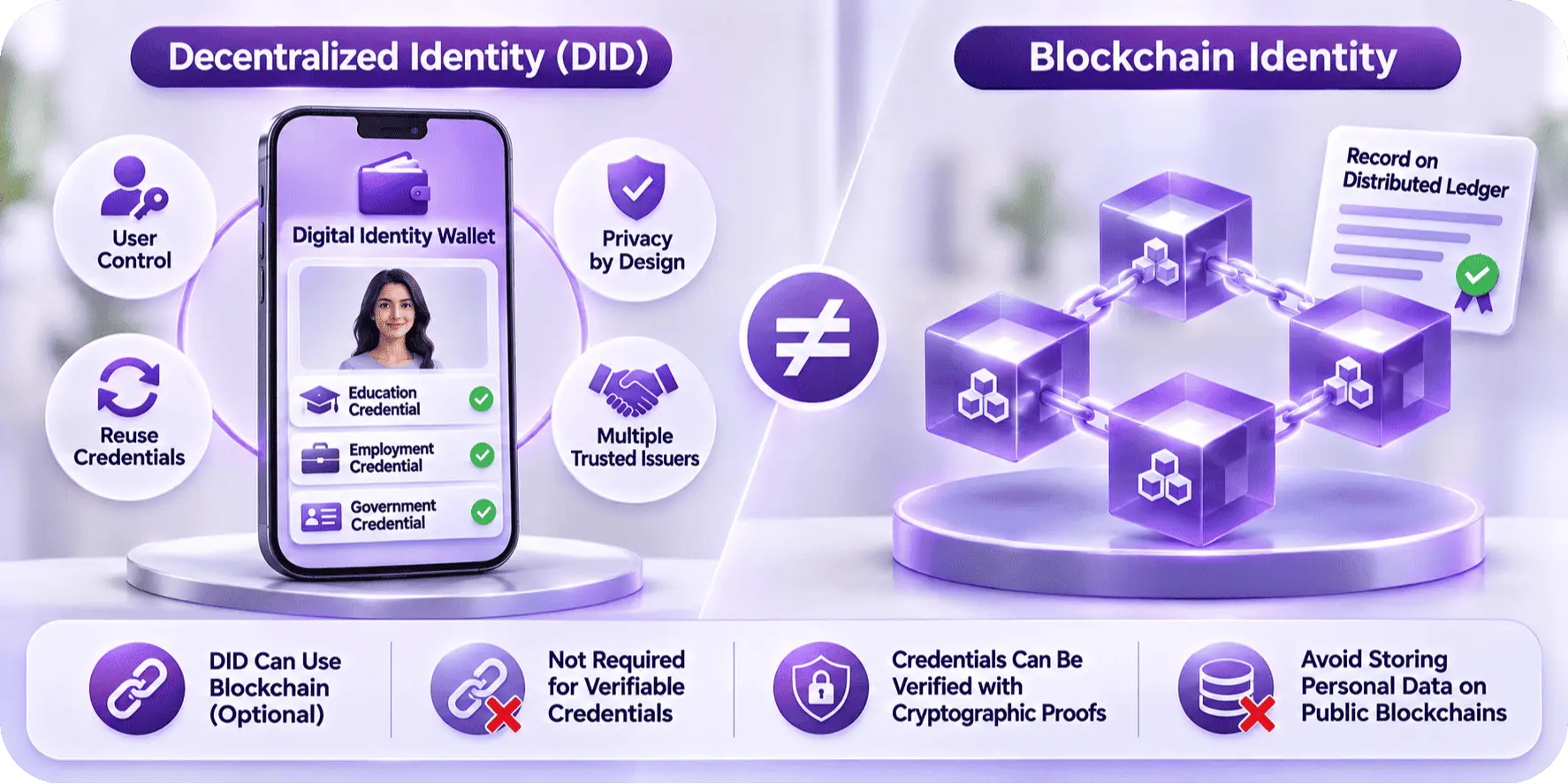
No. Although blockchain is frequently associated with decentralized identity, verifiable credentials do not require blockchain technology.
Some decentralized identity systems use distributed ledgers to publish identifiers, public keys, or registry information. Others rely on conventional infrastructure, trusted registries, and cryptographic mechanisms.
Credential integrity can be established through digital signatures and other cryptographic proofs without publishing personal identity information on a blockchain.
In fact, putting personal information or persistent identifiers on an immutable public ledger can create significant privacy and data-protection concerns.
The important question is not whether an identity platform uses blockchain. It is whether the participants can exchange evidence securely, establish trust, protect personal information, and verify credentials reliably.
How Organizations Can Prepare for Verifiable Credentials
Organizations considering decentralized identity should begin with a practical business requirement rather than adopting a wallet or protocol simply because the technology is available.
- Identify the use case. Determine whether the objective is reusable KYC evidence, employee credentials, qualification verification, or customer attributes.
- Establish issuer requirements. Define which organizations can issue credentials and how their authority will be verified.
- Select suitable standards. Evaluate credential formats, cryptographic mechanisms, and issuance and presentation protocols.
- Define verification policies. Establish how issuer trust, validity, status, and holder binding will be assessed.
- Secure wallets and keys. Plan enrollment, authentication, backup, recovery, and compromised-key response.
- Minimize personal data disclosure. Request only the claims necessary for each transaction.
- Test interoperability. Evaluate actual combinations of issuers, wallets, credential formats, and verification systems.
- Establish governance. Assign responsibility for trust management, disputes, incidents, and ongoing monitoring.
For businesses integrating identity evidence into digital onboarding, identity proofing vs identity verification explains two related but distinct stages of the identity process.
The identity verification API and digital customer onboarding guide provides additional context for engineering teams connecting identity verification capabilities with their applications.
Developers can also examine the Recognito GitHub repository alongside their broader technical evaluation and integration research.
Conclusion
Decentralized identity and verifiable credentials offer a different way to establish and exchange digital identity evidence.
Instead of repeatedly collecting the same documents, individuals can hold credentials issued by trusted organizations and present selected information to services that independently verify the evidence.
The approach can improve portability, privacy, and interoperability, but its success depends on reliable issuers, secure wallets, appropriate credential formats, trustworthy verification policies, and effective governance.
A cryptographic proof establishes integrity. It does not automatically establish issuer trust or guarantee that a credential is suitable for every decision.
Organizations should begin with a practical use case and evaluate the complete issuance, storage, presentation, and verification lifecycle before expanding.
For businesses exploring biometric and document-verification technologies alongside broader digital identity workflows, Recognito offers capabilities that can support identity verification as part of a wider ecosystem.
Frequently Asked Questions
Are decentralized identity and verifiable credentials the same thing?
No. Decentralized identity describes an approach to managing and exchanging identity information. Verifiable credentials are digitally structured claims that can be cryptographically verified and are commonly used within decentralized identity ecosystems.
Do verifiable credentials require blockchain?
No. Verifiable credentials can use cryptographic proofs without blockchain. Some implementations use distributed ledgers, but the credential model does not require them.
Who issues a verifiable credential?
A trusted organization issues it after validating the relevant information. Examples include governments, universities, employers, professional organizations, and financial institutions.
Can a verifier access everything stored in a digital wallet?
Not necessarily. When supported by the credential format and cryptographic mechanism, selective disclosure allows users to share only the requested claims.
Are verifiable credentials completely secure?
No technology is completely secure. Issuer trust, credential integrity, wallet protection, key management, status checking, privacy, and interoperability all require appropriate controls.