
A person does not need to show an identity document for every application that depends on age. Increasingly, organizations are exploring whether a camera and an AI model can estimate someone’s age or determine whether they appear to be above or below a defined threshold.
That sounds straightforward until the technology reaches a real environment. Facial age estimation is influenced by image quality, lighting, pose, expression, demographic characteristics, and the age of the person being assessed. A model may perform well in one population or condition and less reliably in another.
For businesses, facial age estimation is therefore less about producing a number and more about understanding the confidence and limits behind that number. It can support age assurance, access control, personalization, safety controls, and research, but the right implementation depends on the consequences of an incorrect decision.
Facial Age Estimation Is Not Facial Recognition
Facial age estimation and facial recognition use face images, but they answer different questions.
Facial recognition attempts to determine who a person is by comparing biometric information with another sample or enrolled identity. Age estimation instead examines a face and predicts an age or age range without needing to identify the individual.
NIST makes this distinction explicit in its age-estimation evaluation. Age estimation uses images associated with known ages to learn relationships between facial characteristics and age, while face recognition focuses on identity comparisons.
That difference also matters for privacy. A system designed only to estimate age can, depending on its architecture, operate without creating a persistent identity record. NIST notes that age estimation can be performed statelessly, meaning the captured image or derived information does not necessarily need to be retained after processing.
Businesses should still treat facial data as sensitive personal information where applicable. Not identifying someone does not automatically remove privacy obligations.
How Facial Age Estimation Works
A typical age-estimation pipeline begins with a camera image or video frame.
The software first detects a face and determines whether the input is suitable for analysis. The model then processes facial characteristics that correlate with age and produces an estimated value.
There are two common approaches.
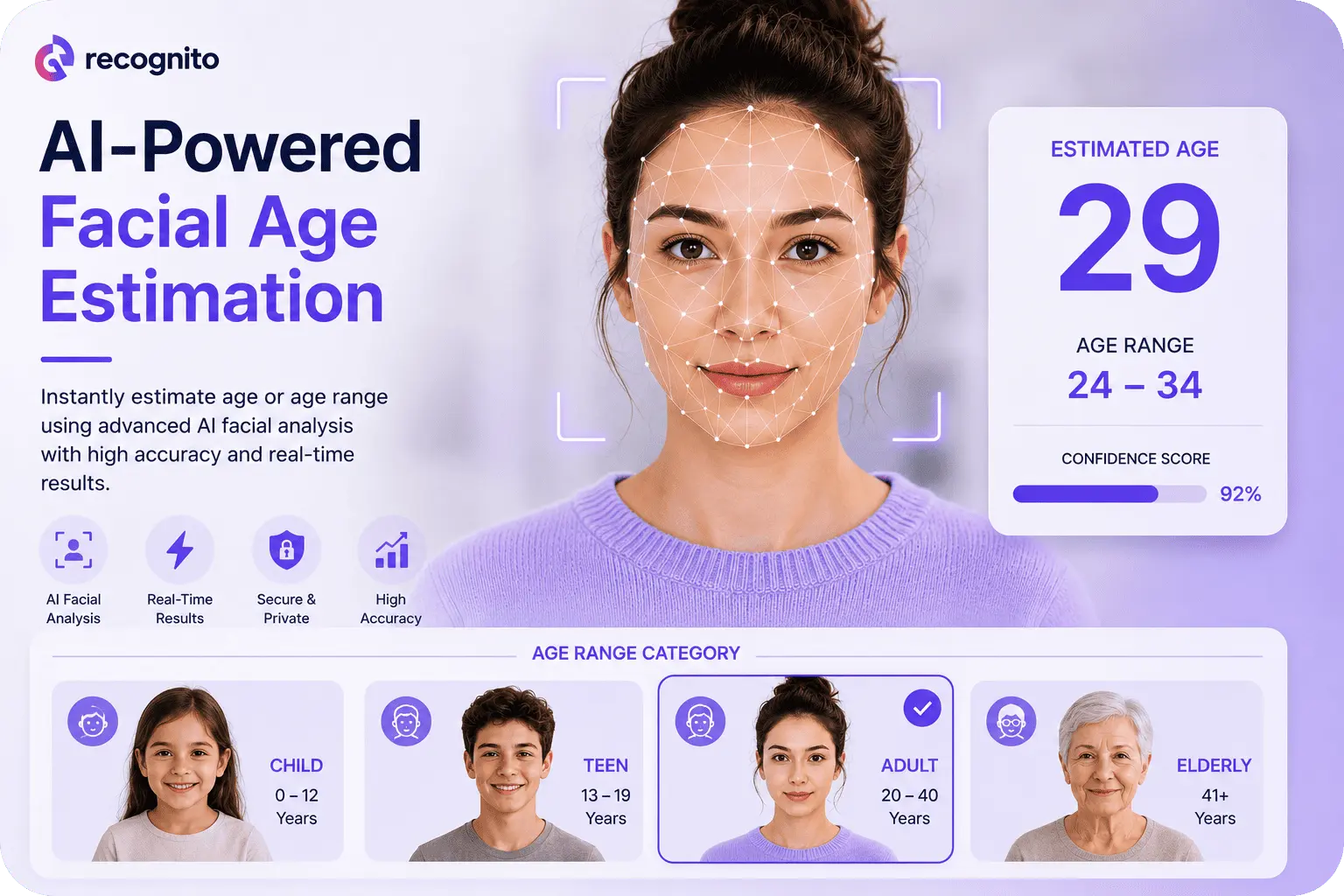
Age estimation produces a numeric prediction, such as an estimated age of 24.
Age verification makes a decision against a threshold, such as whether the person is likely to be at least 18.
The second approach is especially useful for age assurance because a business often does not need to know someone’s exact age. It needs to know whether the person appears to meet a defined requirement.
If the application only needs a threshold decision, retaining an exact age estimate may also create unnecessary data exposure.
What NIST Testing Reveals
NIST treats facial age estimation as part of its Face Analysis Technology Evaluation work. Its current FATE Age Estimation and Verification evaluation tracks algorithm submissions and reports measures including mean absolute error, accuracy within a specified number of years, false-positive and false-negative rates for threshold decisions, and failure-to-process rates.
NIST’s 2024 Face Analysis Technology Evaluation report on Age Estimation and Verification evaluated six submitted algorithms using millions of images from operational repositories. The results showed no uniformly superior algorithm across every condition.
That finding matters for procurement. A vendor’s headline age-estimation accuracy does not necessarily reveal performance at a particular threshold, population, or capture condition.
The earlier NIST evaluation of automated age estimation algorithms also assessed demographic groups, image quality, and different age ranges, reinforcing the need to look beyond one overall accuracy figure.
Which Factors Affect Age Estimates?
Age is not a fixed facial characteristic like a document number. Its visible appearance changes gradually and is affected by multiple variables.
NIST’s recent evaluation found performance influenced by algorithm, sex, region of birth, image quality, and the age of the person in the image. These factors can also interact. Image quality is particularly important.
A low-resolution selfie, strong shadow, backlighting, camera noise, unusual pose, or partial obstruction can deprive the model of useful facial information. Expression and accessories may also change the visual characteristics presented to the model.
For broader context on environmental and image variables, face recognition accuracy factors provides a useful technical reference.
Where Businesses Are Using Facial Age Estimation
Age-restricted online services
One of the clearest applications is age assurance for services that must distinguish between adults and minors.
Platforms may use facial age estimation as one signal when controlling access to age-restricted content, communities, or functionality. NIST identifies age assurance as an important driver of current interest in the technology.
Retail and physical access
Age estimation can support controlled environments where staff or automated systems need an additional age-related signal, including age-restricted retail experiences or venue access.
The appropriate architecture depends on the consequences of an incorrect decision. A convenience feature may tolerate some uncertainty; a regulated purchase may require a stronger verification method.
Personalized experiences
Age estimates can support personalization, such as adapting interfaces or content to an approximate age range.
This is less security-sensitive, but it still raises a basic question: is age inference actually necessary? A business should not collect sensitive signals merely because AI makes them available.
Online safety
Age assurance can also support efforts to create more age-appropriate online environments. The European Data Protection Board’s Statement 1/2025 on Age Assurance emphasizes proportionate, privacy-conscious approaches to determining age or age ranges, particularly where children are involved.
Facial Age Estimation vs. Age Verification
These terms are closely related but not interchangeable.
| Approach | Output | Best suited to | Main consideration |
| Facial age estimation | Numeric or range estimate | Analytics and approximate age assessment | Prediction error |
| Facial age verification | Above/below threshold | Age assurance and access decisions | False accept and false reject rates |
| ID-based age verification | Verified age from identity evidence | Higher-assurance eligibility checks | Document handling and friction |
| Combined approach | Multiple evidence types | Higher-risk workflows | Complexity and privacy |
For many business workflows, a threshold decision is more useful than a precise age prediction. If the requirement is “18 or older,” knowing the model estimates 27 rather than 26 adds little value.
A higher-risk workflow can use age estimation as a low-friction first signal and require stronger evidence when the result is close to the threshold.
The Risk of Treating an Estimate as Fact
If an algorithm estimates that someone is 19, that does not mean the person’s true age is 19. It means the model has generated a prediction from visible facial characteristics.
The difference becomes critical near regulatory or policy thresholds. If a service allows access to adults and a model estimates a customer at 18, an error around that boundary can create compliance and safety problems.
A sensible architecture should define what happens when confidence is insufficient.
Possible responses include another verification step, an ID-based check, manual review, or denial until stronger evidence is provided. The correct response depends on the risk and legal requirements of the use case.
Demographic Performance and Bias
Age estimation systems should be assessed for performance differences across demographic groups.
NIST’s 2024 evaluation found substantial variation linked to demographic and image-related factors and reported that no algorithm consistently dominated across all evaluated conditions. NIST also found that error rates were often higher for female faces in the evaluated algorithms, while the study did not establish the underlying causes.
An average score can therefore hide a poorer experience for specific groups.
The goal is to understand where performance is strong, where it weakens, and whether those differences are acceptable.
Security Considerations
Age estimation is usually not an identity-authentication mechanism, but it can become security-sensitive when used as an access gate.
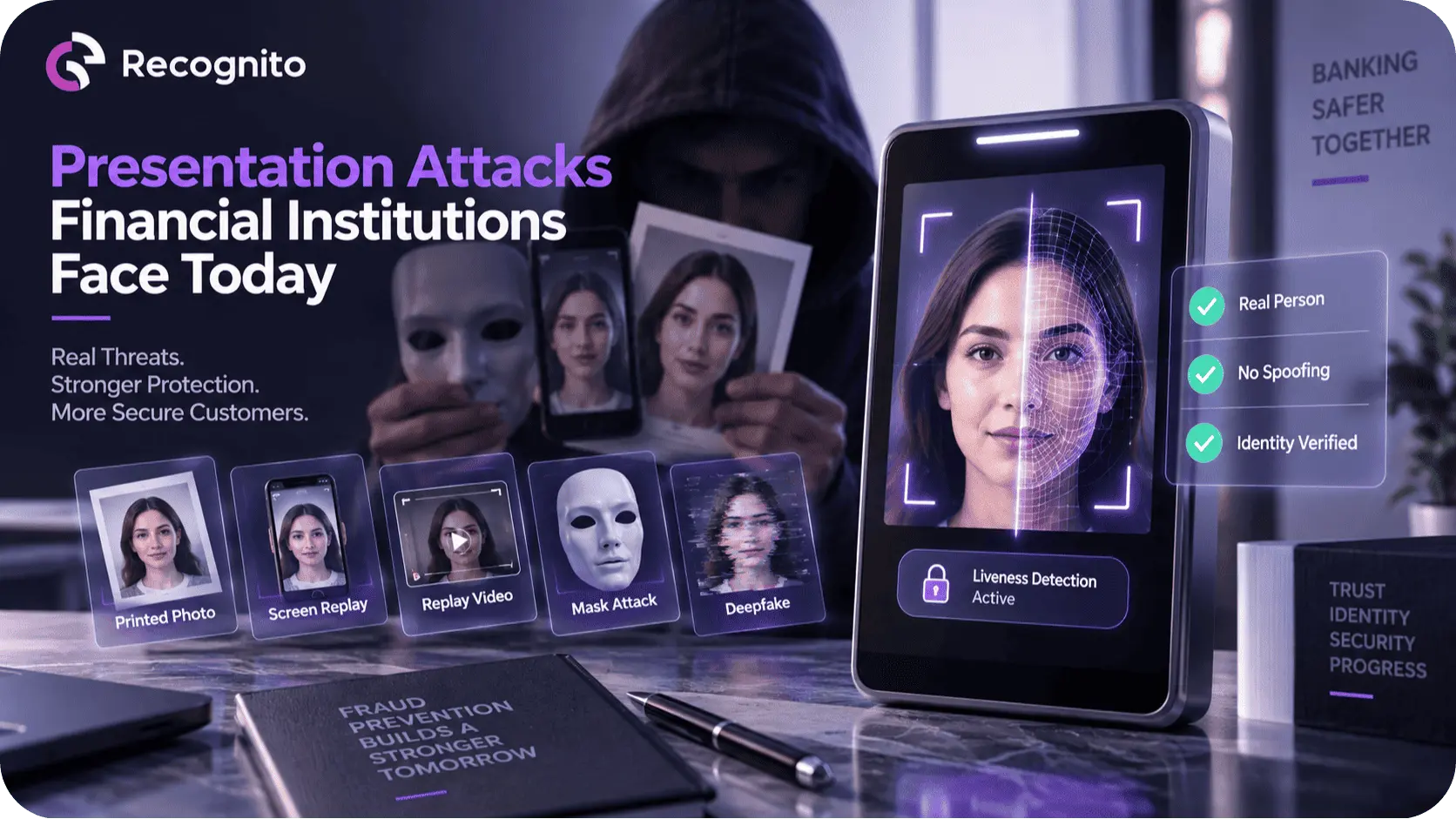
Attackers may try to influence the input rather than the model itself. They could use another person’s image, replay media, manipulate the capture environment, or exploit weaknesses in the application connecting the camera to the age-estimation service.
A production design should therefore distinguish between age inference and capture integrity.
If the application makes a consequential decision from a camera feed, it may need controls for presentation attacks, injected media, compromised capture environments, and other ways of feeding untrusted inputs into the model.
The wider AI-driven facial analysis technology cluster provides additional context on facial analysis beyond simple identity matching.
Privacy Should Be Designed Around the Minimum Needed Output
Privacy architecture should start with the decision the business actually needs to make.
If the requirement is “Is this person above 18?” then storing a detailed age estimate, a face image, and a long-term biometric profile may be unnecessary.
This becomes especially important when children may be involved. Age-assurance systems can process sensitive information while attempting to protect minors, so the organization must consider necessity, proportionality, transparency, and retention.
Technology selection should therefore include privacy architecture, not just model accuracy.
What Businesses Should Evaluate Before Deployment
A useful evaluation should cover more than benchmark performance.
Threshold performance
Measure false-positive and false-negative behavior around the exact age thresholds that matter to the business.
Failure to process
Determine how often the system cannot produce an estimate. A model that is accurate when it succeeds may still create poor outcomes if too many customers fail capture.
Real-world devices
Test actual smartphones, webcams, lighting conditions, camera orientations, and network environments.
Demographic coverage
Use test populations that represent the people who will interact with the system.
Attack resistance
Assess whether the wider application can be manipulated through replay, presentation attacks, or injected media.
Privacy and retention
Establish what information is processed, stored, shared, and deleted.
Fallback design
Decide what happens when the estimate is uncertain, unavailable, or inconsistent with other evidence.
These factors often matter more to the final business outcome than a single model accuracy figure.
How to Build a Practical Age-Assurance Flow
A reliable workflow can use progressive assurance.
First, capture. Give the user clear instructions and verify that image quality is sufficient.
Second, estimate. Produce an age estimate or threshold decision.
Third, assess confidence and risk. Determine whether the result is comfortably above or below the relevant threshold or falls into an uncertain zone.
Fourth, escalate where necessary. Introduce a stronger method, such as document-based verification, when the decision has greater consequences or confidence is insufficient.
Finally, minimize storage. Keep only the information required for the legitimate purpose.
This avoids a common mistake: forcing every user through the most intrusive verification method when many cases could be resolved with a lower-friction approach.
What the Technology Means for Product Teams
Product teams should think about facial age estimation as a decision component, not a standalone feature.
The interface should make successful capture easy, while backend logic should account for uncertainty and exceptions. Analytics should track failure-to-process rates, threshold outcomes, abandonment, demographic patterns, and escalation volumes.
For development and implementation work, teams can also review the Recognito GitHub repository alongside model evaluation and integration testing.
The Future of Facial Age Estimation
The technology is becoming more relevant as cameras become ubiquitous and age assurance receives greater regulatory attention.
At the same time, the field still contains measurable uncertainty. NIST’s current age-estimation evaluation remains open to submissions, allowing performance to be tracked as algorithms change.
Future systems may improve at handling diverse populations, different image conditions, and age boundaries. But better model performance will not remove the need for thoughtful product design, privacy controls, attack resistance, and appropriate fallback mechanisms.
Conclusion
Facial age estimation can provide a useful way to infer approximate age or support age-assurance decisions without always requiring a government-issued identity document.
Its value is greatest when the business understands exactly what the model can establish—and what it cannot.
For low-friction applications, age estimation can provide a practical signal. For higher-risk decisions, it may need to work alongside stronger evidence. In every case, deployment should account for image quality, demographic performance, threshold errors, security threats, privacy, and failure handling.
The strongest approach is not to treat facial age estimation as a perfect answer. It is to use it as one carefully governed component of an age-assurance or facial-analysis workflow. For organizations building biometric and facial-analysis capabilities, Recognito can support practical implementations where age estimation fits within a broader technology strategy.
Frequently Asked Questions
Is facial age estimation the same as facial recognition?
No. Facial age estimation predicts age-related information from a face, while facial recognition attempts to determine identity by comparing biometric samples.
How accurate is facial age estimation?
Accuracy varies by algorithm, age range, image quality, demographic characteristics, and evaluation metric. NIST’s recent testing found no single algorithm that performed best across every evaluated condition.
Can facial age estimation legally verify someone’s age?
It depends on the jurisdiction and use case. Age estimation is an inference, not automatically equivalent to verified date-of-birth evidence. Organizations should determine whether the method provides sufficient assurance for the relevant requirement.
Is facial age estimation suitable for children?
It can be used as part of age-assurance systems, but children introduce important privacy, accuracy, and safeguarding considerations. A stronger verification method may be appropriate when an incorrect age decision has significant consequences.
Should businesses store the estimated age?
Not necessarily. If the application only needs a threshold decision, retaining an exact age estimate or source image may be unnecessary. Data collection and retention should be limited to what the specific purpose requires.