
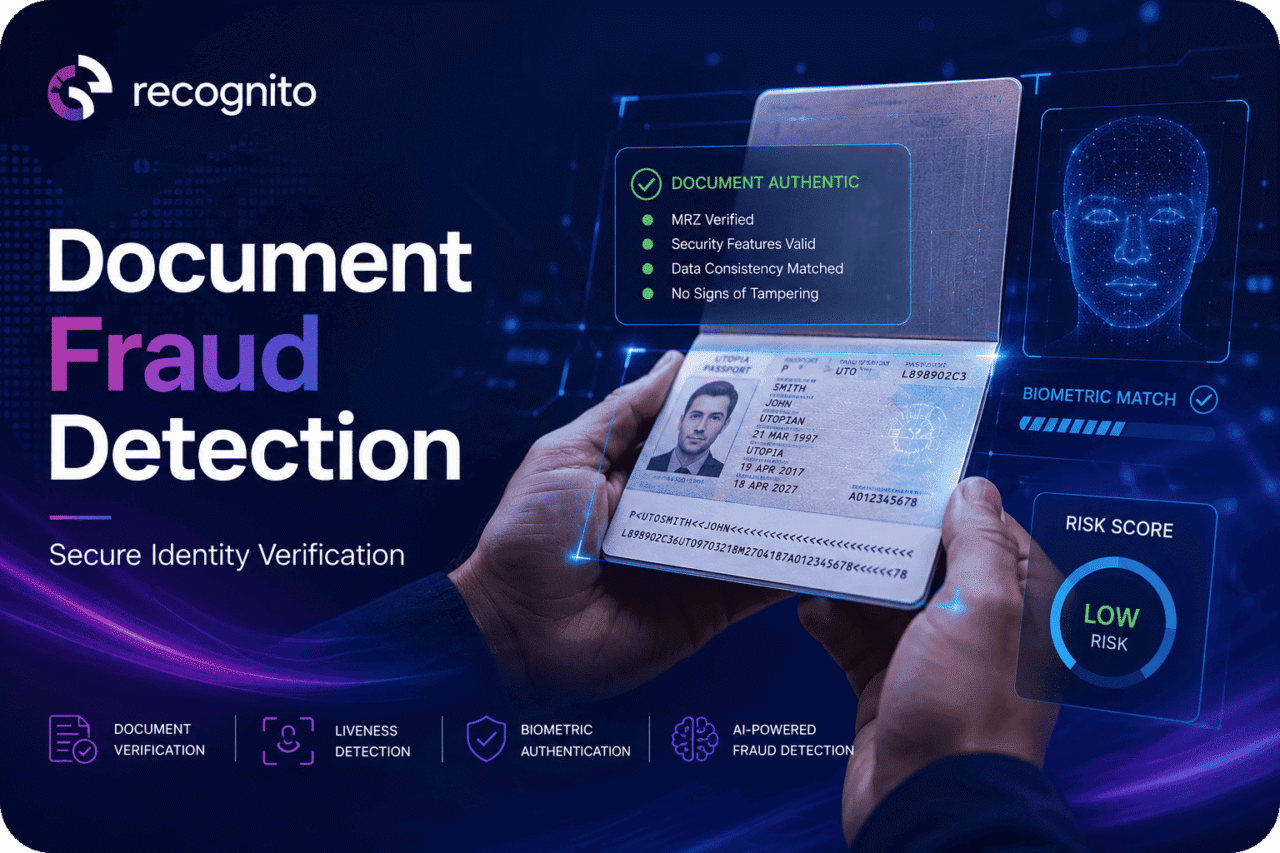
As digital onboarding becomes the standard across financial services, businesses face increasing pressure to verify customer identities quickly without compromising security. Banks, fintech companies, payment providers, cryptocurrency exchanges, healthcare organisations, and online marketplaces now rely heavily on automated identity verification to establish trust before providing access to their services.
At the same time, fraudsters continue developing increasingly sophisticated ways to bypass verification systems. What once involved simple counterfeit identity cards has evolved into AI-generated documents, digitally manipulated images, synthetic identities, and presentation attacks designed to deceive traditional onboarding processes.
This evolving threat landscape has made document fraud detection one of the most important components of modern identity verification. Detecting fraudulent documents before an account is approved helps organisations reduce financial losses, strengthen regulatory compliance, and protect legitimate customers from identity-related crime.
Modern verification platforms now combine document verification, biometric authentication, liveness detection, artificial intelligence, and behavioural analysis to identify fraudulent identity documents far more accurately than manual inspection alone.
In this guide, we’ll explore how document fraud detection works, the techniques organisations use to identify fake identity documents, and the technologies helping businesses stay ahead of increasingly sophisticated fraud.
What Is Document Fraud Detection?
Document fraud detection is the process of identifying forged, altered, counterfeit, or manipulated identity documents before they are accepted during customer onboarding.
Instead of relying solely on visual inspection, today’s verification systems analyse hundreds of characteristics to determine whether an identity document is genuine, untampered, and issued by a legitimate authority.
Modern document verification platforms typically examine:
- Security features
- Machine-readable zones (MRZ)
- Optical Character Recognition (OCR)
- Holograms
- Typography
- Document integrity
- Image manipulation
- Data consistency
Many organisations now automate these checks using the id document recognition SDK, allowing compliance teams to improve verification accuracy while significantly reducing manual review times.
Verifying a document, however, is only one part of the onboarding process. Businesses looking to better understand how identity validation fits into customer onboarding should also read identity proofing vs identity verification explained, which explores the difference between establishing an identity and confirming ownership of that identity.
Why Document Fraud Detection Matters
Identity documents remain one of the primary targets for organised financial crime.
If fraudulent documents successfully bypass onboarding controls, criminals may gain access to banking services, lending platforms, digital wallets, investment accounts, or cryptocurrency exchanges using false identities.
The consequences often extend far beyond a single fraudulent application.
Weak document verification can contribute to:
- Identity theft
- Account takeover fraud
- Synthetic identity fraud
- Loan fraud
- Payment fraud
- Money laundering
- Regulatory penalties
- Reputational damage
Strong document fraud detection helps organisations prevent these risks before an account is ever created.
It also supports broader KYC and AML obligations. The Financial Action Task Force (FATF) continues to recommend a risk-based approach to customer identification and verification as a core part of effective anti-money laundering programmes.
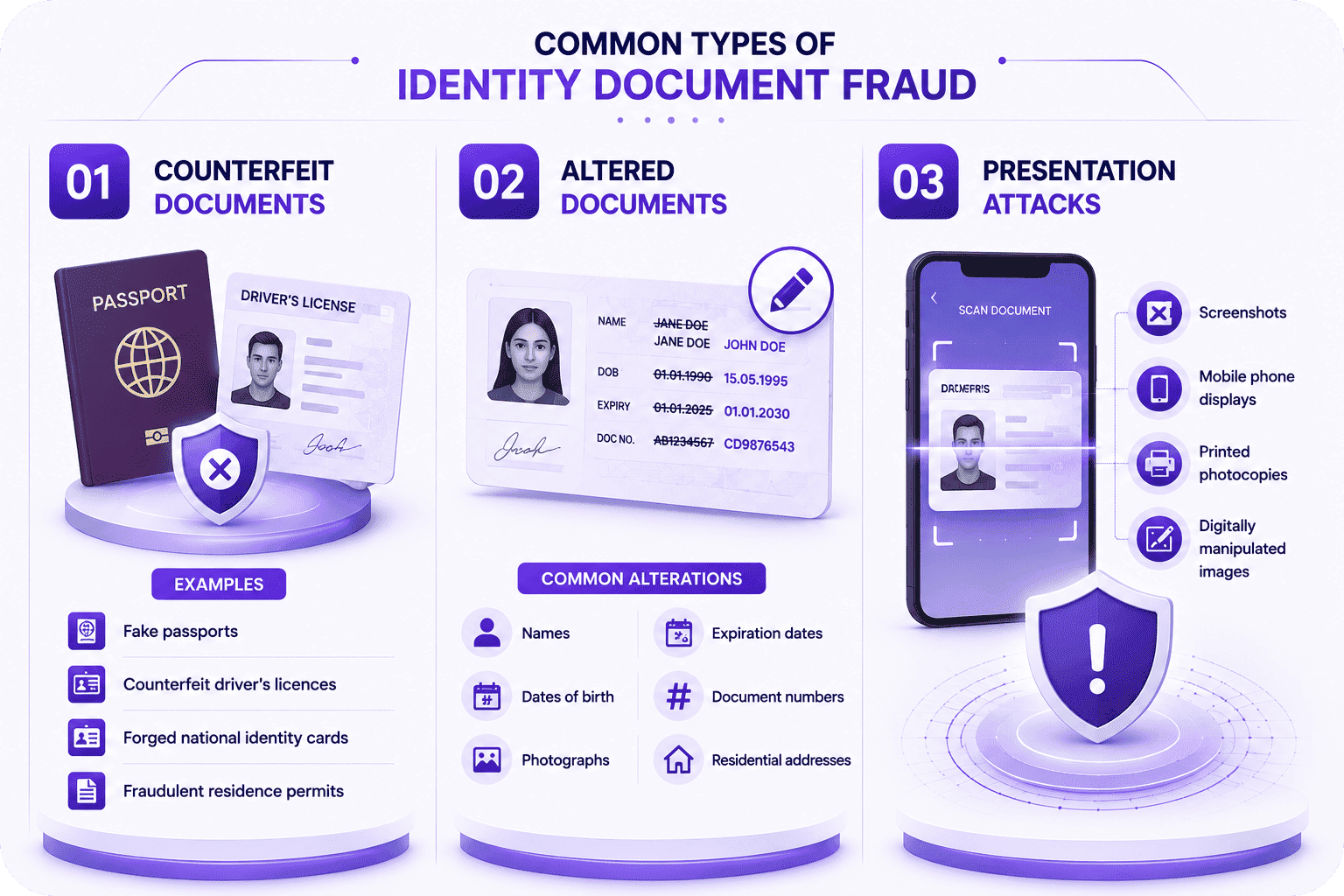
Common Types of Identity Document Fraud
Understanding how fraudsters manipulate identity documents helps organisations build stronger verification processes.
1. Counterfeit Documents
Counterfeit documents are created entirely from scratch to imitate genuine government-issued identity credentials.
Modern counterfeit documents often replicate official layouts, fonts, colours, and security elements closely enough to deceive manual inspection.
Examples include:
- Fake passports
- Counterfeit driver’s licences
- Forged national identity cards
- Fraudulent residence permits
Automated verification systems analyse document structures and security features that are difficult to evaluate consistently through manual reviews, making them significantly more effective at identifying counterfeit documents.
2. Altered Documents
Rather than creating entirely new documents, many fraudsters modify genuine identity documents.
Common alterations include changing:
- Names
- Dates of birth
- Photographs
- Expiration dates
- Document numbers
- Residential addresses
Modern document verification systems identify these modifications by analysing inconsistencies within document layers, typography, image quality, and embedded security features before approval.
3. Presentation Attacks
One of the fastest-growing forms of identity document fraud no longer involves altering the document itself.
Instead, fraudsters attempt to complete verification using screenshots, mobile phone displays, printed photocopies, or digitally manipulated images instead of presenting an authentic physical document.
Traditional document verification alone may not detect these attacks.
To strengthen onboarding security, many organisations now combine document verification with the id document liveness detection SDK, allowing verification systems to determine whether a genuine physical identity document is actually present during the verification process.
For a deeper understanding of this technology, our guide explaining why document liveness detection is essential for KYC verification explores how document liveness helps prevent modern presentation attacks before customer onboarding is completed.
Detecting Document Fraud in Modern Identity Verification
Identifying fraudulent documents requires far more than checking whether an ID looks authentic. Today’s verification systems combine multiple technologies to evaluate the document itself, the person presenting it, and the overall level of fraud risk before an onboarding decision is made.
Below are some of the most effective techniques used by modern identity verification platforms.
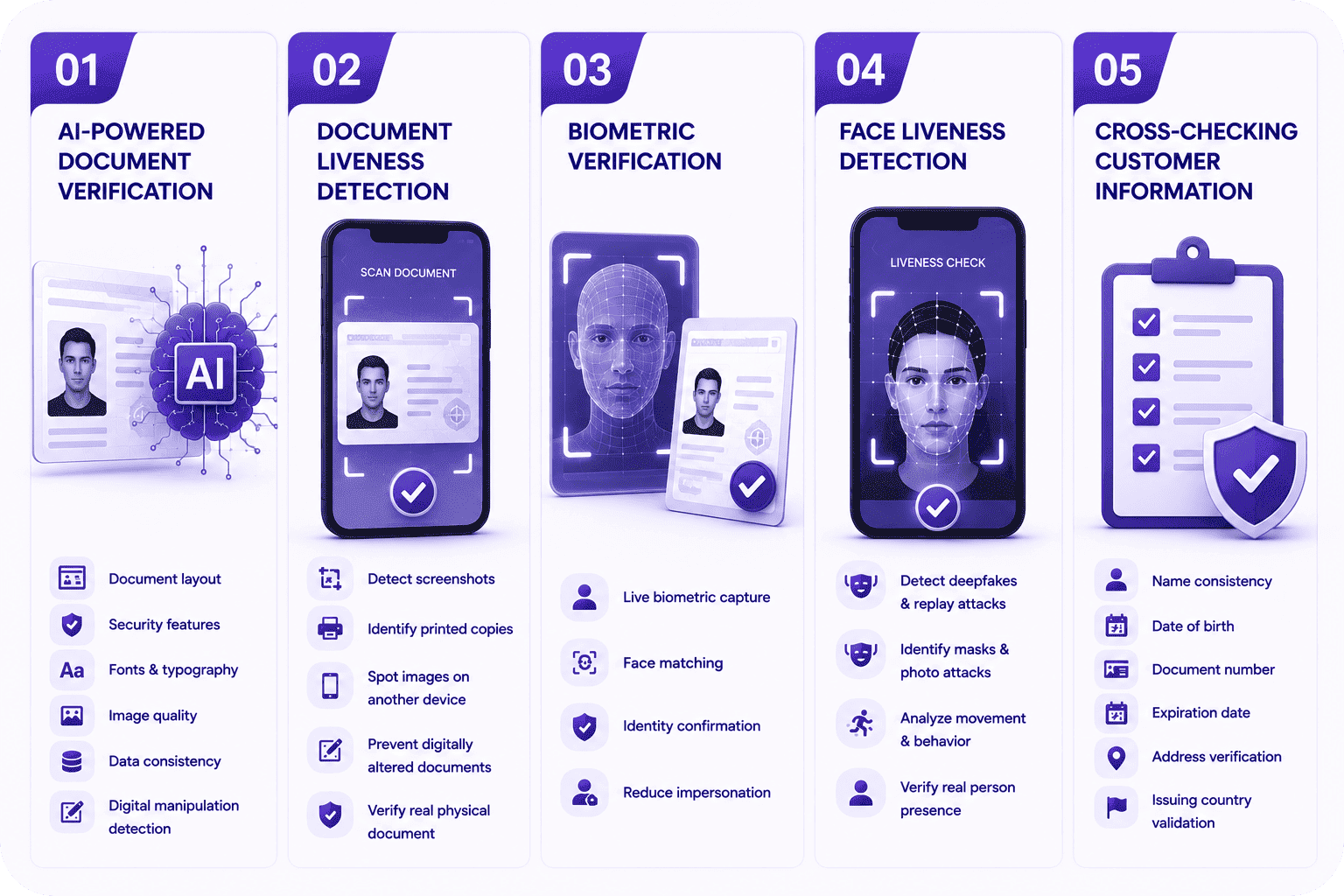
1. AI-Powered Document Verification
Artificial intelligence has transformed how organizations detect document fraud.
Instead of relying on manual inspection, AI-powered verification systems can analyse hundreds of document characteristics within seconds. Machine learning models are trained using millions of genuine and fraudulent identity documents, allowing them to recognize subtle inconsistencies that may be impossible for the human eye to detect.
Modern AI verification systems evaluate factors such as:
- Document layout
- Security features
- Fonts and typography
- Image quality
- Data consistency
- Signs of digital manipulation
Many organizations automate this process using the id document recognition SDK, enabling faster customer onboarding while improving fraud detection accuracy.
2. Document Liveness Detection
One of the biggest weaknesses of traditional document verification is that it often focuses only on the authenticity of the document itself.
Fraudsters increasingly bypass these systems by presenting:
- Screenshots
- Printed photocopies
- Images displayed on another mobile phone
- Digitally altered identity documents
Document liveness detection addresses this challenge by verifying that an actual physical identity document is present during the verification process.
Rather than analysing only the document image, the system evaluates characteristics such as reflections, movement, texture, perspective, and environmental lighting to distinguish genuine documents from digital reproductions.
Organizations looking to strengthen onboarding security increasingly deploy the id document liveness detection SDK to reduce presentation attacks without creating unnecessary friction for legitimate users.
If you’re interested in learning more, our guide on why document liveness detection is essential for KYC verification explains how this technology fits into modern compliance programs.
3. Biometric Verification
A genuine identity document does not necessarily prove that the individual presenting it is its rightful owner.
This is where biometric verification becomes essential.
Modern onboarding systems compare a live biometric sample with the photograph stored on the submitted identity document, helping organizations confirm that both belong to the same person.
Facial recognition has become the preferred biometric technology because it combines strong security with a seamless customer experience.
Organizations increasingly rely on the face recognition SDK to improve identity verification while reducing impersonation attempts during customer onboarding.
Independent evaluations conducted through the NIST Face Recognition Vendor Test (FRVT) continue to demonstrate the significant improvements achieved by modern facial recognition algorithms across diverse operating environments.
4. Face Liveness Detection
Biometric verification alone is no longer enough.
Fraudsters now use deepfake videos, replay attacks, printed photographs, silicone masks, and AI-generated facial imagery to deceive verification systems.
Face liveness detection helps prevent these attacks by confirming that a real person is physically present during the verification process.
Instead of simply comparing facial images, modern liveness systems analyse behavioural and environmental signals to detect spoofing attempts before verification is approved.
Many organizations integrate the face liveness detection SDK into their onboarding workflows to strengthen fraud prevention without adding unnecessary steps for genuine customers.
To better understand current implementation approaches, our comparison of active vs passive liveness detection explains how each method contributes to stronger identity verification.
5. Cross-Checking Customer Information
Modern document fraud detection extends beyond analysing the identity document itself.
Verification platforms also compare information across multiple trusted sources to identify inconsistencies that may indicate fraud.
Common validation checks include:
- Name consistency
- Date of birth
- Document number
- Expiration date
- Address verification
- Issuing country validation
When customer information does not align across multiple verification sources, organizations can automatically trigger additional verification before approving the application.
This layered approach significantly improves fraud detection while reducing unnecessary manual reviews.
Common Challenges in Document Fraud Detection
Although verification technology continues to improve, organizations still face several challenges when combating identity document fraud.
Rapidly Evolving Fraud Techniques
Fraudsters continuously develop new methods for bypassing identity verification systems.
AI-generated documents, synthetic identities, and sophisticated image editing tools have dramatically increased the quality of fraudulent identity documents.
Organizations must continuously update their verification technologies to stay ahead of these evolving threats.
Businesses looking to understand one of today’s fastest-growing fraud risks should also read how financial institutions detect synthetic identity fraud, which explains how synthetic identities are created and how modern verification platforms identify them.
Balancing Security and Customer Experience
Customers expect onboarding to be completed within minutes.
Adding unnecessary verification steps can increase abandonment rates, while insufficient verification exposes organizations to fraud.
The most successful onboarding programs combine automation, biometric verification, document analysis, and risk assessment to deliver both security and convenience.
Regulatory Compliance
Organizations operating across multiple countries often need to comply with different identity verification and privacy regulations.
In addition to KYC and AML requirements, businesses should ensure that document verification programs align with international privacy frameworks such as the General Data Protection Regulation (GDPR) when processing identity documents and biometric data.
Best Practices for Preventing Document Fraud
While fraud techniques continue to evolve, organizations can significantly reduce their exposure by implementing a layered identity verification strategy. Rather than relying on a single technology, the most effective onboarding programs combine multiple verification methods that work together throughout the customer journey.
Here are some of the best practices organizations should follow.
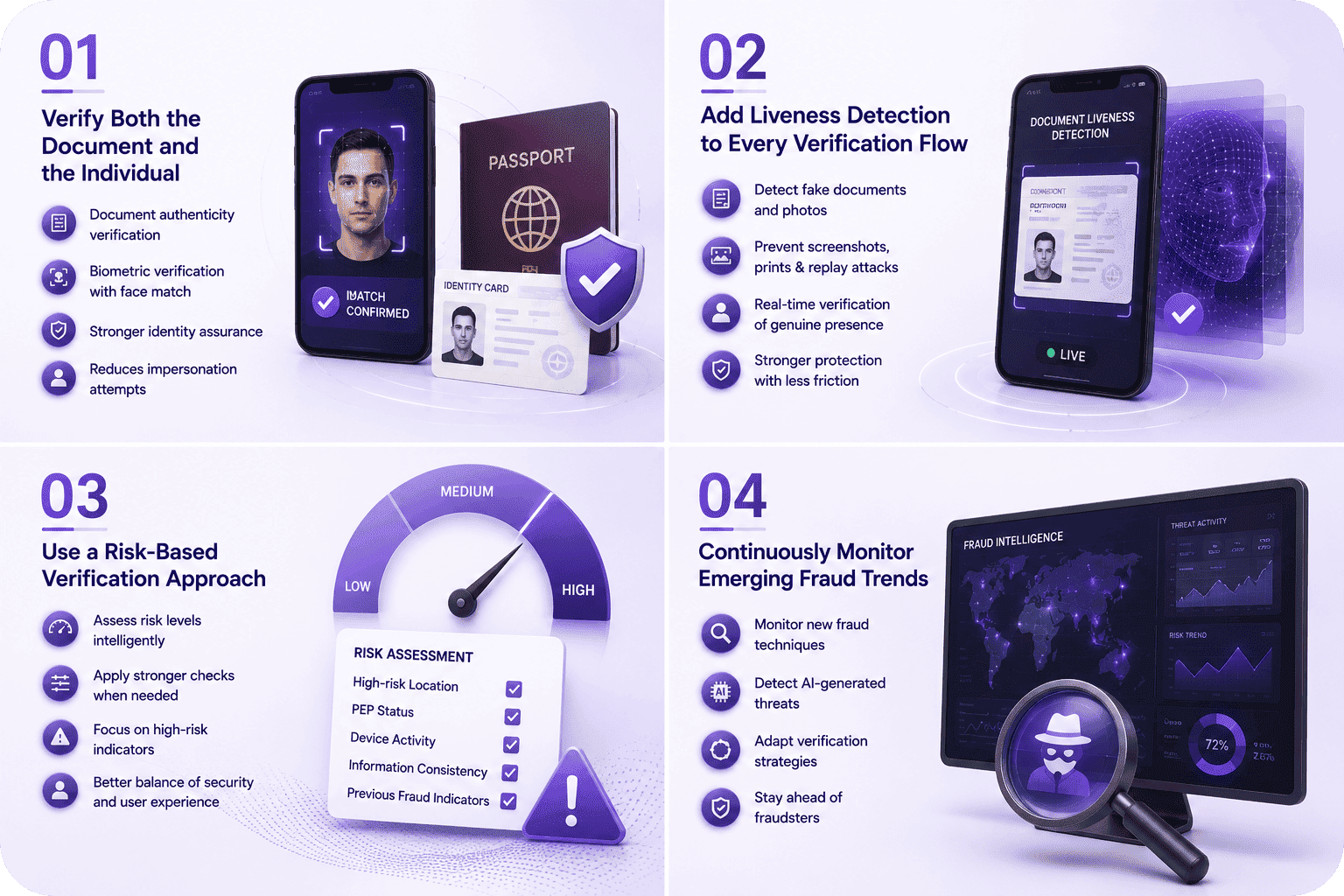
1. Verify Both the Document and the Individual
One of the most common mistakes in digital onboarding is verifying only the identity document.
Even if a passport or national ID is genuine, it does not automatically prove that the person presenting it is its legitimate owner.
Combining document verification with biometric verification provides much stronger identity assurance. Organizations can verify the authenticity of the document and then compare it with a live biometric sample using the face recognition SDK to ensure the customer matches the identity document.
This layered approach significantly reduces impersonation attempts while maintaining a seamless onboarding experience.
2. Add Liveness Detection to Every Verification Flow
Presentation attacks continue to increase as fraudsters use screenshots, printed documents, replay attacks, and AI-generated content to bypass weak verification systems.
Integrating document and facial liveness detection adds another layer of protection by confirming that both a real document and a real person are present during verification.
Organizations that combine biometric verification with the face liveness detection SDK are better equipped to defend against spoofing attacks while minimizing friction for legitimate users.
Businesses looking to improve their verification workflows should also explore our guide on common identity verification mistakes, which highlights avoidable issues that often lead to onboarding failures.
3. Use a Risk-Based Verification Approach
Not every customer presents the same level of risk.
Applying the same verification process to every applicant can either create unnecessary friction or leave organizations vulnerable to fraud.
A risk-based approach allows businesses to strengthen verification only when additional risk indicators are detected, such as:
- High-risk geographic locations
- Politically Exposed Person (PEP) status
- Suspicious device activity
- Inconsistent customer information
- Previous fraud indicators
This approach improves both operational efficiency and customer experience while supporting regulatory compliance.
4. Continuously Monitor Emerging Fraud Trends
Identity fraud is constantly evolving.
New technologies such as generative AI have made counterfeit documents, synthetic identities, and deepfake attacks increasingly difficult to identify through traditional verification methods.
Organizations should regularly evaluate new fraud techniques and update their verification processes accordingly.
For example, businesses concerned about AI-generated identity fraud can read our guide on deepfake attack prevention strategies to understand how modern verification platforms detect emerging presentation attacks.
The Future of Document Fraud Detection
Document fraud detection is becoming increasingly intelligent as artificial intelligence, machine learning, and biometric technologies continue to advance.
Instead of relying on predefined rules, modern verification systems analyse hundreds of signals simultaneously to make real-time fraud decisions.
Several trends are expected to shape the future of identity verification.
AI-Driven Fraud Detection
Artificial intelligence will continue improving document verification by identifying subtle manipulation patterns that traditional rule-based systems often miss.
As verification datasets grow larger, machine learning models will become even more effective at distinguishing genuine identity documents from sophisticated forgeries.
Continuous Identity Verification
Identity verification is no longer limited to customer onboarding.
Many organizations now perform continuous verification throughout the customer lifecycle, triggering additional checks when unusual account activity, device changes, or high-value transactions occur.
This proactive approach helps identify compromised accounts before fraud can occur.
Smarter Fraud Intelligence
Future verification platforms will combine multiple sources of intelligence, including:
- Document verification
- Biometric authentication
- Device intelligence
- Behavioral analytics
- Transaction monitoring
- AI-powered risk scoring
By evaluating these signals together, organizations can identify increasingly sophisticated fraud attempts while minimizing unnecessary verification for legitimate customers.
Choosing the Right Document Fraud Detection Solution
Selecting the right verification platform involves more than simply comparing document recognition capabilities.
Organizations should evaluate whether a solution can support long-term growth while adapting to evolving fraud techniques and changing regulatory requirements.
Key factors to consider include:
- Document verification accuracy
- Global document coverage
- Biometric verification capabilities
- Document and face liveness detection
- AI-powered fraud detection
- Integration flexibility
- Scalability
- Compliance support
- Developer documentation
Solutions that combine document verification, biometric authentication, liveness detection, and fraud prevention within a single platform often reduce implementation complexity while improving overall onboarding performance.
Development teams interested in integrating enterprise-grade identity verification can also explore the official Recognito GitHub repository for SDK documentation, implementation guides, and developer resources.
Conclusion
Document fraud continues to evolve alongside digital onboarding, making traditional verification methods increasingly ineffective against modern identity fraud. Counterfeit documents, altered IDs, screenshots, presentation attacks, and AI-generated forgeries require organizations to adopt more advanced verification strategies.
By combining document verification, biometric authentication, liveness detection, artificial intelligence, and risk-based assessment, businesses can identify fraudulent identity documents more accurately while maintaining a fast and seamless onboarding experience.
Organizations that invest in modern verification technologies today will be better positioned to reduce fraud, strengthen compliance, and build greater trust with their customers. Solutions such as Recognito identity verification technologies provide the tools needed to create secure, scalable, and future-ready digital onboarding processes.
Frequently Asked Questions
What is document fraud detection?
Document fraud detection is the process of identifying forged, altered, counterfeit, or manipulated identity documents during customer onboarding to prevent fraud and strengthen identity verification.
How does document verification detect fake IDs?
Modern document verification systems analyse security features, document structure, machine-readable zones, typography, and signs of tampering to identify fake or altered identity documents.
Why is document liveness detection important?
Document liveness detection verifies that a genuine physical identity document is being presented instead of a screenshot, photocopy, or digitally manipulated image, helping prevent presentation attacks.
How does biometric verification support document fraud detection?
Biometric verification compares a live facial image with the photograph stored on an identity document to confirm that the individual presenting the document is its legitimate owner.
What are the biggest document fraud threats today?
Some of the most common threats include counterfeit identity documents, altered IDs, synthetic identities, presentation attacks, deepfake-assisted fraud, and digitally manipulated documents.
Which industries benefit from document fraud detection?
Banks, fintech companies, payment providers, insurance companies, healthcare organizations, government agencies, telecommunications providers, online marketplaces, and cryptocurrency exchanges all use document fraud detection to strengthen identity verification and prevent fraud.
