
A face match can tell a verification system that two facial images are sufficiently similar. It cannot, by itself, prove that a real person is standing in front of the camera.
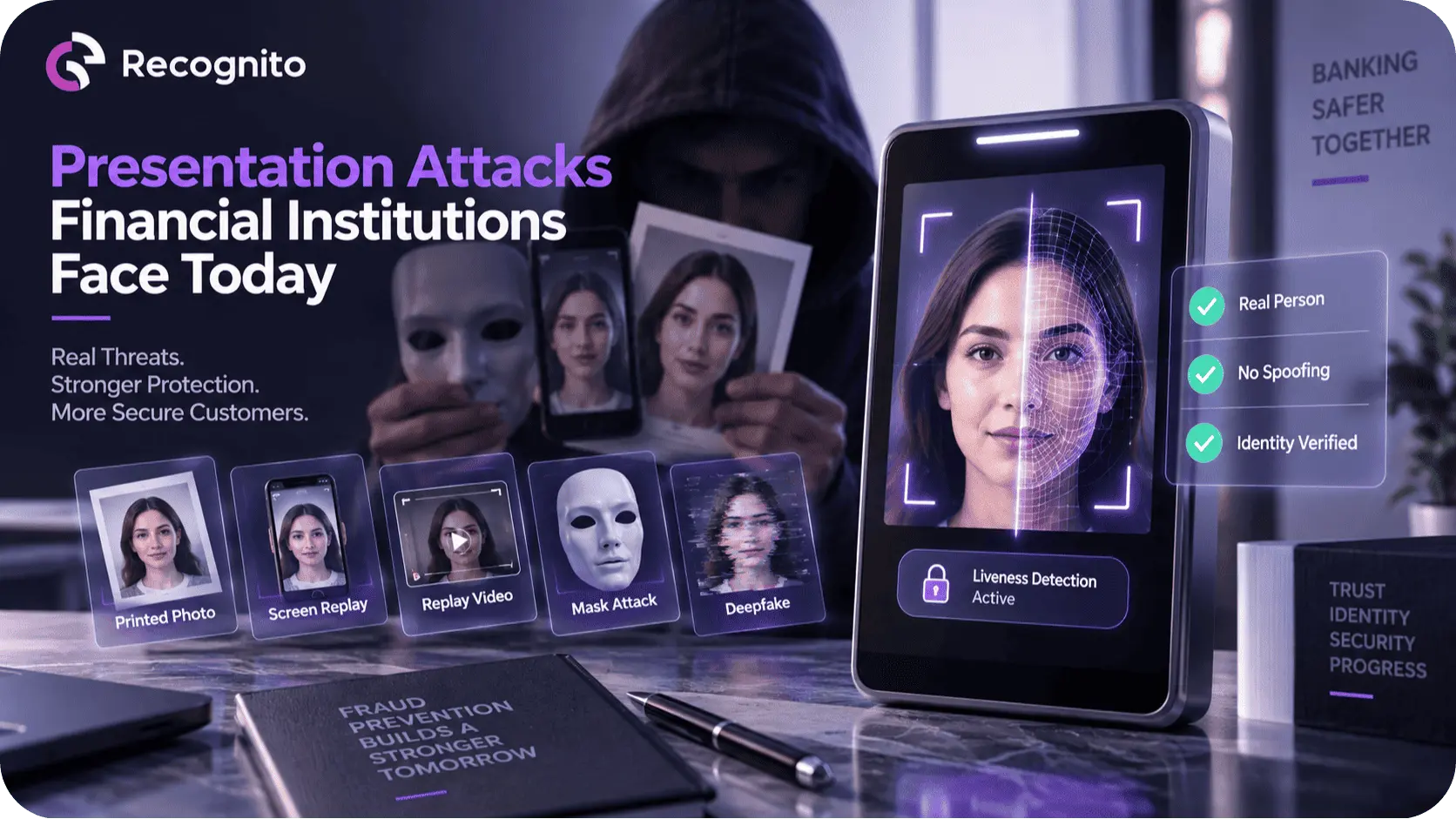
That distinction has become increasingly important as fraud moves further into remote channels. A criminal does not always need to break a biometric algorithm. They may simply attempt to present a photograph, replayed video, mask, manipulated media, or another artifact to the camera and make the system process it as genuine biometric input.
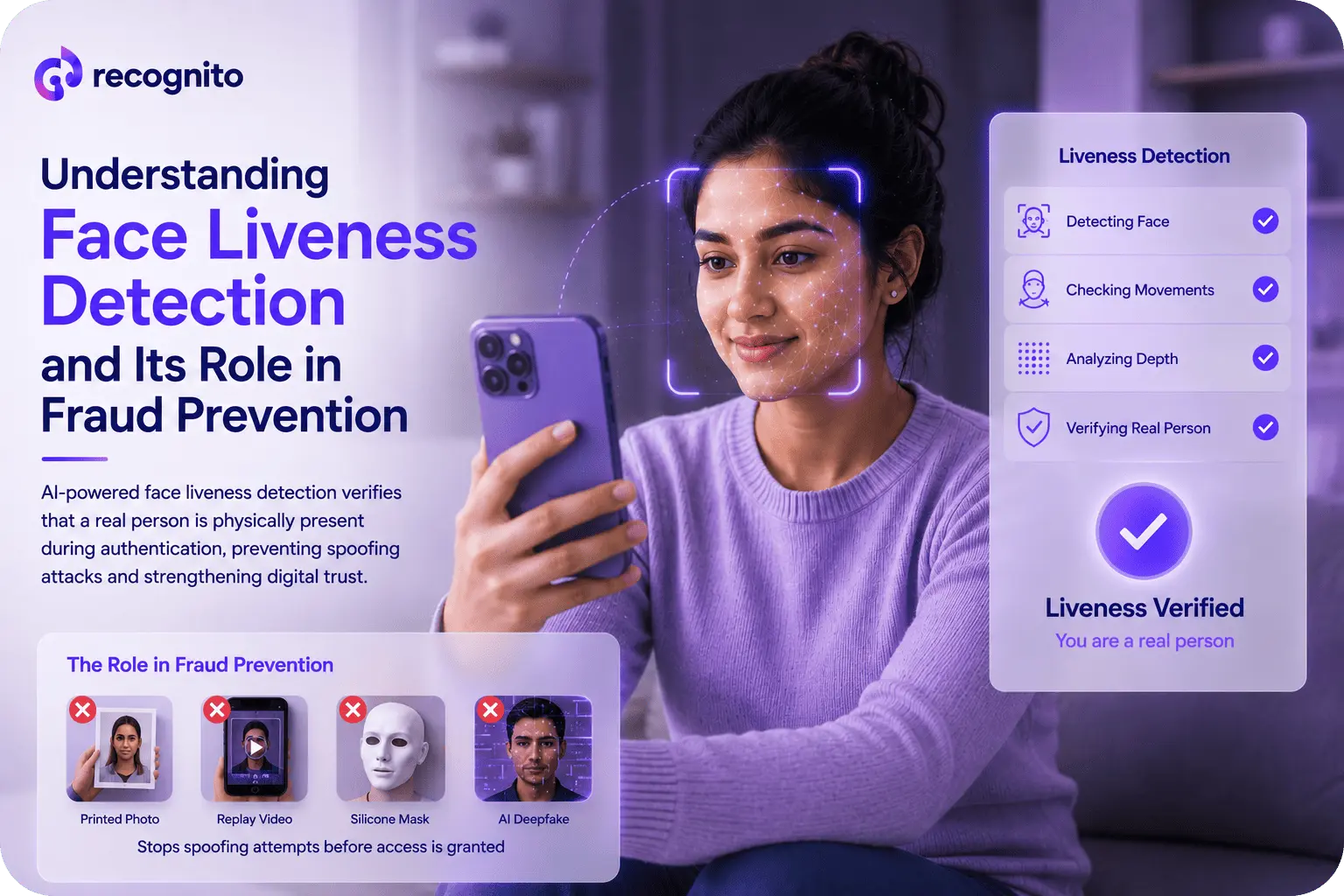
Face liveness detection addresses this problem by assessing whether the facial sample appears to come from a live person who is physically present at the point of capture. NIST defines presentation attack detection as the automated determination of a presentation attack and describes liveness detection as a subset that can analyze characteristics or reactions associated with a living subject. (NIST’s PAD definition)
For organizations using facial biometrics in identity verification, authentication, onboarding, or fraud prevention, liveness is therefore not a cosmetic add-on. It is a separate security layer that helps determine whether the biometric evidence itself should be trusted.
Why Facial Recognition Alone Is Not Enough
Facial recognition and liveness detection solve different problems.
Facial recognition asks whether the submitted face matches a reference identity.
Liveness detection asks whether the presented biometric sample appears to come from a live subject rather than a presentation attack.
Consider a remote account-opening workflow. An attacker may obtain a legitimate customer’s photograph and display it to the front-facing camera. A facial recognition model could potentially determine that the face looks highly similar to the enrolled person. Without an additional control, the system may have no reliable way to distinguish the legitimate customer from the displayed image.
The same principle applies to other forms of presentation attacks. NIST’s face PAD research has evaluated attacks involving photographs and other presentation attack instruments and found that different algorithms exhibit different strengths and weaknesses. The research also demonstrates why no single detector should be treated as capable of identifying every possible attack. (NIST’s FATE PAD research)
This is the core reason liveness belongs beside face matching rather than underneath it.
How Face Liveness Detection Works
Liveness detection does not necessarily require a customer to perform exaggerated actions such as turning their head or blinking repeatedly.
Modern systems may use passive techniques, active techniques, or a combination of methods.
Passive approaches attempt to determine liveness from the captured facial imagery and associated signals without deliberately asking the user to complete a challenge. The system may analyze texture, motion, depth-related cues, lighting behavior, image characteristics, or other evidence.
Active approaches introduce an interaction. The user might be instructed to move their head, change orientation, or follow a guided prompt. The purpose is to generate additional evidence that is harder to reproduce with a static artifact.
The choice depends on the application’s risk model, user experience requirements, camera environment, and attack exposure.
A useful comparison is provided in active vs passive liveness detection, particularly when deciding how different approaches affect security and user friction.
The underlying methods are important, but the larger architectural principle is even more important: liveness should produce evidence that is useful for the final security decision.
What Types of Fraud Can Liveness Help Prevent?
Liveness is primarily designed to address presentation attacks at the biometric capture stage.
Common examples include:
Printed photographs
An attacker presents a printed photograph of another person to the camera. The image may be surprisingly convincing under controlled conditions, but it remains a two-dimensional artifact.
Digital screen attacks
Instead of printing an image, an attacker may display a photograph or video on a phone, tablet, or monitor. This creates a different capture environment and can introduce reflections, display characteristics, and replay behavior.
Replayed video
A pre-recorded video may be used to simulate a legitimate user. More sophisticated attacks can include facial motion that appears natural to a human observer.
Masks and physical replicas
Attackers may attempt to reproduce another person’s appearance using masks or other physical artifacts. NIST’s face analysis work has included evaluation of presentation attacks involving altered appearance and masks, demonstrating that presentation attack detection is a distinct technical challenge from ordinary face matching. (NIST face-analysis research)
Manipulated or generated media
AI-generated and manipulated media introduces another layer of complexity. A convincing synthetic face may be designed specifically to defeat a remote verification workflow, making it increasingly important to consider liveness alongside media integrity and other controls.
These attacks are not identical, so a system’s performance against one presentation attack should not automatically be interpreted as protection against all others.
Liveness Detection Is Not the Same as Deepfake Detection
The terms are sometimes used interchangeably, but they represent different security concepts.
Liveness is primarily concerned with whether the biometric input corresponds to a live subject at the point of capture.
Deepfake detection focuses on identifying manipulated or synthetic media.
A system may need both.
For example, an attacker could attempt to present manipulated video through a capture environment designed to imitate a legitimate user. A liveness mechanism may contribute useful signals, while media analysis, device integrity controls, or other protections address additional attack paths.
This is why fraud prevention should be layered rather than built around a single detection model. The broader problem is covered in deepfake attack prevention strategies, including how organizations can think about AI-assisted threats as part of a broader biometric security architecture.
Where Liveness Fits Into Identity Verification
A modern identity-verification workflow typically combines several distinct checks.
A customer may first present an identity document. The system verifies document information and available authenticity signals. The customer then captures a selfie or short video. Facial recognition compares that biometric sample with the trusted identity reference.
Liveness enters at the point where the system needs additional confidence that the facial sample is genuine.
The resulting flow may look like this:
- Identity document capture establishes the source of the claimed identity.
- Document analysis extracts and evaluates identity information.
- Face capture provides the biometric sample.
- Face matching compares the sample with the trusted facial reference.
- Face liveness evaluates whether the submitted facial sample appears live.
- Risk orchestration combines the results with other available signals.
- Decisioning determines whether to approve, reject, or escalate the application.
This separation makes failures easier to understand. A customer may fail because their document is unreadable, because their face does not match, because the capture quality is inadequate, or because the system detects a presentation attack. Those outcomes have very different meanings.
Security Standards Matter
Organizations should not rely only on vendor terminology when evaluating liveness.
The ISO/IEC 30107 family establishes internationally recognized terminology and evaluation concepts for biometric presentation attack detection. ISO/IEC 30107-1:2023 defines the framework and terminology surrounding PAD methods, while ISO/IEC 30107-3:2023 establishes principles and methods for performance assessment and reporting of PAD mechanisms.
This distinction is important because a vendor saying that a system “supports liveness” does not tell a buyer how it was tested, what attacks were included, or what error trade-offs were observed.
For organizations procuring biometric technology, the evaluation process should therefore ask for concrete evidence: which attack types were tested, under what conditions, using what methodology, and with what measured performance.
FIDO’s Face Verification Certification is another useful reference because its certification process evaluates face verification in remote identity scenarios while considering biometric matching, liveness, deepfake threats, injection attacks, bias, and usability.
Passive vs Active Liveness: The Business Trade-Off
Security is only part of the problem. The customer experience matters too.
Active liveness can provide useful interaction signals, but every additional instruction introduces friction. A customer may become frustrated when asked to repeat movements or follow unclear prompts.
Passive approaches can create a smoother experience because the customer may only need to position their face correctly and follow straightforward capture guidance. The trade-off is that organizations must understand how the selected technology performs against the attack types relevant to their environment.
There is no universal winner.
A high-risk financial workflow may justify stronger interaction and additional verification. A consumer application with millions of low-risk authentication events may prioritize speed and simplicity.
The correct decision comes from balancing attack exposure, false rejects, latency, accessibility, and conversion.
False Rejects Can Become a Business Problem
A liveness system that is too aggressive may block legitimate users.
Someone might fail because of poor lighting, motion blur, camera limitations, reflections, partial facial visibility, or unusual environmental conditions. The failure does not necessarily indicate malicious behavior.
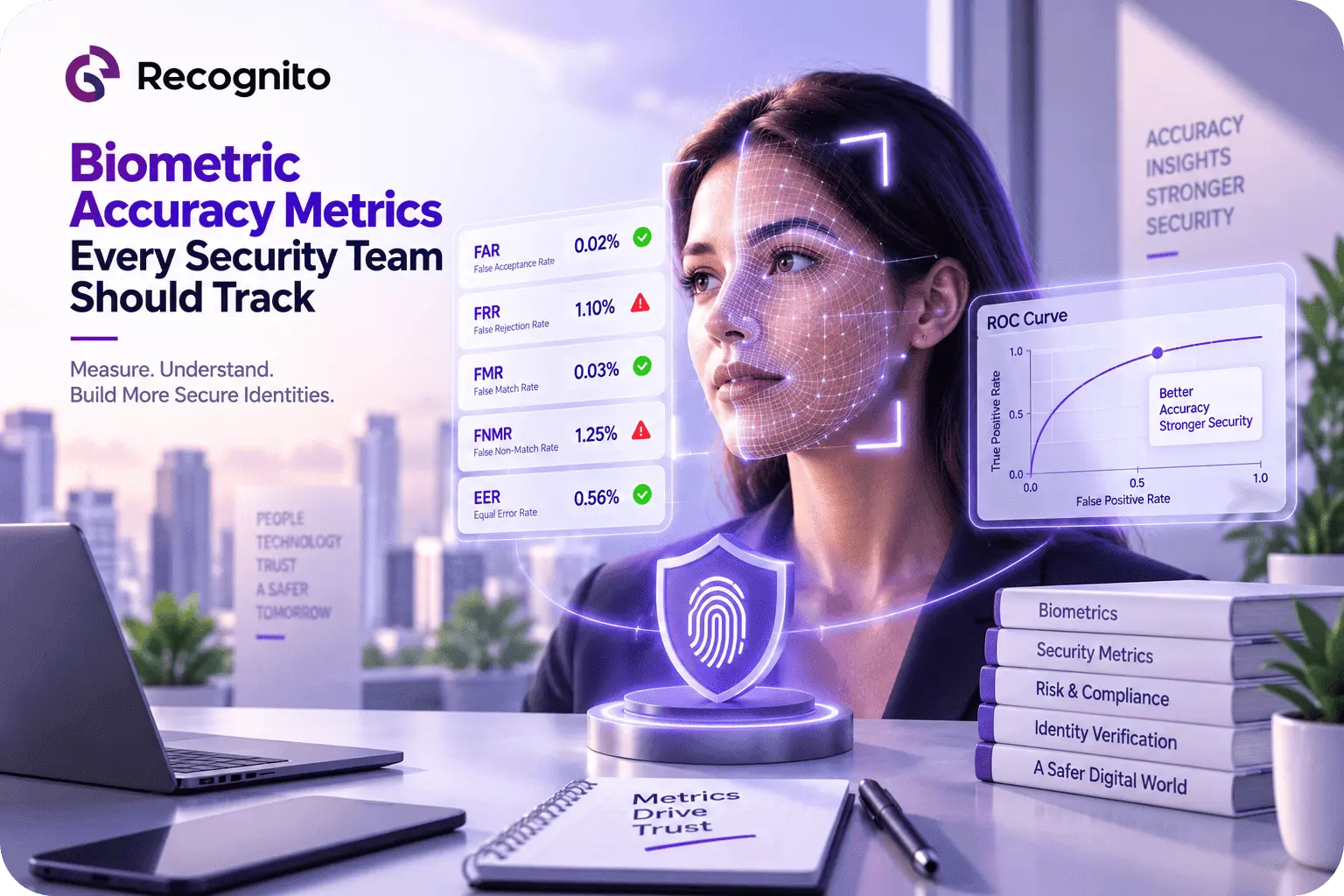
This is why organizations should monitor both security and usability metrics.
Useful measures include:
- liveness acceptance and rejection rates
- confirmed attack detection rates
- false rejection rates
- retry frequency
- time to successful verification
- manual-review volume
- abandonment rate
- performance across supported devices and environments
The objective is not to maximize rejection. It is to reject genuine attack attempts while keeping legitimate users moving through the verification journey.
Why Capture Quality Matters
A detection algorithm can only analyze the evidence it receives.
Poor lighting, camera blur, extreme angles, low resolution, reflections, and unstable framing can affect both face recognition and liveness detection. A customer who repeatedly fails capture may perceive the verification platform as unreliable even when the underlying security technology is functioning as designed.
The capture interface should therefore be treated as part of the security system.
Real-time guidance can help users position their faces correctly. Quality checks can identify problems before the application sends unusable evidence to a backend service. Intelligent retry logic can distinguish recoverable capture problems from higher-risk failures.
The broader face liveness detection discussion explains how this technology contributes to biometric security and why liveness needs to be considered alongside facial recognition.
Building a Layered Anti-Fraud Architecture
A common mistake is to think of liveness as the final barrier between an attacker and approval.
It is better understood as one component within a layered architecture.
A resilient remote identity system might combine:
Document verification to assess identity evidence.
Face matching to connect the applicant with the identity reference.
Face liveness to address presentation attacks.
Device and application controls to identify suspicious environments or unusual capture behavior.
Media and injection protections to reduce the risk of manipulated input reaching the biometric engine.
Risk-based decisioning to combine signals rather than depending on one score.
Human escalation for uncertain or high-risk cases.
The advantage of this architecture is that different controls compensate for different weaknesses. If an attacker finds a way around one layer, they still need to defeat the others.
Choosing a Face Liveness Solution
Technology evaluation should begin with the intended threat model.
1. Identify the actual attack surface
A mobile banking application has different risks from an access-control terminal or workforce authentication platform. Consider whether attacks are likely to involve photographs, screens, replayed video, deepfakes, masks, injection, or compromised devices.
2. Understand the detection approach
Ask whether the solution uses passive techniques, active challenges, multiple signals, or a combination.
3. Examine independent testing
Vendor demonstrations are useful, but independent testing offers stronger evidence. Check whether evaluations follow recognized PAD testing principles and whether the reported results match the intended deployment environment.
4. Test real devices
Camera models, operating systems, lighting, network conditions, and user behavior can all affect performance.
5. Measure usability
Security controls that produce excessive false rejects can create operational costs and customer abandonment.
For development teams integrating biometric controls into their applications, a face liveness SDK can provide the liveness layer while leaving the surrounding identity workflow under application-level control.
Should Businesses Use a Liveness SDK or a Full Verification Platform?
The answer depends on the architecture.
A company with an existing identity platform may only need a specialized biometric component that can integrate with its document, risk, and customer-data systems.
Another organization may prefer an end-to-end verification service that combines document processing, facial verification, liveness, and orchestration.
The important consideration is control over the complete workflow.
A biometric component should provide predictable outputs, clear failure states, reasonable latency, supported platforms, secure data handling, and enough visibility for fraud and compliance teams to understand how decisions are being made.
Teams that want a practical way to explore biometric capabilities can use a face biometric playground during early technical evaluation before committing to production integration.
Privacy Must Be Designed Alongside Security
Face liveness processes biometric information, so stronger fraud prevention should not come at the expense of weak data governance.
Organizations need to determine what biometric information is captured, whether raw imagery is retained, how templates or derived representations are protected, where data is processed, who can access it, and how long it is kept.
Centralized processing may simplify large-scale operations but can introduce additional privacy and security considerations. Device-based processing can reduce some data movement while introducing its own implementation constraints.
The correct architecture depends on the use case, regulatory environment, security requirements, and operational model.
Privacy should therefore be assessed during solution design rather than after deployment.
What Liveness Detection Cannot Guarantee
It is important to keep expectations realistic.
No liveness technology should be described as an absolute guarantee against all fraud. Attackers change their techniques, and different presentation attack instruments can behave differently.
ISO’s PAD framework itself does not define one universal countermeasure or claim to provide an overall system-security assessment. It establishes terminology and evaluation principles rather than certifying that a specific implementation is invulnerable. This makes independent testing and continuous threat assessment essential.
NIST’s published evaluations reinforce the same lesson: different algorithms exhibit different detection behavior across attack types, and performance must be interpreted in the context of the tested conditions.
Liveness should therefore be viewed as a risk-reduction control, not a guarantee of perfect fraud detection.
Measuring Liveness After Deployment
A production deployment needs continuous monitoring.
Useful questions include:
- Are attack attempts increasing?
- Which attack patterns generate the most failures?
- Which devices produce the highest false-reject rate?
- Are legitimate customers abandoning the flow?
- Are manual reviews increasing?
- Has performance changed after an application or model update?
- Are certain environments consistently producing poorer results?
These measurements help distinguish genuine security issues from capture problems.
A mature fraud program should also feed confirmed attack cases back into testing and model evaluation. Threat patterns discovered in production can become part of future red-team scenarios.
The Role of Liveness in the Future of Fraud Prevention
As identity fraud becomes more automated, biometric systems increasingly need to distinguish genuine human presence from sophisticated representations.
That does not mean liveness will replace identity verification, document checks, or other fraud controls. Its role is narrower and more valuable: protect the biometric capture point from presentation attacks.
This makes it an important building block for digital onboarding, authentication, account recovery, payments, workforce access, and other environments where a remote camera becomes part of the security boundary.
For technical teams exploring implementation options, the Recognito GitHub repository provides developer-oriented resources that can complement product evaluation and integration planning.
Conclusion
Face liveness detection closes an important gap between facial recognition and trustworthy biometric verification.
A face can match without being genuine. A captured image can look convincing without proving that the person is physically present. Liveness adds a separate layer of evidence designed to identify presentation attacks at the point of biometric capture.
The strongest implementations combine liveness with facial matching, document verification, device and media protections, risk-based decisioning, and appropriate human escalation.
For organizations building secure biometric identity workflows, Recognito provides technology that can support liveness and facial verification as part of a layered fraud-prevention architecture.
Frequently Asked Questions
What is face liveness detection?
Face liveness detection is a biometric security capability designed to determine whether a facial sample appears to come from a live person who is physically present during capture rather than from a presentation artifact.
Is liveness detection the same as facial recognition?
No. Facial recognition compares facial biometric samples to determine similarity or identity. Liveness detection assesses whether the biometric input appears genuine and live.
Can liveness detection stop deepfakes?
Liveness can help address presentation attacks, but it should not be treated as a universal deepfake defense. Sophisticated threats may require additional media, device, injection, and risk controls.
Is passive liveness better than active liveness?
Neither is universally better. Passive approaches may reduce interaction friction, while active approaches can introduce additional challenge-response evidence. The best choice depends on risk, usability, devices, and the expected attack environment.
How should a business evaluate a liveness solution?
Assess independent testing, relevant attack coverage, false-reject behavior, device performance, latency, privacy controls, integration requirements, monitoring capabilities, and performance under realistic production conditions.