
Remote biometric verification has become an important part of digital onboarding, authentication, fraud prevention, and account recovery. But confirming that a face matches a trusted identity is only one part of the process.
The system also needs to determine whether the face being presented is genuine.
This is where liveness detection comes in. It helps distinguish a bona fide biometric presentation from an artificial one, such as a photograph, replayed video, or other presentation attack. NIST defines presentation attack detection as the automated determination of a presentation attack and describes liveness detection as one approach that can assess whether biometric data is being captured from a living subject. (NIST Computer Security Resource Center)
Two broad approaches are commonly discussed: active liveness detection and passive liveness detection.
Active systems require some form of user interaction or challenge. Passive systems attempt to assess whether the presentation is genuine without requiring the same deliberate action.
So, which is better in 2026?
There is no universal winner. The right approach depends on the application’s threat model, user experience requirements, device environment, risk level, and the evidence available from testing.
What Is Active Liveness Detection?
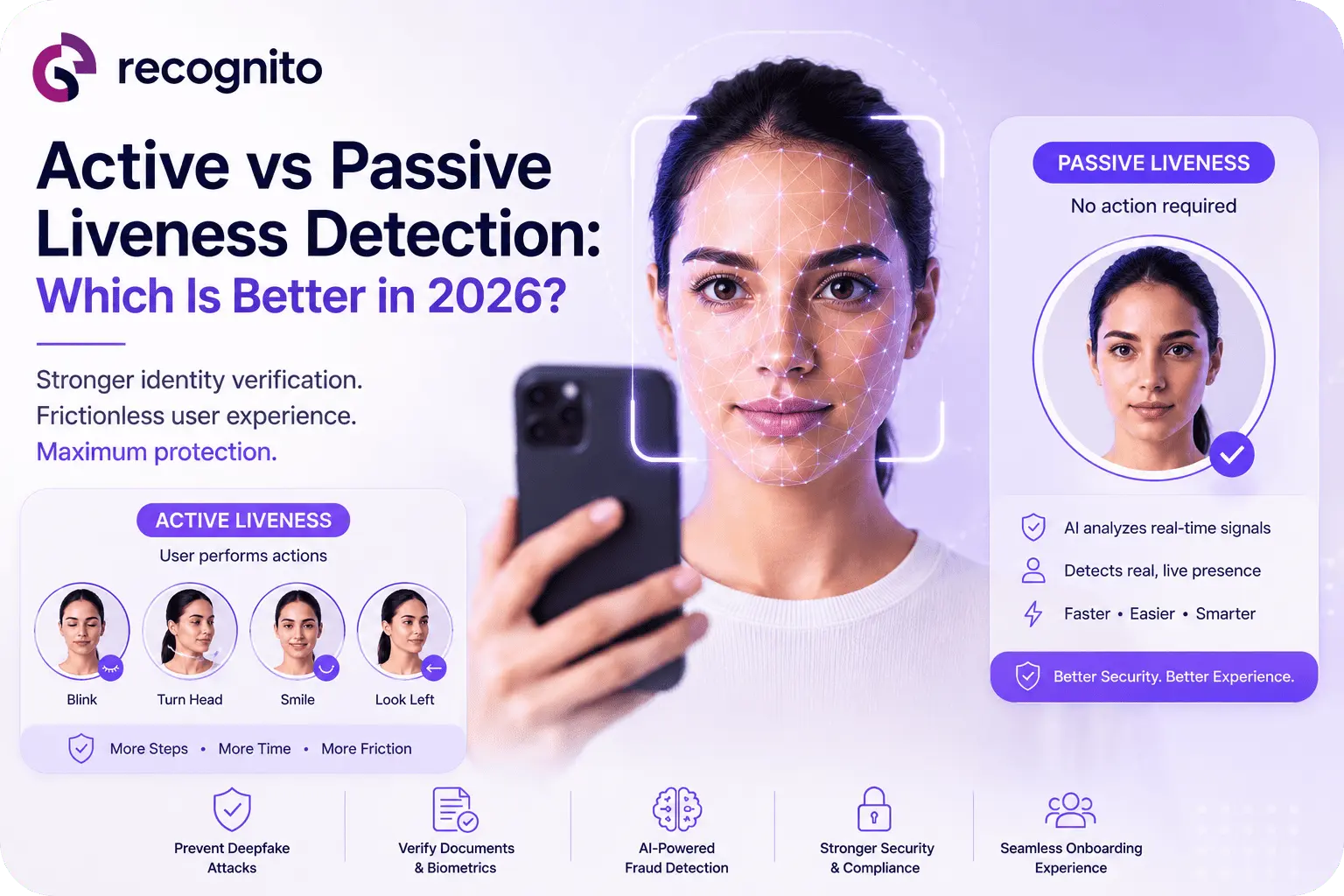
Active liveness detection asks the user to participate in the verification process.
The application may instruct the person to perform a specific action during facial capture. The exact interaction can vary by implementation.
The underlying idea is simple:
The system challenges the user, and the user’s response becomes part of the liveness assessment.
For example, an application might require the person to follow a visual instruction before completing the biometric check.
Active approaches can be useful because they introduce an explicit interaction rather than relying only on passive analysis of the captured face.
NIST’s remote identity-proofing guidance has historically described supervised and automated approaches in which an applicant may be instructed to move their head or respond during live capture to help establish that the interaction is live rather than prerecorded. (NIST Pages)
What Is Passive Liveness Detection?
Passive liveness detection attempts to determine whether a facial presentation is genuine without requiring the same type of deliberate user challenge.
The user can generally look at the camera normally while the system analyzes the biometric presentation.
The goal is to make security less visible to the customer.
A passive workflow may therefore look like:
Open verification → capture face → analyze presentation → return result
This can be attractive for digital onboarding because fewer explicit instructions can make the experience feel faster and more natural.
But the lack of interaction does not mean lower security.
The important question is whether the underlying technology has been appropriately tested against the attacks relevant to the deployment.
Active vs Passive Liveness: The Core Difference
The easiest way to understand the distinction is to focus on the user’s role.
Active liveness: the user participates in a challenge.
Passive liveness: the system evaluates the presentation with minimal deliberate user interaction.
That difference affects several business considerations.
| Factor | Active Liveness | Passive Liveness |
| User interaction | Higher | Lower |
| Customer friction | Usually higher | Usually lower |
| Capture experience | More guided | More seamless |
| Security design | Challenge-based plus biometric analysis | Analysis-driven |
| Best fit | Higher-friction, controlled workflows | High-volume digital journeys |
| Main concern | User abandonment or inconvenience | Whether detection is sufficiently robust |
| Evaluation priority | Challenge integrity and attack resistance | Attack resistance and real-world usability |
The table is only a starting point. A well-designed implementation can combine different techniques rather than relying on a simplistic active-versus-passive choice.
Is Active Liveness More Secure?
Not automatically.
One of the most persistent misconceptions is that asking a user to perform an action automatically makes a biometric system safer.
The quality of the challenge matters.
The quality of the biometric analysis matters.
The attack testing matters.
The application around the liveness technology matters.
A system can have an active challenge and still have weaknesses elsewhere.
ISO/IEC 30107-3:2023 provides principles and methods for evaluating presentation attack detection mechanisms and reporting their performance. The standard does not prescribe one specific anti-spoofing algorithm, sensor, or technique. (ISO)
This is why buyers should focus on evidence rather than labels.
Instead of asking:
“Is the system active?”
ask:
“How does it perform against the attacks relevant to our application?”
Is Passive Liveness Less Secure?
Passive liveness is not inherently weaker either.
A modern passive system can evaluate many characteristics of the presentation without requiring obvious user actions. This can reduce opportunities for poor user interaction while keeping biometric protection largely invisible.
The real question is whether the system can maintain an appropriate security level against realistic attack scenarios.
FIDO’s biometric certification framework evaluates both biometric matching and presentation attack detection, and its current documentation covers remote face verification as an end-to-end scenario involving the user interface, capture, quality processing, matching, and PAD. (FIDO Alliance)
That is a more useful way to evaluate passive liveness than assuming that less interaction means less protection.
User Experience Is a Major Factor in 2026
Digital identity verification has become part of the customer experience.
A bank may lose an applicant if verification takes too long.
A fintech platform may see more abandoned applications if users repeatedly fail a biometric challenge.
A marketplace may create unnecessary friction if every seller has to complete a complicated sequence before creating an account.
This makes passive liveness particularly attractive for high-volume consumer workflows.
The ideal experience can be almost invisible:
Capture → analysis → result
That does not mean every business should choose passive detection.
High-risk environments may accept additional interaction when the stronger workflow provides meaningful security value.
The decision should therefore balance:
Security assurance + completion rate + user expectations + fraud exposure
Active Liveness Can Still Be Valuable
Active liveness remains useful when the business wants an explicit interaction during biometric verification.
This can be relevant when:
- The verification process is high risk
- Users are already willing to follow instructions
- Additional interaction is acceptable
- The environment is controlled
- The business needs an explicit challenge
For example, a sensitive account-recovery workflow may justify more friction than routine customer onboarding.
An organization can also use stronger verification selectively rather than applying the same experience to everyone.
When Passive Liveness Makes More Sense
Passive liveness is often attractive when the business needs low-friction verification at scale.
It can be particularly useful for:
- Digital customer onboarding
- Fintech applications
- Marketplace registration
- Remote account recovery
- Large consumer platforms
- Mobile identity verification
The user does not need to understand the security architecture.
They simply complete the facial capture.
This can reduce cognitive load and make verification feel more like a normal product interaction.
Recognito’s discussion of why face liveness verification is important for online security provides additional context on the role liveness can play in remote identity workflows.
Active and Passive Can Be Part of the Same Strategy
Businesses do not necessarily need to choose one approach for every user.
A risk-based architecture can use different levels of biometric interaction depending on the circumstances.
For example:
Low risk → passive biometric verification
Elevated risk → passive liveness with additional signals
High risk → stronger biometric controls and additional verification
This can provide a better balance than forcing every customer through the same flow.
The technology becomes part of a broader identity decision rather than a single fixed step.
Liveness Is Not the Same as Face Recognition
Another important distinction is between liveness and facial recognition.
Facial recognition determines whether facial representations correspond.
Liveness determines whether the biometric presentation appears genuine.
These capabilities solve different problems.
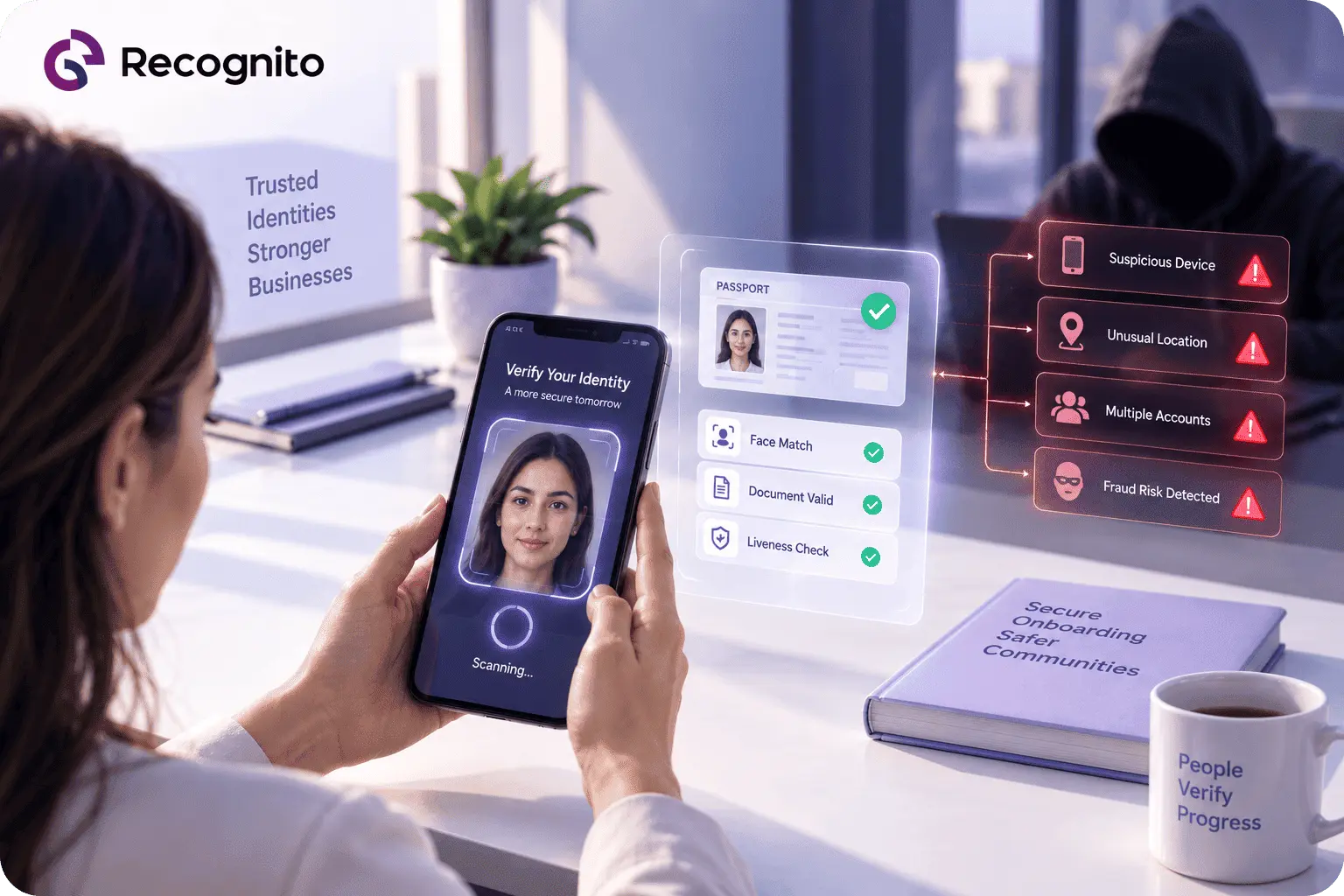
Imagine an attacker presents a realistic video of another person.
Face recognition may find a strong similarity.
Liveness is designed to determine whether the presentation itself appears genuine.
This is why remote identity verification commonly combines:
Identity document + face matching + liveness + risk analysis
A biometric verification SDK can support the face-matching part of this architecture, while a liveness component addresses presentation risk.
Liveness and Presentation Attacks
Organizations should understand the broader concept of presentation attack detection, or PAD.
ISO/IEC 30107-1 provides the framework and terminology for PAD, while ISO/IEC 30107-3 addresses testing and reporting. The standards focus specifically on attacks at the biometric capture device and do not constitute an overall system-security assessment. (ISO)
This distinction is important because a liveness system may be effective against presentation attacks while the overall application still has other vulnerabilities.
For example, an attacker could target:
- The application
- The device
- The capture pipeline
- The API
- The identity database
Liveness should therefore be evaluated as one security layer.
What About Deepfakes?
Deepfake technology has made facial security more complicated.
Synthetic video can imitate a real individual, potentially creating a convincing biometric presentation.
Neither active nor passive liveness should automatically be described as a complete deepfake solution.
Instead, businesses should evaluate whether their overall architecture can resist:
Synthetic facial media
Replay attacks
Screen-based presentations
Physical presentation attacks
Injection attacks
Recognito’s article on deepfake attack prevention explores the broader defensive approach required when synthetic media becomes part of the threat model.
The key lesson is that deepfake defense is broader than choosing active or passive liveness.
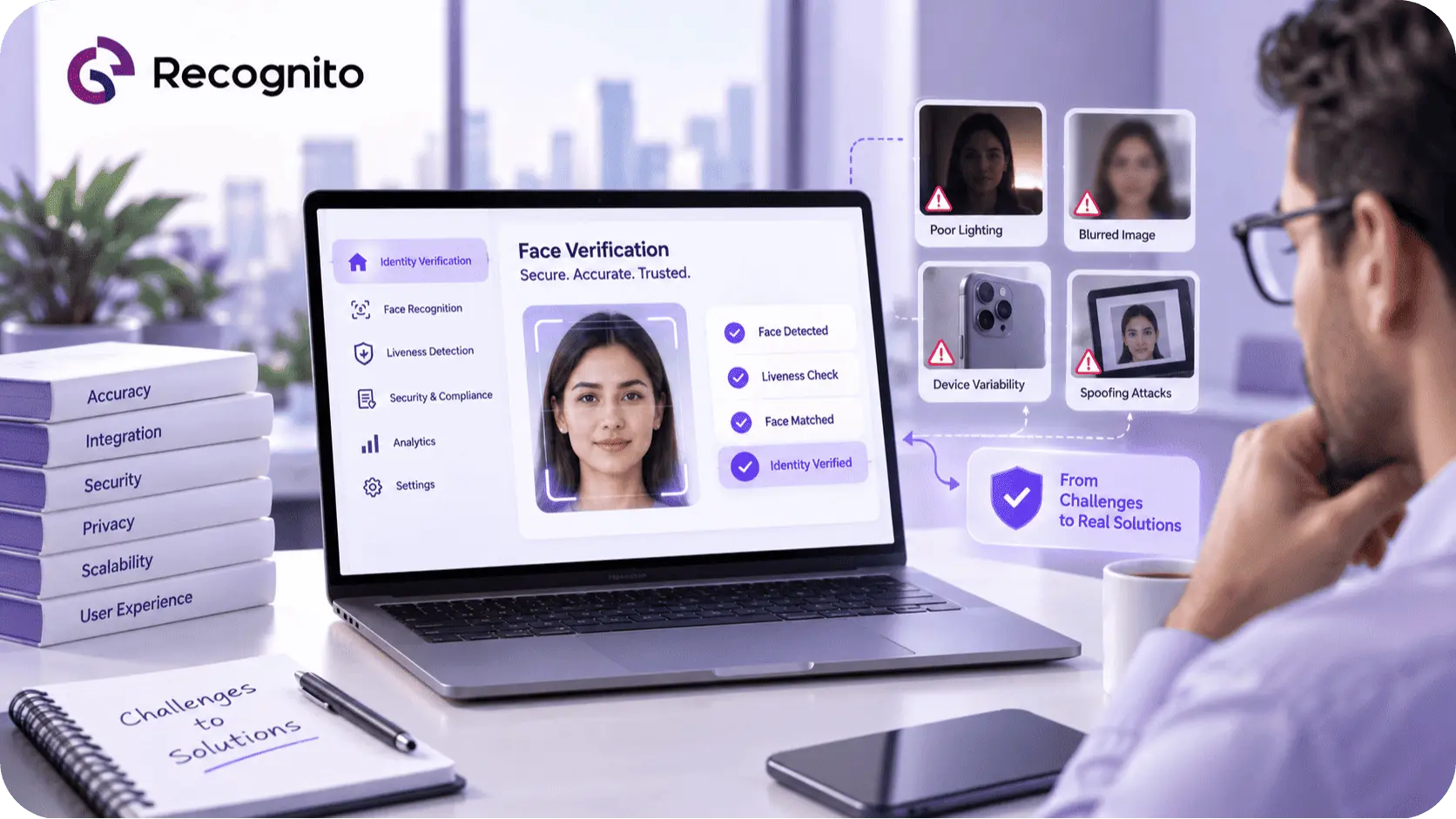
What About Mobile Devices?
Mobile verification creates its own challenges.
Users have different:
- Camera qualities
- Lighting conditions
- Device models
- Operating systems
- Network conditions
A solution that works well in a controlled test environment may behave differently in production.
ISO/IEC 30107-4 provides a specific profile for PAD testing on mobile devices, illustrating the importance of evaluating biometric presentation protection in the environments where users actually interact with the technology. (ISO)
Businesses should therefore test real devices rather than relying only on demonstrations.
How to Evaluate Active and Passive Liveness
The correct evaluation should begin with the business threat model.
Identify the Attack Surface
Determine which presentation and injection attacks are realistic.
Measure Legitimate-User Performance
Track successful verification, retries, failure rates, and completion time.
Test Multiple Devices
Use the mobile and camera environments used by real customers.
Evaluate Security Separately
Measure how the system responds to relevant presentation attacks.
Review Independent Testing
FIDO’s certification program is designed around scenario-based evaluation of biometric components, including capture, quality processing, matching, and PAD. (FIDO Alliance)
Test the Complete Workflow
Do not evaluate liveness independently from document verification, facial matching, application security, and risk decisioning.
Which Approach Is Better for KYC?
For many digital KYC workflows, passive liveness has a practical advantage because customer friction directly affects onboarding completion.
A seamless experience can be especially valuable when the organization processes large volumes of applications.
However, high-risk KYC processes may justify stronger interaction or additional verification.
FATF’s digital identity guidance emphasizes that organizations should consider the reliability and assurance of digital identity technology in the context of the relevant customer and transaction risk. FATF Digital Identity Guidance
The takeaway is not “always use passive.”
It is:
Use the level of biometric assurance appropriate to the risk.
Which Approach Is Better for Account Recovery?
Account recovery deserves special treatment because it can provide an alternative path into a protected account.
For a normal low-risk recovery request, passive biometric verification may provide a smoother experience.
For a suspicious recovery involving an unfamiliar device, unusual activity, or sensitive account changes, additional controls may be appropriate.
This is a good example of why active and passive detection should be viewed as tools within a risk-based strategy rather than competing products.
How Liveness Fits Into a Layered Verification Architecture
A mature verification system should not depend on liveness alone.
A practical architecture can include:
1. Identity evidence
Establish who the user claims to be.
2. Document verification
Check the credibility of the identity document where applicable.
3. Facial verification
Compare the user with the trusted facial reference.
4. Liveness
Assess whether the facial presentation appears genuine.
5. Risk analysis
Combine biometric, account, device, and transaction context.
6. Additional review
Escalate ambiguous or high-risk cases when needed.
This architecture allows each control to address a different part of the identity problem.
Why SDK Integration Matters
Businesses building their own products often need liveness to work inside an existing customer journey.
An identity verification SDK can support integration into a wider onboarding experience, allowing biometric checks to become part of the application rather than an unrelated external workflow.
For technical teams, the Recognito GitHub repository can also be useful when researching implementation and integration.
The goal should be a verification flow that is secure without becoming unnecessarily complicated for legitimate users.
Common Mistakes When Choosing Liveness
Choosing Based Only on “Active” or “Passive”
The label says little about real-world performance.
Ignoring User Experience
Excessive interaction can increase abandonment.
Ignoring Security Testing
A smooth experience has little value if attack resistance is inadequate.
Testing Only One Device
Production users have diverse cameras and environments.
Treating Liveness as Identity Verification
Liveness does not determine who the person is.
Ignoring the Wider Application
Injection and application-level attacks require additional protection.
How Recognito Fits Into Liveness Workflows
Businesses evaluating biometric workflows can use a face liveness SDK to integrate presentation-attack protection into their applications.
The appropriate implementation can then connect liveness with facial matching and identity evidence according to the organization’s requirements.
For broader technical evaluation, the face liveness technology overview provides additional context on how liveness contributes to biometric security.
The right approach depends on factors such as customer volume, fraud exposure, acceptable friction, supported devices, and the level of identity assurance required.
Conclusion
So, active vs passive liveness detection: which is better in 2026?
Neither approach is universally better.
Active liveness can be useful when explicit user interaction provides meaningful value and additional friction is acceptable.
Passive liveness can be highly attractive when businesses need fast, low-friction biometric verification at scale.
The better decision is therefore not based on whether the technology is active or passive.
It is based on:
Attack resistance + legitimate-user performance + device compatibility + application security + risk level
ISO/IEC 30107-3 provides a framework for PAD testing, FIDO’s certification approach evaluates biometric performance and presentation attack detection as part of broader scenarios, and NIST’s digital identity guidance recognizes liveness and remote biometric protections as important elements of identity proofing. (ISO)
For many consumer-facing digital journeys, passive detection can provide an excellent balance between security and usability.
For higher-risk events, businesses may choose stronger verification, including active interaction, additional identity evidence, or human review.
The most resilient architecture is ultimately the one that does not depend on a single control.
Trusted identity evidence + facial verification + liveness + secure capture + contextual risk analysis provides a more practical foundation for protecting digital identities as biometric attacks continue to evolve.
Organizations evaluating SDK-based liveness and biometric verification can explore Recognito as part of a broader identity-verification and fraud-prevention architecture.
Frequently Asked Questions
Is active liveness more secure than passive liveness?
Not necessarily. Security depends on the implementation, attack resistance, testing methodology, device environment, and broader application architecture. The active/passive label alone does not determine effectiveness.
Is passive liveness better for customer onboarding?
It can be advantageous when minimizing friction and maximizing completion are priorities, especially in high-volume digital onboarding. Higher-risk applications may require additional controls.
Can active or passive liveness prevent deepfakes?
Both can contribute to biometric presentation protection, but neither should be considered a universal deepfake defense. Businesses should also consider injection protection, facial verification, identity evidence, and broader fraud controls.
Does liveness replace facial recognition?
No. Liveness evaluates whether the biometric presentation appears genuine, while facial recognition or verification determines whether the face corresponds with a trusted identity.
How should businesses choose between active and passive liveness?
Evaluate the organization’s threat model, risk level, customer experience requirements, device environment, testing evidence, and integration needs. Choose the approach that provides the required assurance without unnecessary friction.