
Online identity systems have a basic weakness: proving that a face matches an account does not necessarily prove that the person behind the camera is actually present.
A photograph can resemble a legitimate user. A replayed video can show convincing facial movement. A deepfake can imitate someone else’s appearance. Even a highly accurate facial recognition model can return the wrong security outcome if the biometric sample itself is fraudulent.
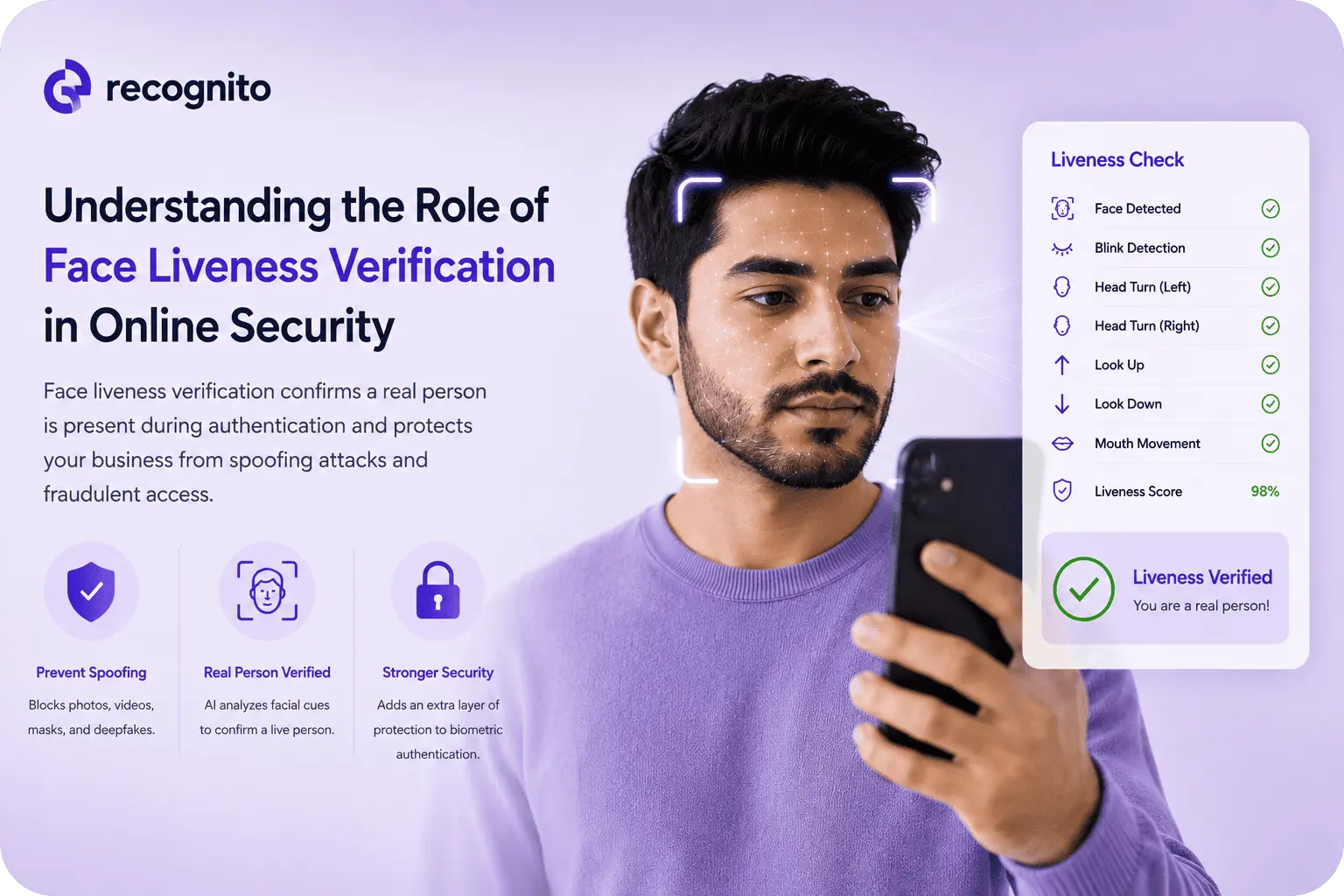
This is why face liveness verification has become an important part of modern online security. It adds a separate question to facial verification: Is this biometric input coming from a live person who is physically present at the point of capture?
That distinction matters across financial services, digital onboarding, authentication, account recovery, remote access, and other workflows where an organization needs stronger assurance that the individual presenting the biometric is genuine.
Why Face Matching Alone Is Not Enough
Facial recognition and liveness detection solve different problems.
A facial recognition system compares biometric features and determines how closely two facial samples correspond. That can establish that a captured face resembles the enrolled identity.
Liveness verification focuses on the origin of the sample. It attempts to distinguish a genuine live interaction from a presentation attack such as a photograph, replayed video, mask, or other artificial presentation.
NIST defines presentation attack detection as an automated determination of a presentation attack. Its current identity-proofing guidance specifically addresses biometric collection and requires presentation attack detection controls for remote biometric comparison. The guidance also emphasizes that these controls are intended to mitigate spoofing and impersonation attempts.
For organizations designing a secure biometric workflow, the separation is fundamental:
Face matching answers “Who does this look like?”
Liveness answers “Is this a genuine live presentation?”
Treating those questions as interchangeable creates a security gap.
For readers who need a broader technical introduction, what face liveness detection is and how it prevents fraud explains the role of liveness within biometric verification.
What Happens During Face Liveness Verification?
A typical liveness system examines a live facial capture and looks for evidence that the input originates from a real person rather than a presentation artifact.
The exact implementation differs between providers. Some systems analyze a short video sequence or subtle facial characteristics. Others use passive signals that do not require explicit user actions. More interactive approaches may ask the subject to perform controlled movements.
The underlying principle is to make a fraudulent presentation harder to reproduce convincingly.
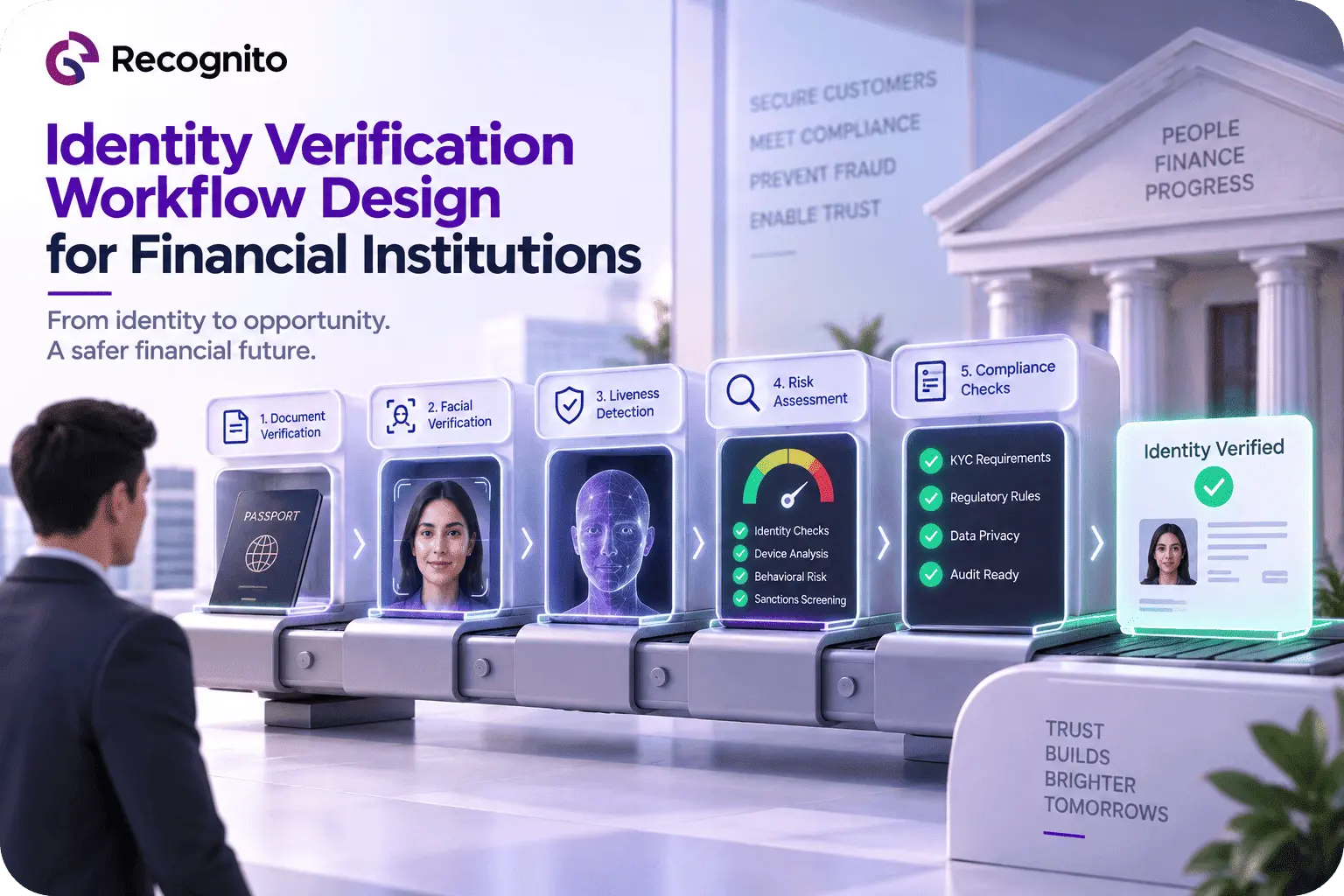
A remote verification journey may therefore look like this:
- The user opens the verification experience.
- The camera begins capturing a face or short sequence.
- The system checks image quality and whether the face is properly positioned.
- Liveness analysis evaluates the biometric input.
- Facial matching compares the captured face with a trusted reference.
- The resulting signals are passed to the application’s risk engine.
- The customer is approved, rejected, or sent through additional verification.
The customer may experience this as a few seconds of camera interaction, while the backend performs several security checks.
Passive vs Active Liveness Detection
One of the most important implementation decisions concerns how liveness is evaluated.
Passive liveness works largely in the background. The customer may simply look at the camera while the system analyzes the capture.
Active liveness asks the customer to perform an action, such as moving the head, following an instruction, or responding to a prompt.
Neither method should be treated as universally superior. The right approach depends on the required assurance level, user experience, attack model, device environment, and operational constraints.
Passive approaches can reduce friction because they require less user interaction. Active approaches can introduce additional challenge-response evidence, but they can also make the experience slower or more cumbersome.
The trade-off is explored in greater detail in active vs passive liveness detection, particularly when balancing security with usability.
The Attackers Liveness Is Designed to Stop
The security value of liveness becomes clearer when looking at how biometric systems are attacked.
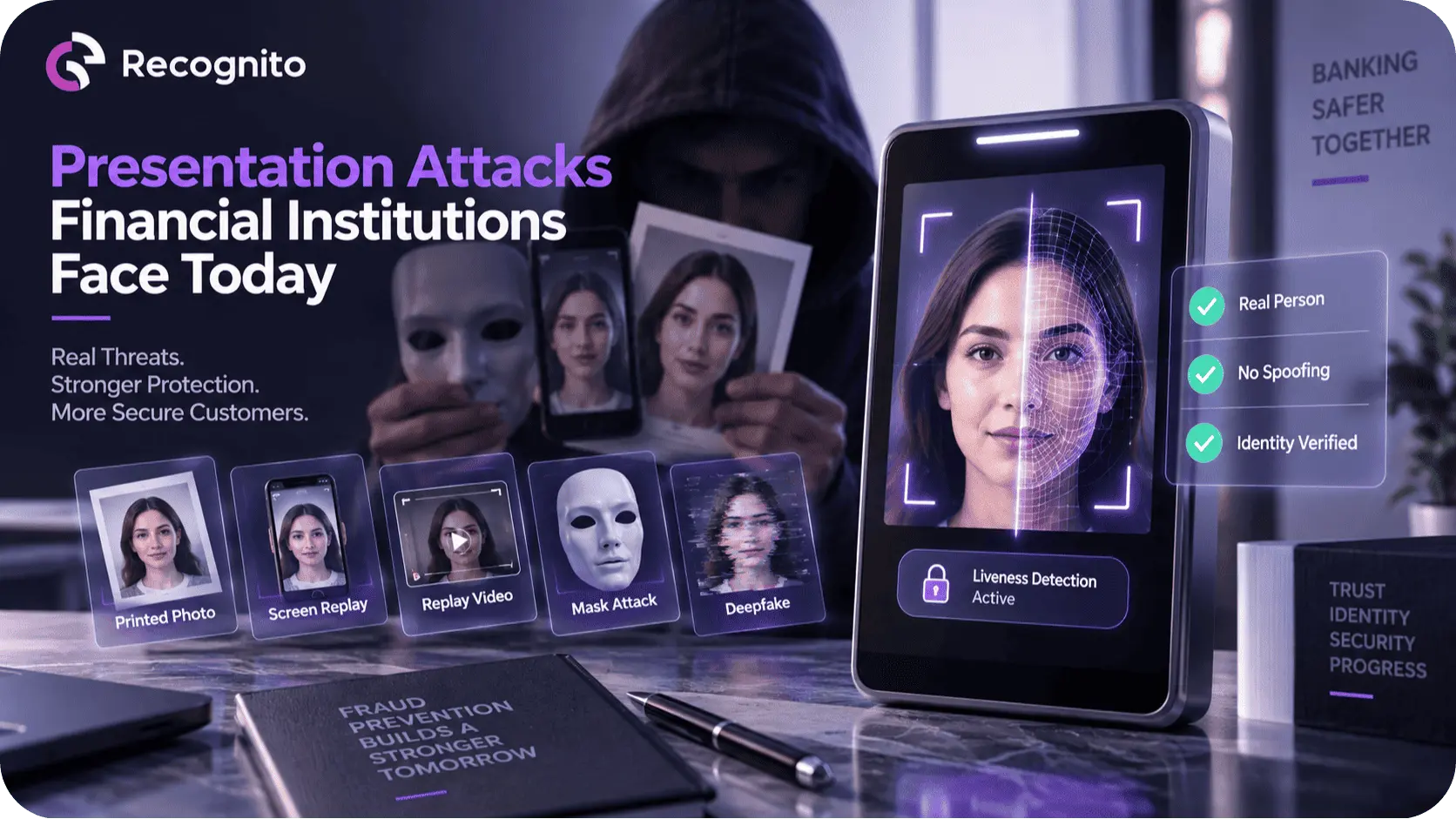
Printed photographs
A fraudster may attempt to present a photograph of a legitimate person to the camera. A basic facial matching system could potentially interpret the image as a valid facial sample if no presentation-attack control is present.
Screen replays
Instead of a static image, an attacker may display recorded video containing facial movement. This is more difficult to distinguish from a live person than a simple photograph.
Masks and physical replicas
Attackers may use realistic masks or other physical artifacts intended to reproduce facial characteristics.
Manipulated or generated media
Generative AI has increased the quality and accessibility of synthetic facial content. Deepfakes can imitate expressions, movement, and appearance closely enough to challenge systems that rely on superficial visual similarity.
Injection attacks
Not every attack involves presenting something in front of a camera. An attacker may attempt to interfere with the media stream before it reaches the verification engine.
This last category is especially important because a system may have strong liveness detection at the camera boundary while remaining vulnerable elsewhere in the technical pipeline.
Liveness Is One Layer in a Larger Security Architecture
It is tempting to describe face liveness verification as the single control that makes facial authentication secure. That is too simplistic.
Modern biometric security should be layered.
| Security layer | Primary purpose | Example concern |
| Image quality | Ensure usable biometric input | Blur, glare, poor framing |
| Face detection | Locate the biometric subject | Incorrect or incomplete capture |
| Liveness/PAD | Determine whether the presentation is genuine | Photo, replay, mask |
| Face matching | Compare identity representations | Impersonation |
| Injection defenses | Protect the media pipeline | Manipulated input stream |
| Risk engine | Combine security signals | Suspicious account behavior |
| Step-up verification | Add assurance when needed | High-risk or uncertain cases |
This layered model helps prevent a common architectural mistake: assuming that success at one stage guarantees security at every other stage.
ISO/IEC 30107-1 defines the framework and terminology for biometric presentation attack detection, while ISO/IEC 30107-3 addresses testing and reporting of PAD mechanisms. These standards are useful because they encourage organizations to think about attack presentation and evaluation systematically rather than treating “anti-spoofing” as a vague product feature.
Why Deepfakes Change the Liveness Conversation
Traditional presentation attacks often involved relatively simple artifacts: printed photos, screens, or physical replicas.
Deepfakes introduce a more dynamic problem.
An attacker may attempt to create or manipulate video in real time so that the camera feed resembles a legitimate person. As synthetic media becomes more convincing, organizations need to evaluate whether their liveness controls are resilient to the specific threat model they face.
FIDO’s Face Verification Certification is a useful example of the broader direction of biometric assurance. Its testing includes face matching, facial liveness, deepfakes, injection attacks, and demographic performance rather than treating facial similarity as the only security criterion.
That approach reflects an important reality: modern identity verification needs to assess the entire path from capture to decision.
A strong matcher without attack resistance can still be exploited. A strong liveness model without reliable matching can still misidentify a legitimate or fraudulent subject.
Where Face Liveness Matters Most
The technology is particularly valuable when a user needs to prove identity remotely and there is no trusted employee or physical checkpoint.
Digital onboarding
Banks, fintech platforms, insurers, marketplaces, and other services may use selfie-based verification during account creation. Liveness helps strengthen the connection between the applicant and the biometric evidence.
Account recovery
Account recovery is an attractive target because attackers may already possess usernames, passwords, or personal information. A live biometric check can provide an additional barrier when risk is elevated.
High-risk transactions
Some transactions may justify stronger identity assurance than routine logins. Liveness can form part of a step-up process before sensitive actions are approved.
Remote authentication
Organizations may use face-based verification in environments where dedicated biometric hardware is unavailable.
Identity re-verification
Existing customers may need to re-establish identity after unusual activity, credential changes, or significant account events.
Across these workflows, the main advantage is not simply biometric convenience. It is the ability to add a stronger signal about the physical presence of the person behind the interaction.
Security and User Experience Must Be Designed Together
A technically strong liveness system can still damage an application if customers cannot complete it reliably.
Poor lighting, camera limitations, weak internet connections, motion blur, incorrect framing, and unclear instructions can increase failed attempts.
That creates two opposing risks.
Too little friction may weaken attack resistance.
Too much friction may cause legitimate users to abandon verification or repeatedly fail to complete it.
The right design therefore depends on the application’s risk level.
A low-risk workflow may favor passive liveness with a short capture. A high-risk action may justify stronger verification or additional challenges.
Device behavior matters as well. A system designed around desktop cameras may perform differently from one intended for a wide range of mobile devices.
What Businesses Should Measure
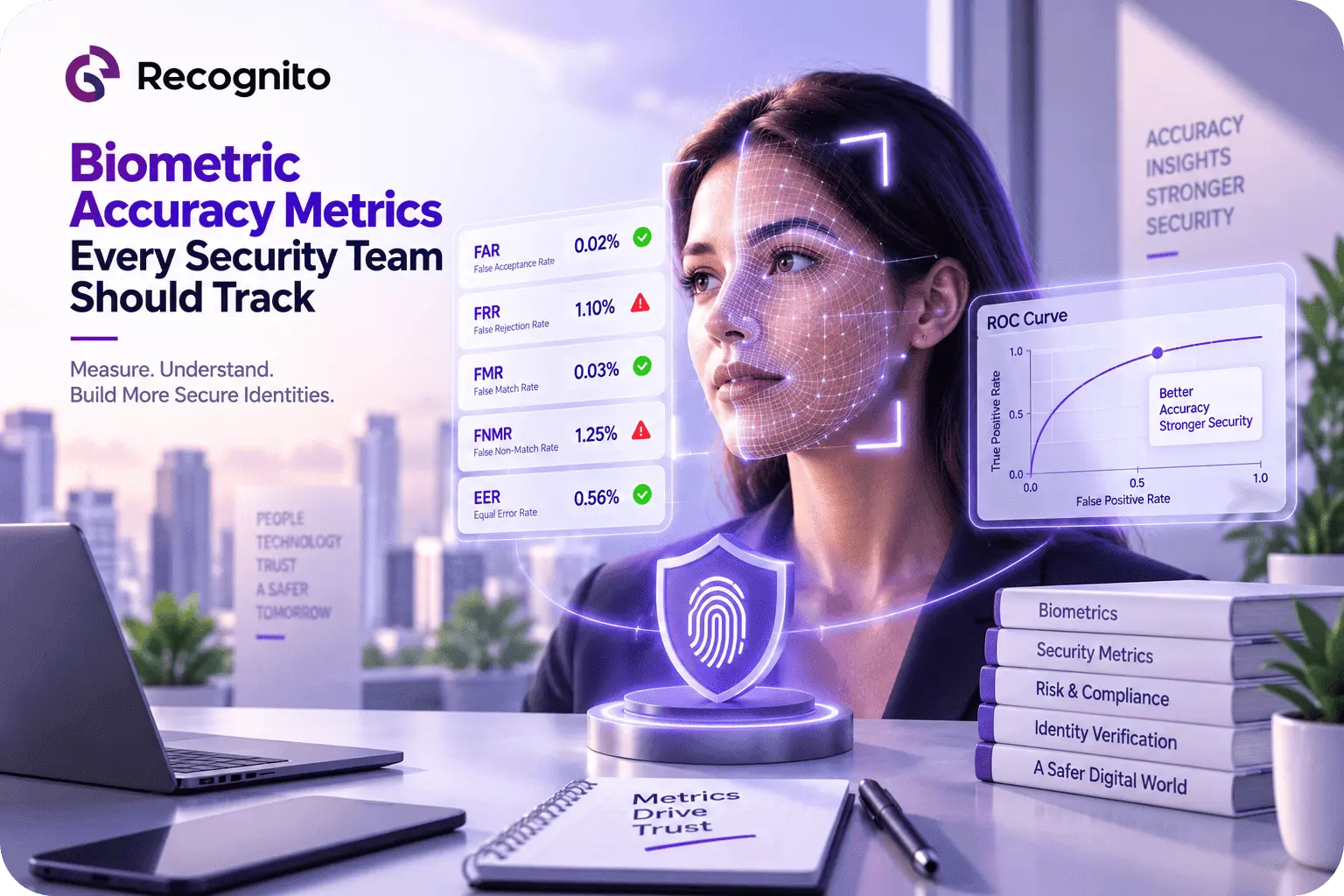
“Liveness accuracy” is too broad to be a meaningful deployment metric on its own.
A serious evaluation should measure several dimensions:
Attack detection: How does the system perform against relevant presentation attacks?
False rejection: How often are genuine users incorrectly blocked?
User completion: How many users successfully finish the flow?
Retry rate: How often do legitimate users have to repeat capture?
Latency: How quickly does the system return a decision?
Environmental performance: How does it behave across devices, lighting conditions, and network environments?
Demographic performance: Are there meaningful differences in outcomes across relevant populations?
Operational stability: How does the system behave when services, cameras, or network connections fail?
NIST’s identity-proofing guidance provides an especially useful reference because it treats biometric collection, presentation attack detection, performance, and operational conditions as parts of a broader identity-proofing process.
Independent Testing Matters
Vendor demonstrations are useful, but they should not be the only evidence used to evaluate a liveness system.
Independent testing helps organizations understand whether a technology performs against defined attack categories and performance criteria.
ISO/IEC 30107-1 establishes terminology and a framework for presentation attack detection, while ISO/IEC 30107-3 establishes principles and methods for assessing and reporting PAD performance.
NIST’s current SP 800-63A-4 Identity Proofing and Enrollment also provides technical requirements for remote biometric collection, including presentation attack detection and testing considerations.
These references should not be treated as a simple checklist. Businesses still need to validate performance against the actual devices, users, workflows, and threats they expect to encounter.
Privacy Is Part of Liveness Architecture
Face liveness relies on biometric information, so security architecture needs to account for privacy as well.
The relevant questions include:
- What biometric data is captured?
- Is a raw image stored?
- How are biometric representations protected?
- How long is information retained?
- Who can access it?
- Where is processing performed?
- What happens after a failed verification?
- Can unnecessary biometric data be deleted immediately?
Data minimization should be considered alongside attack resistance. Collecting more biometric information than necessary can create additional exposure without necessarily improving verification.
Organizations should also understand the difference between a biometric security feature and a complete privacy program. Strong liveness does not compensate for excessive retention, weak access controls, or unclear data governance.
Integrating Face Liveness Into a Production Application
For engineering teams, liveness should be treated as a component of a broader verification pipeline.
The implementation should define:
- Capture conditions — supported cameras, image quality, lighting, and framing.
- Decision thresholds — what level of confidence is required for different risk categories.
- Failure handling — what happens after unsuccessful captures or uncertain results.
- Fallbacks — whether another verification method is available.
- Monitoring — how performance and attack patterns are tracked after launch.
- Version control — how model or SDK updates are evaluated before production.
- Security boundaries — where media enters the system and how injection risks are addressed.
A purpose-built face liveness SDK can simplify integration, but the SDK is only one part of the implementation. Teams still need to design the orchestration around it.
Testing against realistic users and devices is essential. The same liveness model can produce different practical outcomes depending on how the camera flow is implemented.
For developers, the Recognito GitHub repository can provide additional technical resources to support evaluation and integration work.
When Liveness Should Trigger Stronger Verification
Not every session needs the same level of scrutiny.
A risk-based architecture can use liveness results alongside other signals.
For example, a routine login from a familiar device might follow a relatively lightweight path. A login from an unfamiliar device followed by account recovery and a high-value transaction might justify stronger biometric checks and additional identity evidence.
This is where liveness becomes more valuable than a simple “pass” or “fail” feature.
Its result can contribute to a larger risk score that determines whether the application should proceed, request additional evidence, or be reviewed manually.
That approach reduces unnecessary friction while preserving stronger controls for suspicious events.
The Future of Online Biometric Security
Face liveness is becoming less about one anti-spoofing technique and more about coordinated attack resistance.
Organizations increasingly need to consider presentation attacks, deepfakes, media injection, compromised devices, biometric matching, and identity fraud together.
The technical architecture will therefore matter as much as the individual model.
A provider may have excellent liveness performance in controlled testing, but if the application exposes weak APIs, insecure media paths, poor retry handling, or weak decision logic, attackers may target those boundaries instead.
The strongest systems continuously test the entire workflow rather than treating a liveness model as a finished security control.
Conclusion
Face liveness verification provides an important security layer because facial similarity alone does not prove that a real person is present.
Its role is to help distinguish genuine biometric capture from presentation attacks while giving businesses stronger evidence for remote identity decisions. But liveness should never operate in isolation. Effective online security combines it with facial matching, injection defenses, risk analysis, strong capture design, privacy controls, and appropriate fallback procedures.
The most useful mindset is to treat liveness as part of an end-to-end security architecture. Test it against realistic attack scenarios, measure both security and user-experience outcomes, and make its results meaningful within the broader identity decision.
For organizations implementing secure facial verification workflows, Recognito provides biometric technologies that can support liveness-aware online identity and authentication experiences.
Frequently Asked Questions
Is face liveness the same as facial recognition?
No. Facial recognition compares facial biometric characteristics to determine whether samples correspond. Liveness focuses on whether the presented biometric input appears to come from a live subject rather than a spoof or presentation attack.
Can face liveness prevent deepfake attacks?
It can help defend against some presentation attacks, but no single control should be assumed to stop every deepfake or injection technique. Deepfake resistance should be evaluated as part of a broader layered security architecture.
Is passive liveness better than active liveness?
Neither is universally better. Passive methods can reduce interaction and friction, while active methods can introduce additional challenge-response signals. The appropriate approach depends on risk, users, devices, and the required assurance level.
Does liveness increase verification time?
It can add processing or capture time, but a well-designed workflow can keep the additional interaction small. Latency and retry rates should be measured during production testing rather than judged from the feature description alone.
What should businesses look for in a face liveness solution?
Evaluate presentation-attack resistance, false rejection, user completion, demographic performance, device compatibility, latency, injection defenses, privacy controls, independent testing, integration requirements, and how liveness results are incorporated into the wider risk decision.