
Digital identity verification has become a fundamental component of modern customer onboarding. Financial institutions, fintech companies, healthcare providers, telecommunications operators, online marketplaces, cryptocurrency exchanges, and countless other organizations rely on digital identity verification to establish trust with customers before granting access to services.
As businesses continue shifting toward fully digital experiences, the ability to accurately verify identities remotely has never been more important. At the same time, fraudsters are leveraging increasingly sophisticated technologies such as deepfakes, synthetic identities, document forgery, and AI-generated impersonation attacks to exploit weaknesses in verification systems.
This growing battle between security and convenience has created significant challenges for organizations worldwide.
To address these risks, businesses are adopting advanced identity verification solutions that combine document authentication, biometric verification, liveness detection, artificial intelligence, and behavioral analytics to create more secure digital onboarding experiences.
What Is Digital Identity Verification?
Digital identity verification is the process of confirming that an individual is genuinely who they claim to be through digital channels.
Unlike traditional face-to-face verification, digital identity verification allows organizations to verify customers remotely using identity documents, biometric verification, and other trust signals.
Modern online identity verification workflows often include:
- Identity document verification
- Facial recognition
- Biometric verification
- Liveness detection
- Device intelligence
- Risk assessment
- Fraud screening
The objective is simple: establish trust in a customer’s identity while maintaining a seamless onboarding experience.
Organizations implementing digital onboarding solutions often struggle to distinguish between establishing an identity and validating ownership of that identity. Our guide on identity proofing and identity verification explains how these processes work together within modern onboarding environments.
Why Digital Identity Verification Matters
As digital services expand, businesses face increasing pressure to balance customer experience, security, and regulatory compliance.
Strong identity verification helps organizations:
- Prevent fraud
- Support KYC compliance
- Meet AML requirements
- Improve onboarding security
- Reduce operational costs
- Enhance customer trust
- Enable remote onboarding
Without effective verification controls, organizations risk onboarding fraudulent users, exposing themselves to compliance violations, financial losses, and reputational damage.
According to the Financial Action Task Force (FATF), robust customer identification and verification processes remain essential components of modern anti-money laundering programs.
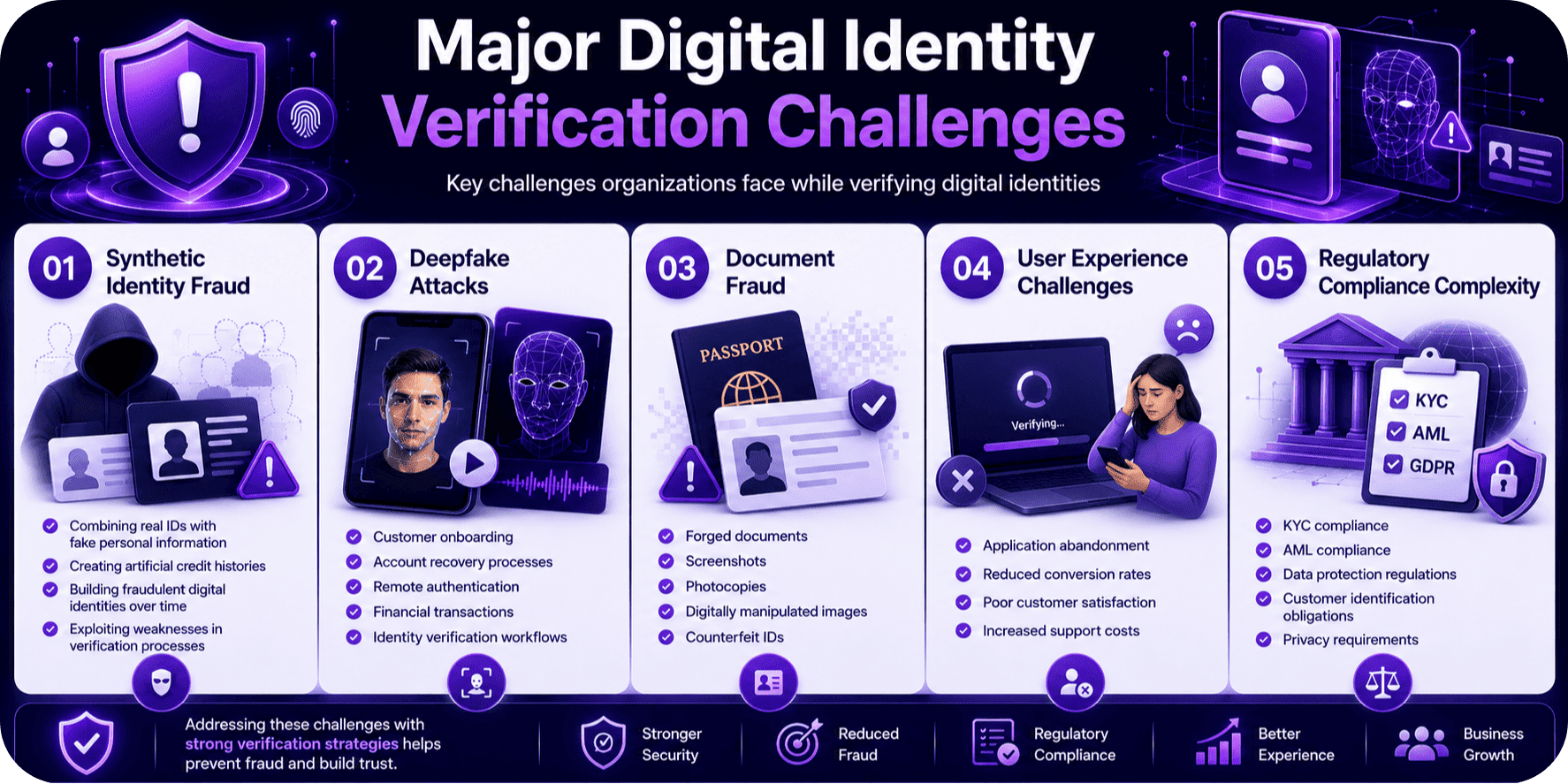
Major Digital Identity Verification Challenges
While identity verification technologies have improved significantly, organizations continue to face several complex challenges.
1. Synthetic Identity Fraud
Synthetic identity fraud has become one of the fastest-growing forms of financial crime.
Instead of stealing an existing identity, criminals create entirely new identities using a combination of real and fabricated information.
These identities often appear legitimate enough to pass weak onboarding systems.
Common synthetic identity techniques include:
- Combining real identification numbers with fake personal information
- Creating artificial credit histories
- Building fraudulent digital identities over time
- Exploiting weaknesses in verification processes
Organizations seeking to address this challenge should review our article on detecting synthetic identity fraud, which explores how advanced verification technologies identify fraudulent applicants.
2. Deepfake Attacks
Artificial intelligence has dramatically improved the quality of deepfake content.
Fraudsters can now create realistic facial videos, voice recordings, and synthetic identities capable of deceiving traditional verification systems.
Deepfake attacks can target:
- Customer onboarding
- Account recovery processes
- Remote authentication
- Financial transactions
- Identity verification workflows
Organizations increasingly deploy biometric verification and liveness detection technologies to defend against these threats.
Additional guidance is available in our article on deepfake attack prevention strategies.
3. Document Fraud
Identity documents remain one of the most commonly targeted components of digital onboarding.
Fraudsters frequently attempt to bypass verification systems using:
- Forged documents
- Screenshots
- Photocopies
- Digitally manipulated images
- Counterfeit IDs
Traditional document reviews often struggle to identify sophisticated document fraud techniques.
Organizations increasingly implement automated identity document verification technology to validate document authenticity and detect tampering attempts more effectively.
4. User Experience Challenges
Customers expect onboarding processes to be completed within minutes.
Excessive verification requirements can lead to:
- Application abandonment
- Reduced conversion rates
- Poor customer satisfaction
- Increased support costs
Organizations must balance security controls with convenience to maintain competitive digital experiences.
5. Regulatory Compliance Complexity
Businesses operating internationally often face multiple regulatory frameworks.
Common requirements include:
- KYC compliance
- AML compliance
- Data protection regulations
- Customer identification obligations
- Privacy requirements
Organizations must ensure that identity verification processes align with standards such as the General Data Protection Regulation (GDPR) and local financial regulations.
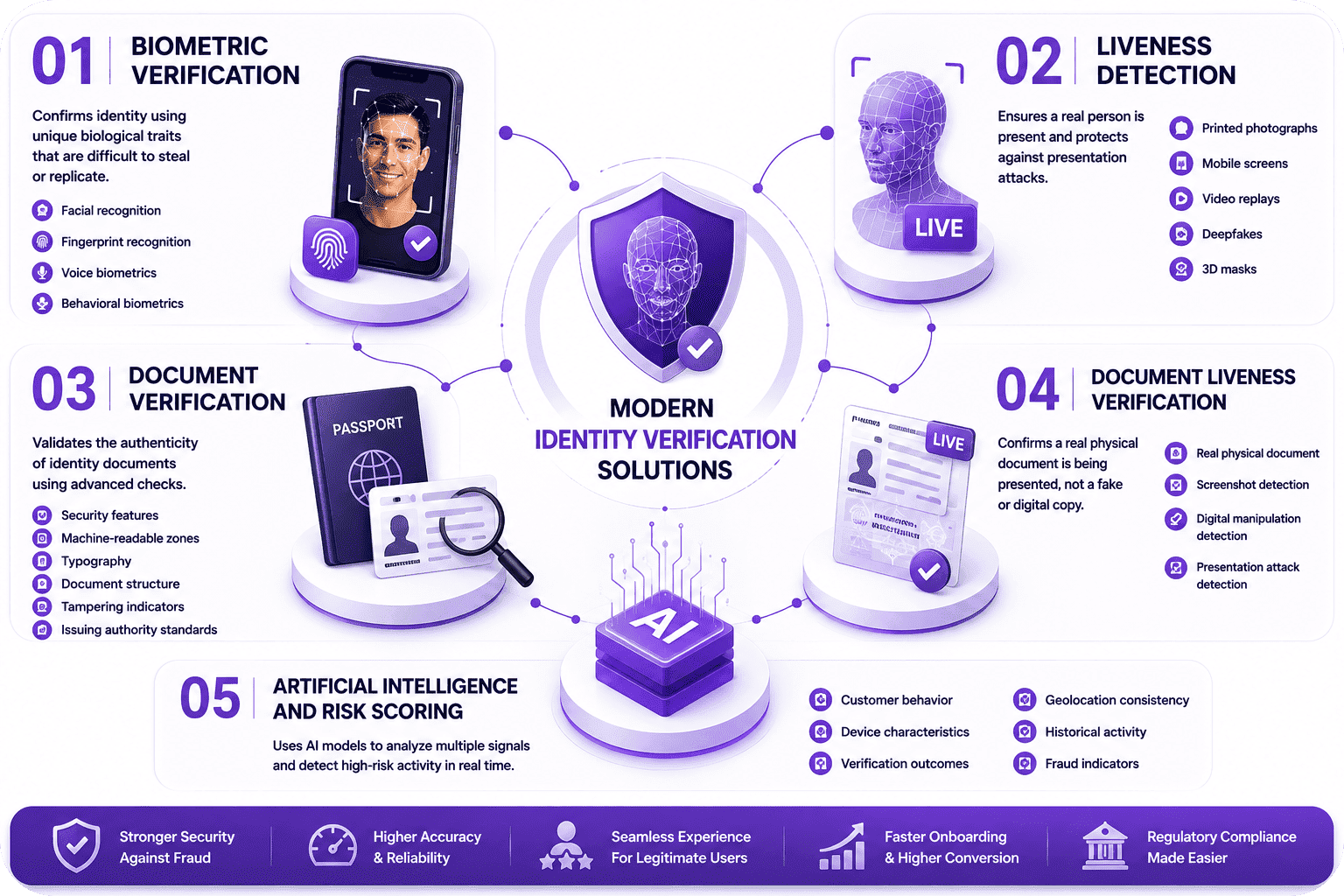
Modern Identity Verification Solutions
To overcome these challenges, organizations increasingly adopt layered verification frameworks.
1. Biometric Verification
Biometric verification has become one of the most effective methods for confirming identity ownership.
Unlike passwords or security questions, biometric characteristics are unique to each individual.
Common biometric methods include:
- Facial recognition
- Fingerprint recognition
- Voice biometrics
- Behavioral biometrics
Organizations increasingly deploy advanced facial recognition technology to strengthen online identity verification and reduce impersonation risks.
Independent testing programs such as the NIST Face Recognition Vendor Test (FRVT) continue to demonstrate significant improvements in biometric accuracy across the industry.
2. Liveness Detection
Face matching alone is no longer sufficient.
Fraudsters frequently attempt to bypass biometric systems using:
- Printed photographs
- Mobile screens
- Video replays
- Deepfakes
- 3D masks
Liveness detection verifies that a real person is physically present during the verification process.
Organizations increasingly use advanced liveness detection technology to identify spoofing attempts before identities are approved.
Businesses evaluating implementation approaches should review our comparison of active and passive liveness detection.
Industry standards such as ISO/IEC 30107 continue to shape how biometric presentation attack detection systems are evaluated.
3. Document Verification
Document verification remains a core component of digital onboarding.
Modern verification systems analyze:
- Security features
- Machine-readable zones
- Typography
- Document structure
- Tampering indicators
- Issuing authority standards
Automated document recognition platforms significantly improve accuracy while reducing manual review requirements.
4. Document Liveness Verification
Organizations increasingly complement document verification with document liveness detection.
This additional layer helps determine whether:
- A real physical document is present
- A screenshot is being used
- A document has been digitally manipulated
- A presentation attack is occurring
Businesses seeking stronger onboarding controls can implement document liveness verification solutions to reduce fraud risks.
Additional insights are available in our guide on why document liveness matters for KYC verification.
5. Artificial Intelligence and Risk Scoring
Modern identity verification systems increasingly rely on AI-powered risk assessment.
Machine learning models evaluate:
- Customer behavior
- Device characteristics
- Verification outcomes
- Geolocation consistency
- Historical activity
- Fraud indicators
These systems help organizations identify high-risk applicants while maintaining efficient onboarding experiences for legitimate customers.
Best Practices for Digital Identity Verification
Organizations seeking to improve digital onboarding should focus on several key principles.
1. Use Multiple Verification Layers
The strongest verification programs combine:
- Identity verification
- Biometric verification
- Liveness detection
- Risk scoring
- Device intelligence
Layered verification significantly improves fraud prevention effectiveness.
2. Verify Documents and Individuals
Businesses should verify both the identity document and the person presenting it.
Combining document verification with biometric verification creates stronger identity assurance.
3. Continuously Monitor Fraud Trends
Fraud techniques continue evolving rapidly.
Organizations should regularly review emerging threats such as synthetic identities, deepfakes, and account takeover attacks.
Our guide on preventing online account fraud with facial recognition provides additional insights into modern fraud prevention strategies.
4. Learn From Common Verification Mistakes
Many onboarding failures stem from avoidable verification errors.
Organizations can improve onboarding success rates by reviewing common identity verification mistakes.
5. Choose Proven Verification Technologies
Businesses should evaluate providers based on:
- Accuracy
- Fraud detection performance
- Global document coverage
- Biometric capabilities
- Independent benchmark testing
Organizations evaluating biometric vendors can also review NIST face recognition benchmark evaluations to better understand performance measurement standards.
The Future of Digital Identity Verification
Digital identity verification will continue evolving as organizations adopt more sophisticated technologies.
Several trends are expected to shape the future of online identity verification:
Continuous Identity Verification
Verification will increasingly extend beyond onboarding and continue throughout the customer lifecycle.
Behavioral Biometrics
Behavioral analysis will play a larger role in identifying fraud and authenticating users.
AI-Powered Fraud Detection
Machine learning systems will continue improving fraud detection accuracy while reducing false positives.
Passwordless Authentication
Biometric verification will increasingly replace traditional password-based authentication methods.
Decentralized Identity Models
Users will gain greater control over digital identity credentials through decentralized identity frameworks.
Development teams interested in biometric implementation resources can explore the official Recognito GitHub repository.
Conclusion
Digital identity verification has become a critical requirement for organizations operating in an increasingly digital world. While businesses face growing challenges from synthetic identities, deepfake attacks, document fraud, and evolving compliance requirements, modern identity verification solutions provide effective ways to manage these risks.
By combining biometric verification, document authentication, liveness detection, artificial intelligence, and risk-based assessment, organizations can improve fraud prevention while delivering seamless digital onboarding experiences.
Technologies such as Recognito identity verification and biometric solutions help businesses establish trust, strengthen security, and prepare for the future of digital identity verification.
Frequently Asked Questions
What is digital identity verification?
Digital identity verification is the process of confirming a person’s identity through digital channels using identity documents, biometrics, and other verification methods.
Why is digital identity verification important?
It helps organizations prevent fraud, meet compliance requirements, improve onboarding security, and establish trust with customers.
How does biometric verification support identity verification?
Biometric verification confirms that the person presenting an identity is its legitimate owner using unique biological characteristics such as facial features.
What are the biggest challenges in digital identity verification?
Common challenges include synthetic identity fraud, deepfake attacks, document fraud, regulatory compliance requirements, and user experience concerns.
What role does liveness detection play in online identity verification?
Liveness detection verifies that a real person is physically present during verification and helps prevent spoofing attacks involving photos, videos, and deepfakes.
How can organizations improve digital onboarding security?
Organizations can improve security by combining document verification, biometric verification, liveness detection, fraud analytics, and continuous risk monitoring.
